
Table of ContentsShow ChaptersHide Chapters
- A 10-step evidence-based framework for evaluating supplement safety, quality, and marketing claims.
Medical Disclaimer
This article is for informational purposes only and does not constitute medical advice. Always consult with a qualified healthcare professional before starting any new supplement regimen.
Read our Medical / Expert Review Policy and Medical Disclaimer for details.
Choosing a supplement shouldn't feel like gambling, but for most shoppers, it does. The shelves are full of bold promises, the labels are hard to decode, and the marketing is engineered to make you buy first and ask questions never. This guide exists to flip that order. It gives you a practical, evidence-based framework for evaluating any supplement: how the products are actually regulated, how to read a label like a skeptic, which quality signals matter, and the red flags that mark a product as a likely scam.
We don't sell supplements, and we don't earn commissions from them. Our only interest is that you don't get scammed or harmed.
The One Fact That Changes Everything: Supplements Are Not Pre-Approved
Most people assume a supplement on a store shelf has been tested and approved by a regulator the way prescription drugs are. It hasn't. This is the single most misunderstood fact in the supplement world, and nearly every scam depends on you not knowing it.
The U.S. Food and Drug Administration (FDA) does not approve dietary supplements for safety and effectiveness before they are marketed. Unlike drug manufacturers, supplement manufacturers are not required to prove their products work, or even that they are safe, before selling them. The legal responsibility sits with the manufacturer, and the FDA generally acts only after a product reaches the market, typically in response to safety problems or false claims (FDA Q&A on dietary supplements).
This has a direct consequence for how claims are worded. Supplement makers may make "structure/function" claims, vague statements like "supports immune health", but they may not claim a product diagnoses, treats, cures, or prevents any disease. When you see a supplement claiming to cure arthritis, reverse diabetes, or shrink tumors, that isn't just hype, it's a product breaking the rules, and a strong signal to walk away (FDA: Dietary Supplements).
The takeaway: no government agency has vetted the bottle in your hand. The burden of checking quality falls on you, which is exactly what the rest of this guide teaches you to do.
How to Read a Supplement Label Like a Skeptic
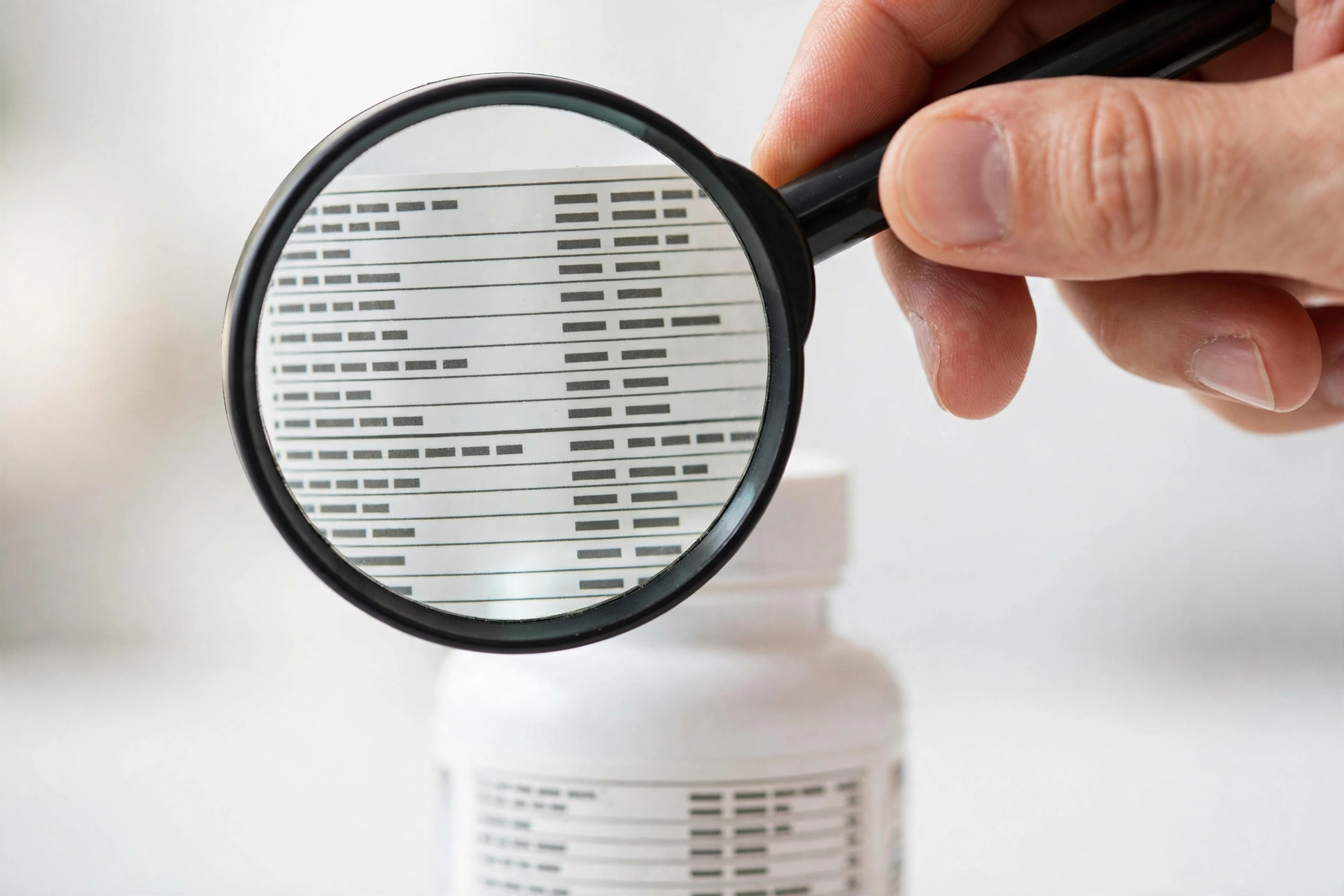
The label is the one place a manufacturer is legally required to tell the truth, which is precisely why misleading labels are designed to be skimmed, not studied. Slow down and check these elements.
The Supplement Facts panel
This is the nutrition-label equivalent for supplements, and it tells you what's actually in the bottle: serving size, servings per container, and the amount of each dietary ingredient per serving. Two common tricks live here:
Serving-size games. A bottle may boast "1,000 mg of X" on the front while the Supplement Facts reveal that's the amount per two capsules, and the suggested serving is one. Always divide the front-of-package hype by the real serving size.
Percent Daily Value (%DV) misdirection. A %DV over 100% isn't a bonus, for some nutrients, megadoses add risk without benefit. More is not always better.
Proprietary blends
A "proprietary blend" lists a total weight for a group of ingredients but hides how much of each one is inside. That makes it impossible to tell whether any ingredient is present at the dose used in actual research. A blend containing ten "clinically studied" ingredients may contain only trace amounts of each. Treat proprietary blends as a transparency failure, not a feature.
Extract percentages and "clinically studied" language
For herbal extracts, look for the percentage of active compounds (for example, the curcuminoid content of a turmeric extract), without it, you can't compare products. And remember a crucial distinction: "clinically studied" does not mean clinically effective. An ingredient can be studied and found wanting. What matters is what the studies found: human trials (not just animal or lab data), consistent results across multiple studies, and realistic effect sizes.
Look for Third-Party Verification
Because no regulator checks supplements before sale, independent testing is the closest thing to a safety net. Third-party certification programs, such as USP, NSF, and Informed Choice, test products for identity (is the ingredient what's claimed?), potency (is the dose accurate?), and contaminants (heavy metals, microbes, undeclared drugs). A seal from one of these organizations means someone other than the manufacturer checked the bottle.
How much does this matter in practice? Consider a 2025 case-series study published in Nutrients that tested 44 weight-loss dietary supplements purchased on or near U.S. military bases. The researchers found that 82% had inaccurate labels, 61% listed ingredients that laboratory analysis could not detect, and 36% contained hidden ingredients not on the label at all. Forty of the 44 products (91%) scored a "no-go" on a military supplement safety scorecard, and not a single product carried a third-party certification seal (Nutrients, 2025).
That study examined one category (weight-loss products) in one retail setting, it doesn't prove every supplement is mislabeled. But it shows what the absence of verification can look like, and why a certification seal is one of the few label features worth actively seeking out.
The Red-Flag Checklist: How to Spot a Scam
Run through this list before you buy anything. One red flag is a warning; two or more mean you should walk away.
Disease-cure claims. "Cures arthritis," "reverses diabetes," "kills cancer cells", illegal for supplements, and a hallmark of fraud.
Miracle language. "Miracle," "breakthrough," "secret formula," "scientific breakthrough Big Pharma doesn't want you to know." Legitimate research doesn't talk like this.
"Free trial" autoship traps. A low-cost trial that quietly enrolls you in expensive monthly billing is one of the most common supplement scams. Read the terms before entering payment details.
Fake review and "top 10" sites. Many "independent review" sites ranking the "best" supplements are affiliate-marketing operations paid per sale. If every review ends in a buy button, it's advertising, not advice.
Hidden drug ingredients. The FDA's health-fraud recalls regularly pull products, concentrated in weight-loss, sexual-enhancement, and bodybuilding categories, found to contain undeclared prescription drugs and banned substances, including sildenafil and tadalafil in "male enhancement" pills, fluoxetine and the dangerous industrial chemical DNP in fat burners, and undeclared yohimbine and kratom compounds in other products (FDA: Recalls & Health Fraud). If a "natural" product works with suspicious, drug-like speed, suspect adulteration.
No company transparency. No physical address, no customer-service contact, no lot numbers on the bottle. Legitimate manufacturers can be reached; scammers can't.
On marketing versus evidence more broadly: major medical institutions that have reviewed weight-loss supplements, one of the most heavily marketed categories, consistently find the advertising far outpaces the proof (Mayo Clinic). Treat dramatic before-and-after photos and "doctors hate this trick" copy as entertainment, not information.
Talk to Your Doctor or Pharmacist First
"Natural" does not mean safe, and it does not mean inert. Supplements can interact with prescription and over-the-counter medicines, with other supplements, and with medical conditions, sometimes seriously. This step matters most if you take any regular medication, are pregnant or breastfeeding, have a chronic condition, or are considering a product with stimulant or hormonal effects.
Bring the actual bottle (or a photo of the Supplement Facts panel) to the conversation, ingredient names and doses matter more than brand names. A pharmacist is often the fastest, most accessible expert for interaction questions (NCCIH: Using Dietary Supplements Wisely).
The 10-Step Decision Framework
The sections above are the why. Here is the how, a structured sequence adapted from the core principles of evidence-based supplement selection. Work through it for any product you're considering:
Define a clear purpose. What specific, measurable outcome are you hoping for? Vague goals ("better wellness") lead to vague, and usually useless, purchases.
Check the evidence quality. Look for human clinical trials, consistent findings across multiple studies, and realistic effect sizes. Animal and lab studies are starting points, not proof.
Put safety before effectiveness. A supplement should be evaluated for risks first. If the safety profile is unclear or the product carries red flags, effectiveness is irrelevant.
Get the dosage right. Compare the label's dose to the ranges actually used in research, and to established daily intake guidance. Correct dosage is essential, more is not always better.
Consider the form. The chemical form affects absorption, mineral forms like citrate versus oxide differ meaningfully in bioavailability. Form influences effectiveness, not just the ingredient name.
Read and interpret the label. Apply the skeptic's checklist from above: real serving size, no hidden proprietary blends, extract percentages stated.
Verify quality. Prefer products with third-party certification seals, and manufacturers that publish certificates of analysis or follow good manufacturing practices.
Dodge decision pitfalls. Ignore miracle claims, urgency tactics ("only 3 left!"), celebrity endorsements, and affiliate "review" sites. Decisions should be based on evidence, not persuasion.
Match the product to your context. Even well-researched supplements aren't right for everyone. Age, medications, health conditions, and pregnancy status all change the calculus, which is why step 10 in the original list, consulting a professional, belongs here too.
Re-evaluate periodically. Supplement use shouldn't be indefinite without review. If no clear benefit appears within a reasonable timeframe, or if anything changes in your health, reconsider continued use.
What to Do If a Product Harms You
If you experience a bad reaction, or suspect a product is adulterated or fraudulently marketed, don't just leave a one-star review:
Stop taking the product and keep the bottle, packaging, and receipt.
Report the adverse event to the FDA through its MedWatch safety-reporting program so regulators can spot patterns and act (FDA Q&A).
Check the FDA's health-fraud recalls page to see whether the product has already been flagged (FDA Recalls).
Seek medical care if symptoms are serious, and tell the clinician exactly what you took.
Reporting matters: because supplements aren't pre-approved, post-market reports from consumers are one of the main ways dangerous products get identified and removed.
Sources
FDA: Dietary Supplements, how supplements are regulated; structure/function vs. disease claims
FDA: Questions and Answers on Dietary Supplements, no pre-market approval; manufacturer responsibility; reporting adverse events
FDA: Recalls & Health Fraud, tainted products with hidden drug ingredients; recall listings
NCCIH: Using Dietary Supplements Wisely, guidance on label reading, talking to clinicians, evaluating claims
Label Accuracy and Quality of Select Weight-Loss Dietary Supplements Sold on or near US Military Bases, Nutrients (2025), 44 products tested: 82% inaccurate labels, 36% hidden ingredients, 91% "no-go" on safety scorecard, none third-party certified
Mayo Clinic: Weight Loss Supplements, review of weight-loss supplement marketing vs. evidence