
Table of ContentsShow ChaptersHide Chapters
- Creatine works for strength and power, which makes the myths and scams around it harder to spot.
- Here is what the evidence supports, what it doesn't, and how to buy it safely.
Medical Disclaimer
This article is for informational purposes only and does not constitute medical advice. Always consult with a qualified healthcare professional before starting any new supplement regimen.
Read our Medical / Expert Review Policy and Medical Disclaimer for details.
Creatine is the rare supplement where the marketing and the science partially agree, which makes it more confusing, not less. It genuinely works for strength and power, and it has one of the best safety records of any supplement sold. But the industry has still built a circus around it: "advanced" forms that cost five times more with no better evidence, kidney damage myths that will not die, a hair loss panic built on a single small study, and steroid comparisons that are pure fiction. This guide covers what creatine actually does, where the evidence is strong, what it cannot do, and how to buy it without getting scammed.
What Is Creatine?
Creatine is a compound the body makes every day, about 1 gram, in the liver and kidneys from the amino acids glycine, arginine, and methionine. Meat contains it too: beef has roughly 2 grams per pound. A 154-pound person carries about 120 grams of creatine and phosphocreatine in total, almost all of it in skeletal and cardiac muscle.
Supplementing with much larger amounts than diet provides saturates the muscles' phosphocreatine stores. That saturation is the entire basis of creatine's effects. Nothing about this requires a proprietary formula or a "delivery system." It is a simple compound doing a simple job.
How Creatine Works
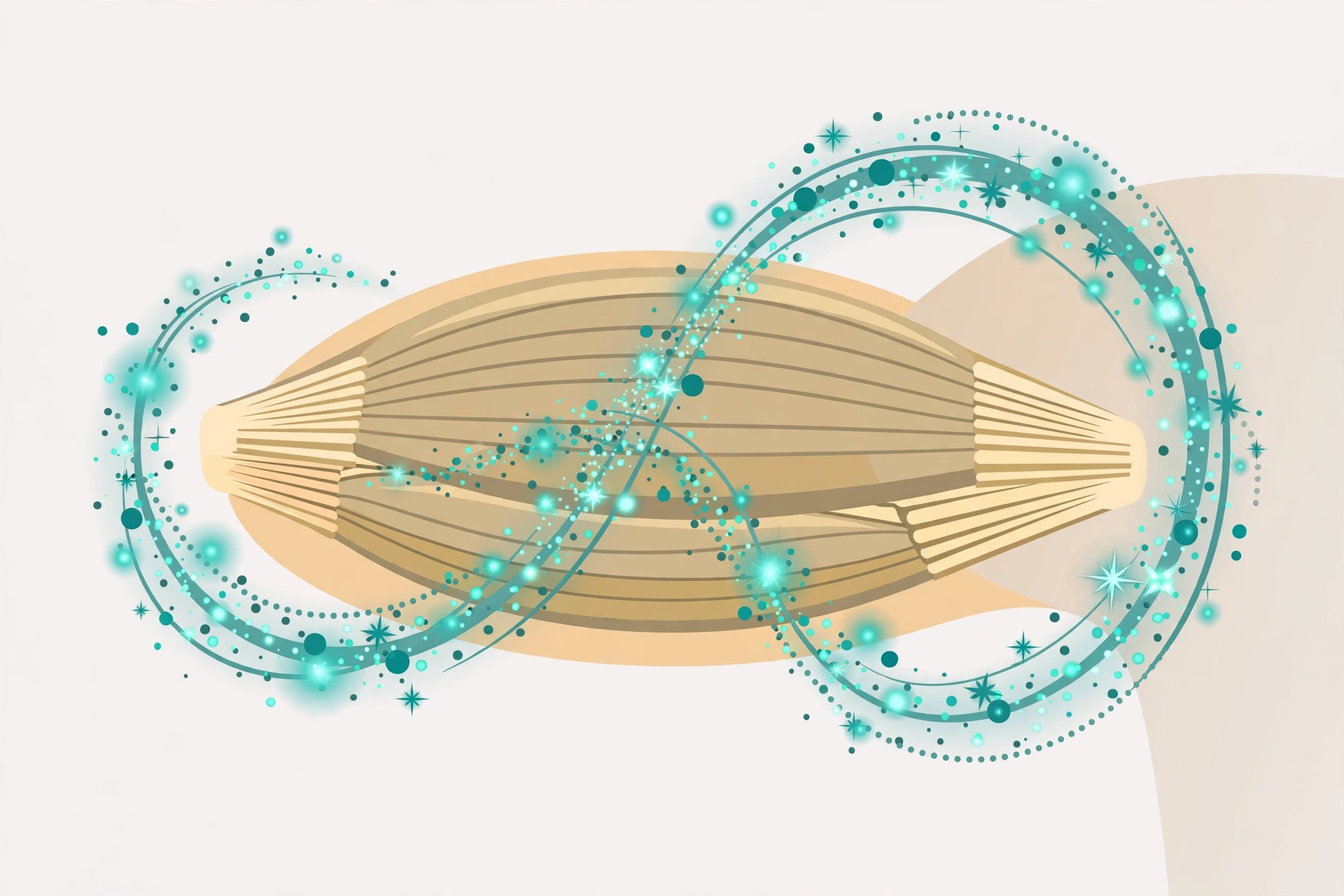
During short, intense effort, muscles burn through adenosine triphosphate (ATP), the cell's energy currency, faster than it can be regenerated. Phosphocreatine acts as a rapid backup battery, donating a phosphate group to rebuild ATP on the spot. More stored phosphocreatine means a few more seconds of high-intensity output before fatigue sets in.
The NIH Office of Dietary Supplements describes four ways creatine may improve muscle performance: increasing phosphocreatine stores used to generate ATP at the start of intense exercise, accelerating phosphocreatine resynthesis after exercise, reducing the breakdown of adenine nucleotides and the accumulation of lactate, and enhancing glycogen storage in skeletal muscle.
The practical translation matters: creatine helps short bursts of high-intensity activity such as sprinting or weightlifting. It does not meaningfully help endurance exercise such as distance running or swimming. Anyone selling creatine as an endurance or fat-loss aid is selling outside the evidence.
What the Evidence Actually Supports
Strength, power, and lean mass: strong evidence
This is creatine's best-supported territory. The International Society of Sports Nutrition's 2017 position stand, after reviewing the full literature, calls creatine monohydrate "the most effective ergogenic nutritional supplement currently available to athletes" for increasing high-intensity exercise capacity and lean body mass during training. Across hundreds of randomized trials, the pattern is consistent: people doing resistance training gain more maximal strength and complete more repetitions when supplementing with creatine than with placebo.
Two honest qualifiers. First, creatine amplifies training; it does not replace it. Studies showing the biggest effects pair supplementation with structured resistance exercise. Second, the gains are real but not dramatic: think a few extra reps and modestly greater lean mass over weeks of training, not a transformation.
Older adults and muscle preservation: promising
Researchers have studied creatine in older adults, where maintaining muscle matters for independence and fall risk. Combined with resistance training, creatine appears to support lean mass and strength in aging populations. Evidence for cognitive benefits (memory, executive function) is mixed and preliminary, with vegetarians and older adults proposed as the groups most likely to benefit because they tend to have lower baseline creatine stores. Interesting, not established.
What creatine does not do
Build endurance. The NIH is explicit: no meaningful benefit for sustained aerobic performance.
Burn fat. Creatine has no direct fat-loss effect. The 1 to 2 kilograms most people gain when starting creatine is water drawn into muscle cells, which is part of how it works, not body fat and not a side effect to fear.
Act like a steroid. Creatine does not raise testosterone, does not work through hormonal pathways, and produces nothing resembling steroid-like gains. "Legal steroid" marketing is fiction.
Creatine Forms: Monohydrate vs the Expensive Alternatives

Creatine monohydrate is the form used in nearly all published research. It is cheap, stable, and effective. The alternatives exist mostly to justify higher prices:
Creatine ethyl ester was marketed as better absorbed. In a head-to-head trial, it degraded into creatinine (the waste product) in the digestive tract before the body could use it: blood creatinine tripled while muscle creatine stores did not significantly rise. It is genuinely inferior to monohydrate.
Buffered creatine (Kre-Alkalyn) claims its higher pH protects against stomach acid breakdown, so you can take less. A controlled trial found no advantage over monohydrate in muscle creatine content, body composition, or training adaptations. The premise that stomach acid destroys monohydrate does not hold up.
Creatine HCl dissolves better in water, which makes for nicer marketing copy, but has no proven advantage in raising muscle creatine levels in humans.
Nitrate, malate, pyruvate, and other salts have thin or no comparative human data showing superiority.
The honest summary: buy plain creatine monohydrate. Every "advanced" form is a margin strategy, not a science strategy.
Dosage: How Much, and Is Loading Necessary?
The standard, well-studied protocol:
Maintenance: 3 to 5 grams per day, taken consistently. Timing relative to your workout is not critical; daily consistency is what saturates the muscle.
Loading (optional): about 0.3 grams per kilogram of body weight per day (roughly 20 to 25 grams for most adults, split into several doses through the day) for 5 to 7 days, then 3 to 5 grams per day. This saturates muscles faster.
No-load approach: 3 to 5 grams per day reaches the same saturation in about 3 to 4 weeks. The destination is identical; loading only changes how fast you arrive.
Practical notes: take it with water. Taking it with carbohydrates or protein may slightly increase muscular retention, but the effect on performance is not meaningfully greater than monohydrate alone. There is no evidence-based need to "cycle" on and off. Expect 1 to 2 kilograms of water weight as muscles saturate; this is intramuscular water, part of the mechanism, not fat gain or bloating to fix with a different product.
Safety: Kidneys, Cramps, and Myths That Will Not Die
The kidney myth, explained properly
This is the most persistent creatine scare, and it rests on a lab-test confusion. Creatine naturally breaks down into creatinine at about 2 percent per day, and creatinine is the blood marker doctors use to estimate kidney function. So creatine users often show modestly elevated serum creatinine, which can look alarming on a lab report.
But creatinine is a proxy, not kidney function itself. Systematic reviews and meta-analyses (2019, 2025, and 2026) consistently find the same pattern: serum creatinine rises slightly while the actual measures of kidney function, glomerular filtration rate, cystatin C, proteinuria, and albuminuria, remain unchanged. The ISSN's conclusion: there is no compelling scientific evidence that short- or long-term creatine monohydrate use, at up to 30 grams per day for 5 years, has detrimental effects in otherwise healthy individuals.
Two practical consequences: tell your doctor you take creatine before kidney blood tests so a creatinine bump is not misread, and if you have existing kidney disease, talk to your clinician first, because that population was not the subject of this safety research.
Cramps and dehydration: myth
The idea that creatine pulls water into muscles and leaves the rest of the body dehydrated sounds plausible and is wrong. Controlled studies, including in athletes training in heat, found no increased risk of cramping or dehydration; some data even favored creatine users. Normal hydration habits still matter, but creatine is not drying you out.
Adolescents, pregnancy, and caution groups
The ISSN considers creatine acceptable for younger athletes involved in serious, supervised competitive training, within recommended doses, calling under-18 label warnings largely a legal precaution. That said, creatine is not for casual teen use, and parents should involve a clinician or qualified coach rather than deciding from marketing. Creatine has not been adequately studied in pregnancy or breastfeeding, so avoidance is the sensible default there.
The Hair Loss Question
The entire creatine hair loss scare traces to one 2009 study of 20 college rugby players. They took 25 grams per day for 7 days, then 5 grams per day for 14 days, and their DHT, a hormone linked to male pattern baldness, rose 56 percent after the loading phase and stayed 40 percent above baseline during maintenance, versus placebo.
What that study did not do matters more than what it did: it never measured anyone's hair, it was never replicated, and intense resistance exercise itself can raise androgenic hormones. About a dozen subsequent studies looking at creatine and DHT found no such effect.
In 2025, researchers finally ran the direct test: 45 resistance-trained men, 12 weeks, 5 grams of creatine monohydrate per day versus placebo, with dermatologists measuring hair density, thickness, and follicle counts via scalp imaging. Result: no differences in DHT, in the DHT-to-testosterone ratio, or in any hair measurement.
The honest grade: the direct evidence now points to no effect on hair, and the scare came from a hormone proxy in one small, unreplicated study. Limitations apply, as always: 12 weeks is short relative to hair growth cycles, and no single study covers everyone. But "creatine causes baldness" is not something the evidence supports.
Choosing a Quality Creatine Product

Creatine monohydrate is a commodity chemical, which is good news: the honest product is also the cheapest.
Buy plain creatine monohydrate powder with no blends, no "matrix," and no added ingredients you did not ask for.
Look for third-party testing seals such as NSF Certified for Sport or Informed Sport. These verify identity and purity and screen for banned substances, which matters if you compete.
Avoid proprietary blends that hide individual doses behind a fancy name. With creatine there is no reason to accept this; the effective dose is public knowledge.
Capsules contain the same compound at a higher price per gram. Powder is the economical choice unless you strongly prefer capsules.
"Micronized" creatine is the same compound ground finer; it mixes better in water but works no better. Do not pay a large premium for it.
Red Flags: Creatine Marketing to Distrust
"Legal steroid" or "steroid alternative" framing. Creatine is not hormonal and not comparable to steroids. This language exists to borrow steroids' mystique.
Before/after photos implying the powder alone caused a transformation. Training and diet did the work; the powder assisted at the margins.
Premium "advanced delivery" forms with no human data beating monohydrate. If the form were better, the studies would show it.
"No loading, no bloating, no cycling" sold as an advantage of a different form. Loading is optional for monohydrate too, the water weight is the mechanism working, and cycling has no evidence basis.
Testosterone, DHT, or hormone-boosting claims. Creatine does not work through hormones.
Disease or cure claims of any kind. Illegal for supplements and a hallmark of scam marketing.
Key Takeaways
Creatine monohydrate is the most evidence-backed ergogenic supplement available for strength, power, and lean mass gains alongside resistance training.
It helps short, intense efforts; it does not improve endurance or burn fat.
Plain monohydrate beats every "advanced" form in head-to-head data; ethyl ester is genuinely inferior.
3 to 5 grams daily works; an optional loading phase of about 20 to 25 grams per day for a week only speeds up saturation.
Kidney fears rest on a creatinine lab-test confusion; actual kidney function measures are unchanged in meta-analyses of healthy users.
The hair loss scare came from one small 2009 study measuring a hormone, not hair; a 2025 trial measuring hair directly found no effect.
Buy plain, third-party-tested (NSF Certified for Sport, Informed Sport) monohydrate powder; skip proprietary blends and premium forms.