
Table of ContentsShow ChaptersHide Chapters
Medical Disclaimer
This article is for informational purposes only and does not constitute medical advice. Always consult with a qualified healthcare professional before starting any new supplement regimen.
Read our Medical / Expert Review Policy and Medical Disclaimer for details.
Key takeaways
- FemiCore is a bladder-support supplement sold through a long BuyGoods advertorial funnel. Its label lists a 350 mg herbal blend and a 50 mg probiotic blend, with no per-ingredient doses and no probiotic CFU counts.
- No clinical trial of FemiCore itself has been published. Its references page cites 25 sources; none of them tested the product, and several cite different ingredients, different strains, or different products than the label.
- The best-supported ingredient, cranberry, has moderate-certainty evidence for preventing recurrent UTIs (Cochrane 2023), not for stopping bladder leaks. The cranberry dose in FemiCore is hidden inside the blend, so no dose comparison is possible.
- Prices work out to $1.63 to $2.80 per day depending on the package. The page carries a 60-day refund that requires returning every bottle at your own shipping cost, while the page itself advises using the product for 3 months, past the refund window.
Contents
- The verdict
- What FemiCore claims
- The label: what you actually get
- Claim vs. evidence, ingredient by ingredient
- Has this product ever been independently tested?
- What experts say about probiotics for urinary and vaginal health
- The price math and the refund terms
- Company transparency: who actually sells this
- Notes for older women
- Sources
The verdict
FemiCore's page promises a "natural breakthrough" for bladder leaks, driven by a microbiome reset. The label underneath that story is less impressive: a 350 mg herbal blend with every individual dose hidden, and a 50 mg probiotic blend with no CFU counts disclosed.
Bladder leaks are a real, common problem for older women, and that vulnerability is exactly what this page is built around. The evidence behind the pitch is a patchwork of general reviews, a rat study, a cranberry-juice study from 1984, and probiotic trials of completely different strains. Nothing on the page tests FemiCore itself.
The ingredients are unlikely to cause serious harm at these doses, but berberine carries real medication interactions and the probiotic content cannot be compared to any trial because the dose is unknowable. The pricing is high per day, and the refund terms are stricter than the headline "60-day guarantee" suggests.
What FemiCore claims
The headline reads: "The Natural Breakthrough Formula That Supports a Strong Bladder." Sub-badges promise bladder control support, microbiome balance, and a healthy urinary system.
The mechanism story is specific: FemiCore "is designed to support bladder health by targeting the microbiome imbalance, which causes involuntary muscle contractions and those sudden, uncontrollable pee leaks." The FAQ goes further: the product targets "the toxic dioxins that can throw your urinary microbiome out of balance, leading to uncontrollable pee leaks."
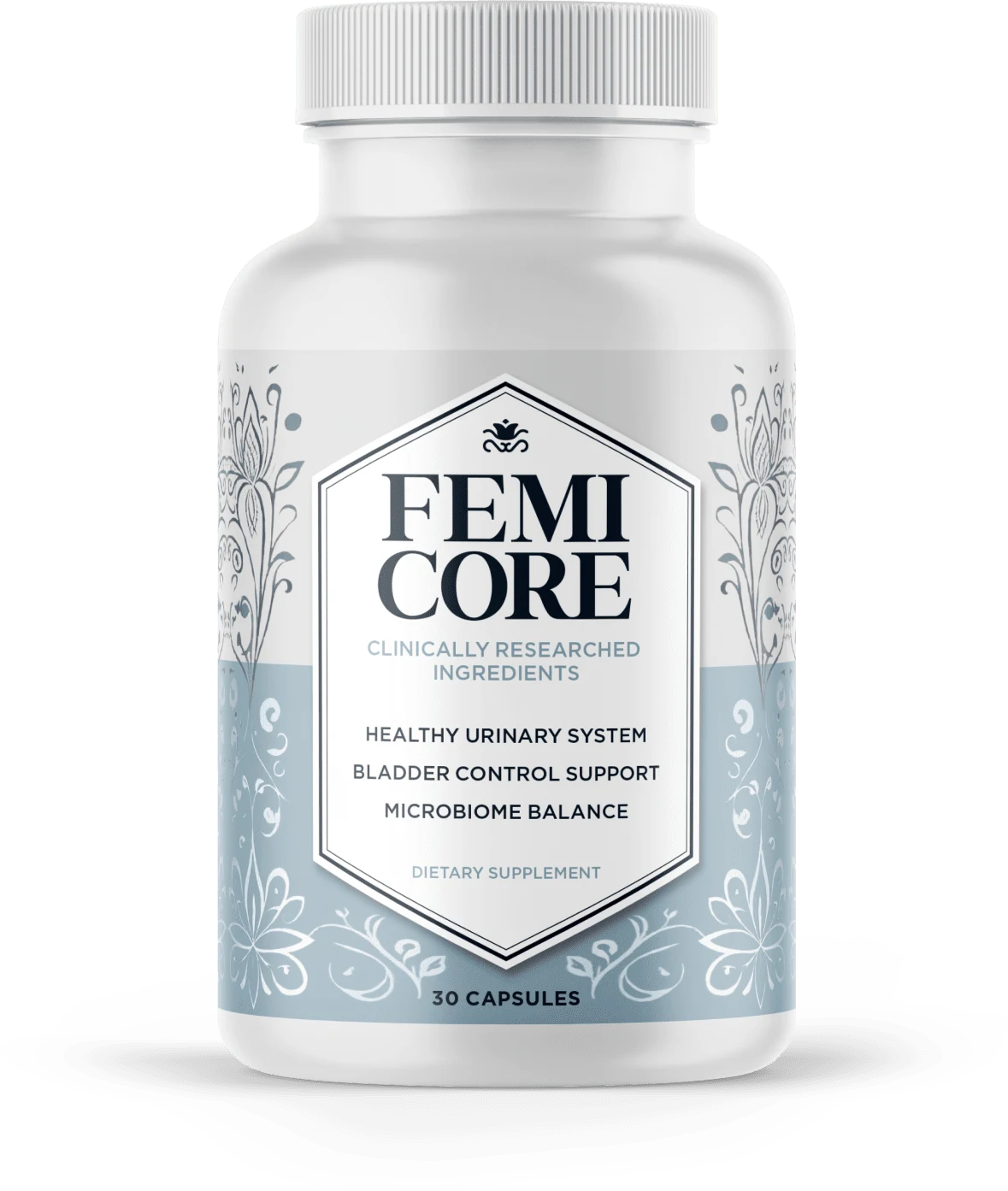
The evidence claim is blunt: "Every single capsule of FemiCore contains a proprietary formula of scientifically proven, extra-strong ingredients, carefully combined to support the health of your urinary system well into old age." The bottle front panel adds "CLINICALLY RESEARCHED INGREDIENTS," plus badges for GMP certification, a USA facility, and a "FDA REGISTERED FACILITY."
Two notes on wording. "FDA registered facility" means the building filed paperwork with the FDA; it says nothing about the product. And "scientifically proven" is a much stronger claim than anything the cited research actually proves, as the sections below show.
The label: what you actually get
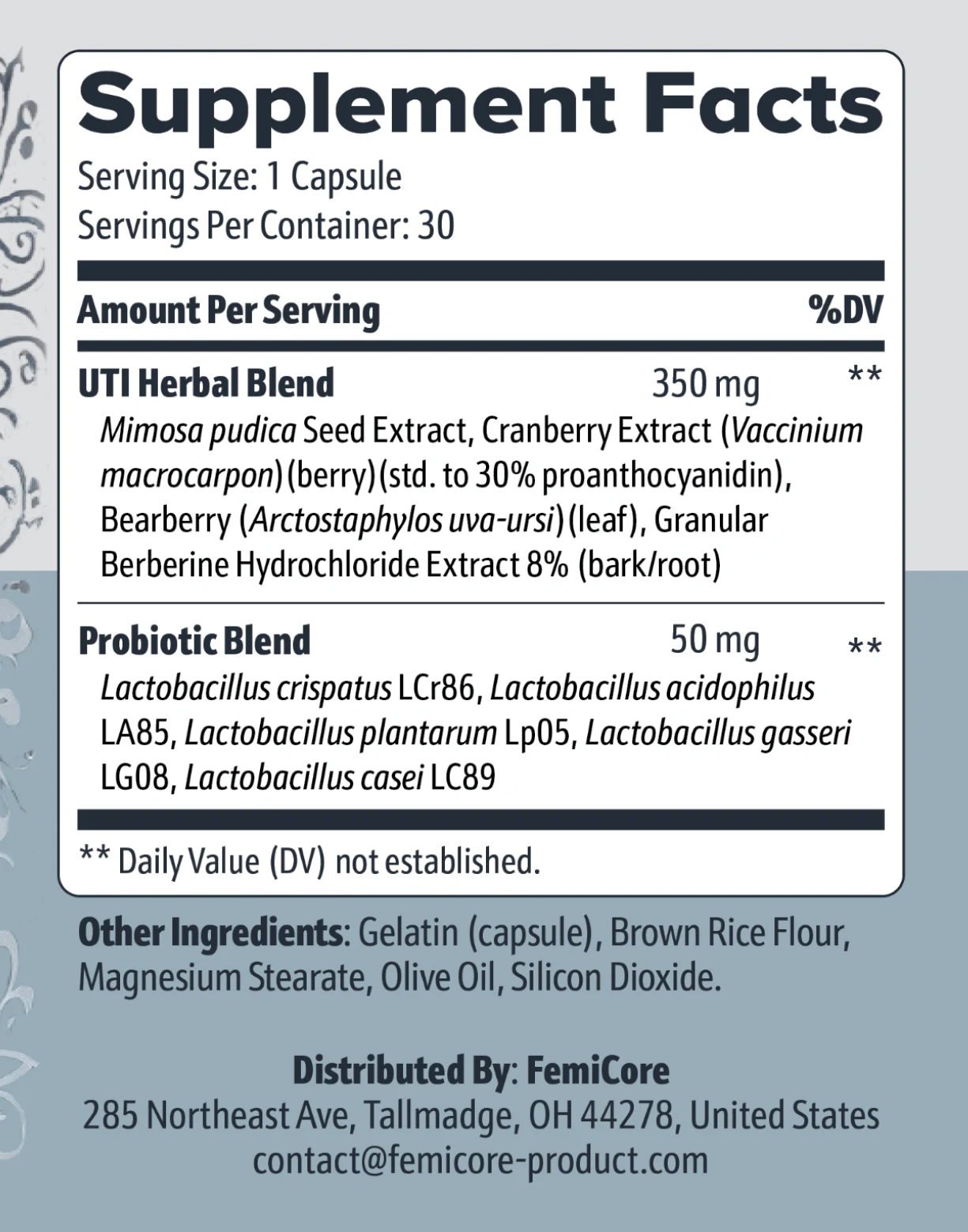
The Supplement Facts panel (shown on the seller's own references page) describes a 1-capsule daily serving with 30 capsules per bottle. Two proprietary blends do all the work:
| Blend | Total | What is in it |
|---|---|---|
| UTI Herbal Blend | 350 mg | Mimosa pudica seed extract, cranberry extract (30% proanthocyanidins), bearberry leaf, berberine HCl 8% extract |
| Probiotic Blend | 50 mg | L. crispatus LcR86, L. acidophilus LA85, L. plantarum Lp05, L. gasseri LG08, L. casei LC89 |
Three facts matter more than the table. First, no per-ingredient dose is disclosed, so the cranberry, bearberry, and mimosa pudica amounts are unknowable. Second, the probiotic blend lists no CFU count (colony-forming units), and probiotic trials dose in CFU, not milligrams, so the 50 mg figure cannot be compared to any study.
Third, the strain designations (LcR86, LA85, Lp05, LG08, LC89) are proprietary. We found no published human trials on any of these exact strains. That matters because NCCIH stresses that probiotic effects are strain-specific: evidence for one Lactobacillus strain does not transfer to another.
Claim vs. evidence, ingredient by ingredient
The page's references section lists 25 sources. We checked what each one actually is. The pattern: general background reading, animal studies, and studies of different ingredients and different strains.
| Page claim | What the evidence actually shows | Evidence grade |
|---|---|---|
| Cranberry supports urinary health | Cranberry is the best-supported ingredient on the label. A 2023 Cochrane review (50 trials, about 8,900 participants) found moderate-certainty evidence that cranberry products lower recurrent UTI risk in women (risk ratio 0.74). But that is recurrent UTI prevention, not bladder-leak or incontinence control, and cranberry is not a treatment for an active UTI. The cranberry dose inside FemiCore's 350 mg blend is hidden, so no dose comparison to the trials is possible. The seller's own cited cranberry study (Sobota 1984) tested cranberry juice, not extract. | Moderate for UTI prevention; none for incontinence |
| Probiotic strains restore the microbiome and prevent leaks | A 2015 Cochrane review of probiotics for recurrent UTI found no significant benefit versus placebo, while noting benefit could not be ruled out from the few small, poorly reported trials. A 2025 systematic review called probiotics promising for bacterial vaginosis but found no consensus on species, strains, or doses. Neither review covers bladder leaks. FemiCore publishes no CFU counts, so its 50 mg blend cannot be compared to any trial dose. | Weak to absent for the claimed outcome |
| Berberine supports the formula | Berberine has genuine pharmacology, including documented interaction with cyclosporine, a transplant-rejection drug (NCCIH, 2023). Human trial doses run about 1,000 to 1,500 mg per day. In FemiCore, berberine HCl 8% extract sits last in a 350 mg four-ingredient blend, so it can weigh at most about 87 mg of extract, or about 7 mg of berberine: roughly one one-hundred-fortieth of the lowest trial dose. The seller cites a 2013 berberine study conducted in diabetic rats, not humans. | Real ingredient at a trivial dose |
| Bearberry supports the urinary tract | The seller's cited bearberry reference (Toth et al. 2022, BRUMI) is a trial protocol, not a result: it announces a study, it does not report one. We found no published human trial of bearberry for bladder leaks or incontinence. | No human evidence for the claimed outcome |
| Mimosa pudica seed extract helps | We found no human clinical trials of mimosa pudica for bladder, urinary, or incontinence outcomes. | No human evidence |
| "Toxic dioxins" cause bladder leaks | The page cites the WHO fact sheet on dioxins as environmental pollutants, a general toxicology reference. We found no published study linking dioxin exposure to bladder leaks or incontinence in women. | No evidence for the causal claim |
| "Scientifically proven" ingredients | No clinical trial of FemiCore itself has been published. The 25 listed references include probiotic trials of different strains (L. rhamnosus TOM 22.8, L. plantarum PCS26 tested in children, L. casei Shirota), a commercial blog post, a 2022 New York Post article about tampons, and a 2012 Reuters piece on FDA tampon complaints. The cited strains do not match the strains on the label. | The product has never been studied |

Has this product ever been independently tested?
This question matters because supplement pages show you a label, not what is inside the bottle. The honest answer for FemiCore: no independent laboratory test of this product has been published, and no FDA or FTC action names it.
What exists instead is a company-issued press release from October 2026, distributed through PR-syndication outlets, claiming the seller hired Cascade Analytical Services to test production lot FMCR-261001 for ingredient identity, potency, microbes, and heavy metals, and that the lot "passed all panels." The full certificate of analysis is available only on request to verified purchasers, so the claim cannot be verified. This is the seller's own claim about the seller's own test of the seller's own lot. It is not independent verification.
What independent testing of the broader category has found, and why it is relevant here:
- Researchers at Georgetown University bought 93 probiotic products and found only 35% could be linked to clinical evidence, mainly because labels did not disclose strain designations or doses at expiration. FemiCore's label repeats exactly that gap: proprietary strain codes and no CFU counts (Journal of General Internal Medicine, 2019).
- Dr. Pieter Cohen (Cambridge Health Alliance / Harvard Medical School) wrote in JAMA Internal Medicine (2018) that probiotic labels give consumers too little to judge safety, and argued the FDA should require every bottle to list the specific strains and live-microorganism count, as Canada already requires.
- Cohen's JAMA studies also showed FDA enforcement often leaves tainted products on the market: two-thirds of recalled supplements still contained banned ingredients at least six months after recall (JAMA, 2014), and a 2018 analysis that re-purchased sports supplements after FDA enforcement action found prohibited stimulants still present years later (JAMA Internal Medicine, 2018). Those studies cover sports and weight-loss products, not probiotics, so they say nothing about FemiCore specifically. They do show why "no FDA action found" is not the same as "proven clean."
What experts say about probiotics for urinary and vaginal health
Two evidence reviews are directly relevant to FemiCore's pitch. The 2015 Cochrane review on probiotics for recurrent urinary tract infection concluded no significant benefit was demonstrated versus placebo or no treatment, while noting the data were too few and too weak to rule a benefit out either.
A 2025 systematic review of 16 randomized trials on probiotics for bacterial vaginosis called them "a promising alternative therapy" but concluded there is no consensus on the most effective species, strains, or doses, and that long-term safety data are limited. Side effects were described as mild and self-limiting.
NCCIH's position is the one that lands hardest on this label: probiotic effects are strain-specific, so evidence for one Lactobacillus strain does not establish anything about another. NCCIH also notes that probiotic supplements do not require FDA approval before marketing, and that dietary supplement labels may make structure-or-function claims without FDA consent.
On safety for older adults, probiotics are generally considered safe for healthy people. But peer-reviewed reviews flag rare serious infections (sepsis, endocarditis) with Lactobacillus in people with severe comorbidities, and advise against use in the critically ill or immunocompromised (PMC4748908). A nursing-home study found probiotic use was safe in that population, with no serious adverse events attributed to the products (PMC7222499). The practical reading: healthy older women are unlikely to be harmed, but anyone with a weakened immune system should talk to their doctor first.
The price math and the refund terms
Three tiers are sold with struck-through anchor prices. Each bottle holds 30 capsules at one capsule per day.
- 2 bottles (60-day supply): $158 plus $9.99 shipping, shown against a struck-through $358. Works out to about $2.80 per day.
- 3 bottles (90-day supply): $207 with free shipping, against a struck-through $537. About $2.30 per day.
- 6 bottles (180-day supply): $294 with free shipping and three bonus ebooks, against a struck-through $1,074. About $1.63 per day.
There is no subscription or autoship, and payment options include Visa, PayPal, Mastercard, Discover, and Amex. Those parts of the page are straightforward.
The guarantee is less generous than it sounds. "60-day 100% money-back guarantee" requires emailing a refund request first, then returning all bottles (empty or full) plus a packing slip to Tallmadge, Ohio, at your own shipping cost. Meanwhile the page advises using the product "for at least 3 months" before judging it, which runs past the 60-day window. The shipping FAQ also contradicts itself, telling buyers "nothing at all" is charged for delivery while the 2-bottle tier adds $9.99 shipping.
Read our guide on how to read supplement doses and labels before paying this kind of daily rate for a proprietary blend.
Company transparency: who actually sells this
The legal pages name the retailer as BuyGoods, a Delaware corporation in Wilmington, Delaware, with a single support email ([email protected]) and no phone number. BuyGoods states its role "does not constitute an endorsement, approval or review of this product or any claim."
The support infrastructure is shared. The references page also hosts Supplement Facts labels for other products (FlushFactor Plus, OrexiBurn), and the contact page's product dropdown lists hundreds of supplement funnels served by one support desk, including sibling brands FemiPro, Flush Factor Plus, and OrexiBurn. FemiCore is one funnel among many on shared template infrastructure.
Two transparency findings are worth stating plainly. The page displays "19,263 reviews" at 4.5 stars, a figure that is not clickable and cannot be verified. And the disclaimer admits that "some names have been changed and some testimonials have been recorded with paid actors." Whatever the 19,263 figure represents, it is not a verified customer count.
The regulatory check is clean but thin: we found no FDA warning letter, FTC action, or FDA recall naming FemiCore as of October 2026. An FTC complaint reference (FTC-261021) does exist, but it runs the other way: according to a company press release, the seller filed it against 14 look-alike and counterfeit websites. That is the seller acting as complainant, not a regulator acting against the seller. For a practical guide on evaluating this kind of funnel, see how to choose a female health supplement safely.
Notes for older women
Bladder leaks in older women have many possible causes: urinary tract infections, vaginal tissue changes after menopause, medication side effects, and neurological conditions among them. A supplement should never delay a proper evaluation of new or worsening symptoms, especially burning, fever, blood in urine, or sudden urgency, which can signal an infection that needs treatment.

Cranberry is not a treatment for an active UTI; the evidence covers prevention of recurrences. Berberine interacts with prescription drugs (NCCIH specifically flags cyclosporine and advises anyone on medication to check with their provider), and it is considered likely unsafe during pregnancy and while breastfeeding because of bilirubin effects in infants.
Common berberine side effects are gastrointestinal: nausea, abdominal pain, bloating, constipation, and diarrhea. Anyone who is immunocompromised or seriously ill should talk to their doctor before taking any probiotic. As always, run any new supplement past your own doctor or pharmacist alongside your current medication list: see our guide to supplement and drug interactions.
Sources
- Williams G, Hahn D, Stephens JH, et al. Cranberries for preventing urinary tract infections. Cochrane Database of Systematic Reviews. 2023. (moderate-certainty evidence of reduced recurrent UTI risk in women; no benefit in institutionalized elderly)
- Xia J, Yang C, Xu D-F, et al. Consumption of cranberry as adjuvant therapy for urinary tract infections: a systematic review and meta-analysis. PLoS ONE. 2021. (23 trials, 3,979 participants; risk ratio 0.70)
- Schwenger EM, Tejani AM, Loewen PS. Probiotics for preventing urinary tract infections in adults and children. Cochrane Database of Systematic Reviews. 2015. (no significant benefit demonstrated vs placebo; benefit not ruled out)
- 2025 systematic review of 16 RCTs on probiotics for bacterial vaginosis. (promising; no consensus on species, strains, doses; limited long-term safety data)
- Expert-opinion review on probiotics for bacterial vaginosis. (mixed results across trials)
- RCT in 126 Chinese women: oral probiotics added to metronidazole did not increase BV cure rates. 2021.
- NCCIH. Berberine and Weight Loss: What You Need to Know. Updated November 2023. (GI side effects; cyclosporine interaction; pregnancy and infant safety cautions)
- NCCIH. Probiotics: Usefulness and Safety. (strain-specificity of effects; supplements need no FDA pre-approval)
- Merenstein D, Guzzi J, Sanders ME. More Information Needed on Probiotic Supplement Product Labels. Journal of General Internal Medicine. 2019;34(12):2735-2737. (93 products bought; only 35% traceable to clinical evidence, mainly because labels hid strain designations or doses)
- Cohen PA. Probiotic Safety, No Guarantees. JAMA Internal Medicine. 2018;178(12):1577-1578. (call for strain and live-count labeling)
- Clinical uses of probiotics. (safety cautions for immunocompromised and critically ill patients)
- Probiotic safety evaluation in nursing-home residents. (no serious adverse events; 2.8% adverse events unlikely caused by probiotics)
- Cohen PA, et al. Presence of Banned Drugs in Dietary Supplements Following FDA Recalls. JAMA. 2014;312(16):1691-1693. (66.7% of still-available recalled supplements remained adulterated at least six months after recall)
- Cohen PA, Wen A, Gerona R. Prohibited Stimulants in Dietary Supplements After Enforcement Action by the US Food and Drug Administration. JAMA Internal Medicine. 2018;178(12):1721-1723. (prohibited stimulants still present in re-purchased supplements after FDA enforcement action)
Fact-checked by the SupplementDecoded Research Editorial Team
Review note: This review covers the FemiCore page as it appeared in October 2026, the "Text Presentation" variant sold through BuyGoods with three pricing tiers and the [email protected] support address. Lookalike sites and review pages under similar names (including a "FemiCore24" presentation and an "Is FemiCore a Scam?" site under a similar spelling) may show different content; this review does not cover them.