
Table of ContentsShow ChaptersHide Chapters
Medical Disclaimer
This article is for informational purposes only and does not constitute medical advice. Always consult with a qualified healthcare professional before starting any new supplement regimen.
Read our Medical / Expert Review Policy and Medical Disclaimer for details.
Key takeaways
- Max Vitalize is sold on a page headlined "Supplement Caps for Erectile Disfunction" (the page's spelling), pitched for male sexual health, blood flow, and confidence. The actual label is a prostate-support blend: saw palmetto, pygeum, phytosterols, nettle, pumpkin seed, and quercetin. Not one ingredient on the label has human evidence for erectile function.
- The dose math is unkind even on the prostate side. Saw palmetto is present at 200 mg; the NIH-funded trials NCCIH summarizes tested the standard 320 mg dose and up to three times that, and found it no better than placebo for urinary symptoms. Quercetin sits inside a 176 mg proprietary blend, while the one randomized trial behind it used 500 mg twice daily, or 1,000 mg a day.
- The senior-safety flags are real. Goldenseal, hidden in the undisclosed-dose blend, carries what NCCIH calls a high risk of drug interactions because it inhibits the CYP2D6 and CYP3A4 enzymes that metabolize more than half of prescription drugs. Graviola powder appears at 50 mg, and epidemiological research has linked regular soursop consumption to atypical parkinsonism through its annonacin content.
- The company pattern is familiar. The label's distributor line, "Max Vitalize, Largo, FL 33773," carries the same +1 (877) 257-0710 phone number found on the labels of the PO Box 12730 Ogden UT family we have reviewed, while the page footer names BuyGoods of Wilmington, DE as the retailer, the same retailer named on our Neuralisse review. All six footer legal links are dead. No FDA or FTC action was found against Max Vitalize as of October 16, 2026.
Contents
- The verdict
- The core problem: an ED pitch on a prostate bottle
- The label, ingredient by ingredient
- The dose math
- Senior-safety notes
- Price and value
- The company behind the label
- Sources
The verdict
This teardown has a clean mirror image in our archive. Our ProstaFlow review covered a "prostate comfort" product whose label contained only amino acids and zero prostate ingredients. Max Vitalize is the reverse: an erectile-health pitch wrapped around a prostate-ingredient bottle. The page sells one condition and the label addresses another.
That mismatch decides the verdict for us, and the dose math confirms it. Even read as a prostate supplement, the formula underdoses its headline ingredients and buries its most interesting ones in an undisclosed 176 mg blend. Men with erectile difficulties need a doctor, not this bottle: erectile dysfunction can be an early warning sign of heart disease, and buying a capsule instead of getting screened trades a real diagnosis for a hope.
Our verdict: skip it. The product being pitched is not the product in the bottle, and neither version is dosed to match the research. Men considering any male-health supplement should read our guide to choosing male health supplements safely and talk to their doctor first.
The core problem: an ED pitch on a prostate bottle
We read the full sales page as it appeared in October 2026. It is a short "SELECT YOUR PACKAGE" checkout page, not a long-form sales letter, and its pitch is stated in the subheadline and the "About Max Vitalize" paragraph: capsules "specifically formulated to support male sexual health and performance," "designed for men seeking to improve blood flow and overall vitality," using "a blend of natural ingredients intended to support healthy erectile function and boost confidence."
Then we read the Supplement Facts panel image on the same page. The headline act is saw palmetto extract (200 mg), pygeum bark powder (100 mg), phytosterols (50 mg), nettle leaf powder (30 mg), pumpkin seed and quercetin (both inside a 176 mg proprietary blend). That is the classic prostate-support stack, the same ingredient family studied for benign prostatic hyperplasia urinary symptoms. None of the ingredients with human erectile-function data, the amino acids and botanicals studied for blood flow and performance, appear anywhere on it.
| What the sales page pitches | What the label actually lists |
|---|---|
| "Support healthy erectile function and boost confidence" | Saw palmetto, pygeum, phytosterols, nettle, pumpkin seed, quercetin: prostate-ingredient names, not erectile-function ingredients |
| "Improve blood flow" | No L-arginine, citrulline, or any circulation-studied ingredient |
| "Male sexual health and performance" | A BPH-style formula: the ingredients researchers test for urinary symptoms, not sexual performance |
| "Blend of natural ingredients" | A 176 mg proprietary blend of 12 ingredients with no per-ingredient amounts, so no buyer can check any dose |
- The honesty note first. Pygeum and plant sterols are not empty of research. A Cochrane review found standardized pygeum extract may help BPH urinary symptoms, and another found beta-sitosterol preparations improved symptoms and flow in four short trials. Those are prostate findings, studied against urinary symptoms, and they do not transfer to erectile function.
- The page is at least modest about its claims. There is no "clinically proven" banner, no doctor endorsement, no before-and-after photos, no disease treat-or-cure language, and the disclaimer block admits the product "may not work for 100% of users" and recommends 60 days of consistent use. Modest claims do not fix a mismatched formula, but they are worth recording.
- This is not a subtle labeling dispute. A man buying this for erectile difficulties is buying a prostate blend, and a man with urinary symptoms is being sold it as an ED fix. Either buyer is being aimed at the wrong condition.
The label, ingredient by ingredient
The Supplement Facts panel is fully legible. Here is the complete panel, transcribed exactly, with serving size 2 capsules and 30 servings per container. Directions: take two capsules once a day, 20 to 30 minutes before a meal with an 8 oz glass of water.
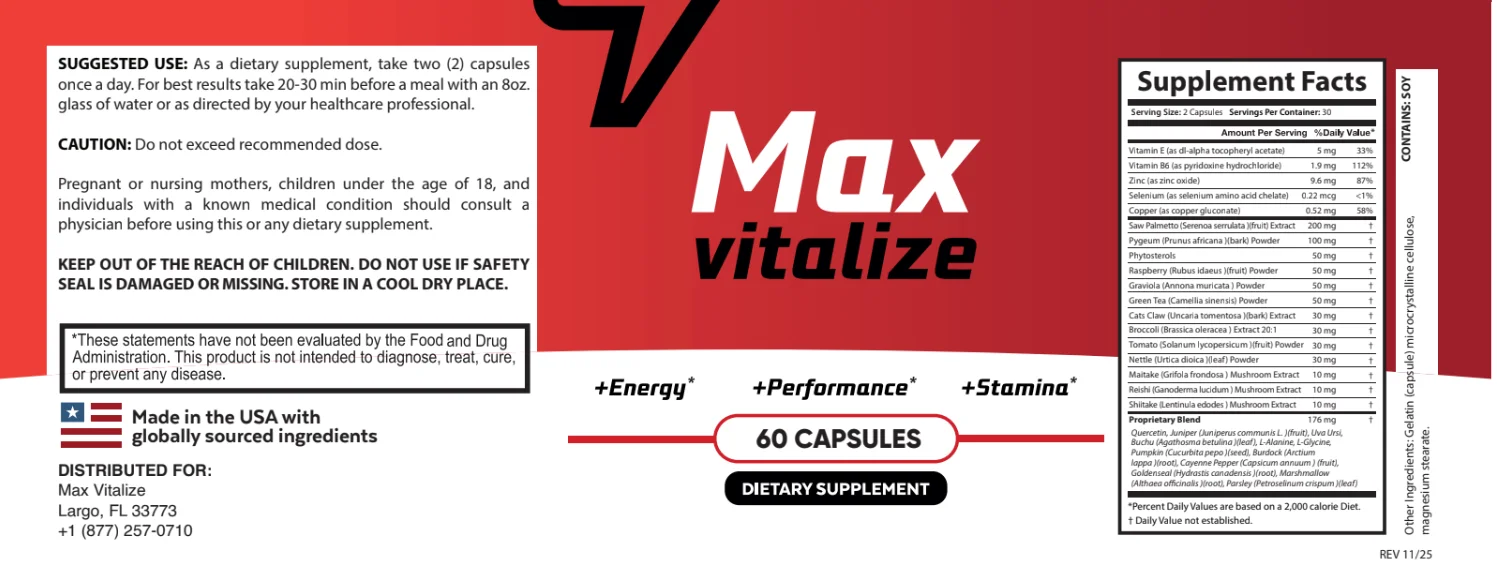
- Vitamin E (as dl-alpha tocopheryl acetate), 5 mg (33% DV): a fraction of the Daily Value. No prostate or erectile-function evidence.
- Vitamin B6 (as pyridoxine hydrochloride), 1.9 mg (112% DV): just over the Daily Value for adult men. Far below the 100 mg upper limit; nothing to flag and nothing to do with the pitch.
- Zinc (as zinc oxide), 9.6 mg (87% DV): near the adult male RDA of 11 mg, per the NIH Office of Dietary Supplements. A normal multivitamin-level amount. No human trials support zinc for erectile function at this dose.
- Selenium (as selenium amino acid chelate), 0.22 mcg (less than 1% DV): the label's oddest line. The adult RDA for selenium is 55 mcg, so 0.22 mcg is less than half of one percent of it. This is label dust, whether by design or by typo, and it contributes nothing.
- Copper (as copper gluconate), 0.52 mg (58% DV): a normal mineral amount, likely included to balance the zinc. No pitch relevance.
- Saw palmetto (fruit) extract, 200 mg: the headline ingredient, and the weakest link. See the dose math below; NCCIH concludes it is probably not helpful for BPH urinary symptoms.
- Pygeum (bark) powder, 100 mg: the bark powder, not a standardized extract. The Cochrane review studied standardized pygeum preparations, so this label does not match what was tested.
- Phytosterols, 50 mg: no named sterol. The Cochrane review studied specific beta-sitosterol preparations, not generic "phytosterols."
- Raspberry (fruit) powder, 50 mg; tomato (fruit) powder, 30 mg; broccoli extract 20:1, 30 mg: food-level dustings. No human prostate or ED trial doses here.
- Graviola (fruit) powder, 50 mg: soursop powder. See the senior-safety section; this ingredient carries a research-backed neurological question mark that does not belong in a daily capsule.
- Green tea (leaf) powder, 50 mg: a small amount of green tea powder. No studied prostate or ED dose.
- Cat's claw (bark) extract, 30 mg; nettle (leaf) powder, 30 mg: the nettle is leaf powder, while the positive BPH trial tested root extract. See the dose math.
- Maitake, reishi, and shiitake mushroom extracts, 10 mg each: culinary-mushroom dustings at one-hundredth of a gram. No prostate or ED evidence.
- Proprietary blend, 176 mg: quercetin, juniper fruit, uva ursi, buchu leaf, L-alanine, L-glycine, pumpkin seed, burdock root, cayenne pepper, goldenseal root, marshmallow root, and parsley leaf. Twelve ingredients sharing 176 mg total, with no individual amounts. Quercetin is listed first, so it is the largest share, but even the entire 176 mg is a fraction of the studied quercetin dose. Goldenseal is in here too, with its amount undisclosed; the interaction section below explains why that matters.
- Other ingredients: gelatin capsule, microcrystalline cellulose, magnesium stearate. Standard. The front label notes "CONTAINS: SOY" and a "REV 11/25" revision mark.
- Label warnings: do not exceed the recommended dose; pregnant or nursing mothers, children under 18, and individuals with a known medical condition should consult a physician. Keep out of reach of children.
The dose math
Here is what human research actually used for the ingredients with real data, against what this bottle discloses.
| Ingredient | What human research actually used | What Max Vitalize discloses |
|---|---|---|
| Saw palmetto extract | NIH-funded trials tested the standard 320 mg/day dose and escalated to 640 and then 960 mg/day over 72 weeks; saw palmetto was no better than placebo for BPH urinary symptoms at any dose. A 2023 review of 27 studies found little or no benefit. | 200 mg, below even the standard studied dose, and the studied doses did not work |
| Pygeum | Cochrane review of 18 randomized trials (1,562 men): standardized pygeum preparations showed a moderately large improvement in combined urinary symptoms and flow measures, but the trials were small, short (average 64 days), and used varied doses and preparations | 100 mg of plain bark powder, not a standardized extract, so it does not match what was tested |
| Phytosterols | Cochrane review of 4 trials (519 men, 4 to 26 weeks): specific beta-sitosterol preparations improved urinary symptom scores (down 4.9 IPSS points) and flow; long-term effectiveness, safety, and prevention of BPH complications are unknown | 50 mg of generic "phytosterols" with no named sterol; does not match the studied preparations |
| Quercetin | One small randomized, double-blind, placebo-controlled trial (30 men with chronic prostatitis, 1 month): 500 mg twice daily, or 1,000 mg/day, significantly improved symptom scores versus placebo | Inside a 176 mg 12-ingredient blend; even if quercetin were the entire blend, it would be less than one-fifth of the studied dose |
| Nettle (Urtica dioica) | One 620-man, 6-month randomized trial of Urtica dioica root extract significantly improved urinary symptom scores and flow versus placebo | 30 mg of leaf powder; the trial tested root extract, not leaf powder |
| Zinc | No human trials support zinc for erectile function at nutritional doses; NIH sets the adult male RDA at 11 mg and the upper limit at 40 mg | 9.6 mg (87% DV): safe, normal, and irrelevant to the pitch |
| Selenium | NIH sets the adult RDA at 55 mcg | 0.22 mcg: less than half of one percent of the RDA |
- The remaining ingredients have no dose to compare. Raspberry, graviola, green tea, cat's claw, broccoli, tomato, the three mushroom extracts, and the other eight blend ingredients have no established human prostate or erectile-function doses, and here they appear in the tens of milligrams or less. Naming ingredient categories is not the same as matching studied doses.
- The vitamin and mineral half of the label is a thin multi. Vitamins E and B6, zinc, selenium, and copper at or near Daily Value levels do not improve blood flow or erectile function. They make the label look substantial without contributing to the pitch.
- The undisclosed blend hides the dose check entirely. Twelve ingredients share 176 mg with no breakdown, so no buyer and no reviewer can verify a single one against research. That is a transparency choice, and it is the wrong one for a product sold on health promises.
Senior-safety notes
A male-health capsule aimed at men over 50 carries real interaction and diagnosis questions. The doses here are mostly small, but the buyer is the variable that matters.

- Erectile dysfunction can be an early warning sign of heart disease. Mayo Clinic explains that ED and heart disease share the same damaged-blood-vessel process, and that because penile arteries are smaller, ED symptoms can appear years before heart symptoms. Mayo's guidance is direct: men with unexplained ED should be screened for heart disease before starting ED treatment. A man who buys this bottle online instead of seeing a doctor may be trading a heart-disease workup for a prostate blend. Our supplement interactions guide explains how to have the medication conversation with your doctor.
- Goldenseal is a drug-interaction risk, and its amount is undisclosed. Goldenseal root sits inside the 176 mg proprietary blend with no stated amount. NCCIH reports that a 2017 review found goldenseal carries an overall high risk of drug interactions because it inhibits two major metabolic enzymes, CYP2D6 and CYP3A4, which metabolize more than half of currently used prescription drugs. Seniors taking statins, blood pressure drugs, or diabetes medications should tell their doctor or pharmacist before touching a blend that hides this ingredient.
- Graviola powder deserves a flag. The label includes 50 mg of graviola (soursop) powder. Epidemiological research in Guadeloupe linked regular soursop consumption to an unusually high rate of atypical parkinsonism, and follow-up work identified annonacin, a compound in the fruit and leaves, as the probable cause, reproducing the brain lesions in rats (Lannuzel et al., Movement Disorders, 2008). The 50 mg here is small and this was an overconsumption finding, but a neurotoxicity-linked ingredient has no place as casual filler in a daily capsule.
- Urinary symptoms deserve a doctor's evaluation, whatever the bottle says. Mayo Clinic advises men to talk to their health care provider about urinary symptoms even when they are not bothersome, because urinary tract infection, inflamed prostate, and prostate or bladder cancer can all mimic BPH. A product sold as an ED fix that actually contains prostate ingredients muddles both conversations.
- The honesty notes. NCCIH reports saw palmetto is well tolerated, with mild and infrequent digestive symptoms, dizziness, or headache, and that it does not appear to affect PSA readings. The Cochrane pygeum review found adverse effects mild and comparable to placebo. This bottle is unlikely to harm most healthy buyers; the harm is in what it replaces: a real diagnosis.
As always, this is not medical advice. Talk to your doctor before starting any new supplement, especially one aimed at conditions as serious as erectile dysfunction or prostate disease.
Price and value
The pricing section is fully visible on the page. Purchases are one-time payments; we saw no subscription, auto-billing, or free-trial terms.
| Package | Price per bottle | Total | Shipping | Cost per day |
|---|---|---|---|---|
| Basic: 2 bottles (60-day supply) | $79 | $158 | $9.99 | $2.63 |
| Most popular: 3 bottles (90-day supply) | $69 | $207 | Free | $2.30 |
| Best offer: 6 bottles (180-day supply) | $49 | $294 | Free | $1.63 |
- The guarantee is 60 days, not 180. The page promises "100% Satisfaction or Your Money Back" for 60 days with a refund of "every penny," and states no restocking fee. That is a shorter window than the 180-day guarantees on the related checkouts from this seller family, and it sits oddly next to the 180-day supply the largest package sells. No return-shipping or empty-bottle terms are spelled out.
- No anchor prices, no urgency. The page shows no struck-through "regular" prices and we observed no countdown timer, no "only X left" counter, no pop-up discounts, and no testimonials at all. For this seller family, that restraint is unusual and worth noting.
- The value math is rough. At $1.63 to $2.63 a day, this is premium pricing for a thin multivitamin plus a prostate-herb blend at sub-trial doses. It is the identical $79/$69/$49 pricing ladder we have seen across this seller family's checkouts.
The company behind the label
Readers of our recent teardowns will recognize this operation's fingerprints.
- Distributor and phone: the label reads "DISTRIBUTED FOR: Max Vitalize, Largo, FL 33773," with +1 (877) 257-0710. That phone number is the same one printed on the labels of the PO Box 12730 Ogden UT family we have reviewed, including our ProstaFlow review. Same network, new letterhead.
- The retailer is BuyGoods. The page footer states: "BuyGoods is the retailer of this product," naming a Delaware corporation at 1201 N Orange Street Suite #7223, Wilmington, DE. That is the same retailer named on the BuyGoods-template page in our Neuralisse teardown. BuyGoods' role, per its own footer text, "does not constitute an endorsement, approval or review of this product."
- The footer legal pages do not exist. All six footer links, Terms & Conditions, Anti-Spam Policy, Privacy Policy, Return & Refund, Contact Us, and Unsubscribe, are dead placeholder links that go nowhere. For a checkout page collecting payment details, that is a meaningful transparency failure.
- Template sloppiness is visible. The subheadline misspells "Erectile Disfunction" (the page's spelling, repeated in the disclaimers). The page is a bare price page with no long-form sales copy and no standalone hero bottle image, which suggests the persuasive version of this page lives at a different URL. Trust badges read "GMP Certified," "FDA - DS24" (an odd label), and "USA Ingredients."
- What the page gets right: the FDA non-evaluation disclaimer appears twice, results-may-vary language is included, and the page admits the product "does not guarantee immediate results" and "may not work for 100% of users." The label advises consulting a physician for medical conditions. Note that an FDA-registered facility is not FDA approval; the FDA does not approve dietary supplements before sale.
Regulatory check: we searched FDA warning letters and FTC actions and found no enforcement action against Max Vitalize as of October 16, 2026. That is a statement of what the public record shows, not an endorsement.
Sources
- National Center for Complementary and Integrative Health. Saw Palmetto: Usefulness and Safety. NCCIH concludes saw palmetto is probably not helpful for BPH urinary symptoms: a 2023 review of 27 studies found little or no benefit, and two NIH-funded trials, one at the standard dose and one escalating to three times the usual dose, did not improve symptoms.
- Wilt TJ, et al. Beta-sitosterols for benign prostatic hyperplasia. Cochrane Database of Systematic Reviews. 1999;4:CD001043. Four randomized trials (519 men, 4 to 26 weeks): beta-sitosterol preparations improved urinary symptom scores and flow measures versus placebo; long-term effectiveness, safety, and ability to prevent BPH complications are unknown.
- Wilt TJ, Ishani A. Pygeum africanum for benign prostatic hyperplasia. Cochrane Database of Systematic Reviews. 2002;1:CD001044. Eighteen randomized trials (1,562 men): standardized pygeum preparations showed a moderately large improvement in combined urinary symptoms and flow measures, but trials were small, short (average 64 days), and used varied doses and preparations.
- Shoskes DA, Zeitlin SI, Shahed A, Rajfer J. Quercetin in men with category III chronic prostatitis: a preliminary prospective, double-blind, placebo-controlled trial. Urology. 1999;54(6):960-963. Thirty men randomized to quercetin 500 mg twice daily or placebo for one month; the quercetin group improved significantly more on the NIH symptom score.
- Safarinejad MR. Urtica dioica for treatment of benign prostatic hyperplasia: a prospective, randomized, double-blind, placebo-controlled, crossover study. Journal of Herbal Pharmacotherapy. 2005;5(4):1-11. Six-month randomized trial in 620 men: Urtica dioica root extract significantly improved urinary symptom scores and flow measures versus placebo.
- Mayo Clinic. Erectile dysfunction: A sign of heart disease? ED can be an early warning sign of heart disease because both depend on healthy blood vessels; men with unexplained ED should be screened for heart disease before starting ED treatment.
- National Center for Complementary and Integrative Health. Herb-Drug Interactions: What the Science Says. A 2017 review found goldenseal carries an overall high risk of drug interactions because it inhibits CYP2D6 and CYP3A4, enzymes responsible for metabolizing more than half of currently used prescription drugs.
- National Institutes of Health, Office of Dietary Supplements. Zinc: Fact Sheet for Health Professionals. Adult male RDA is 11 mg; upper limit is 40 mg.
- National Institutes of Health, Office of Dietary Supplements. Selenium: Fact Sheet for Health Professionals. Adult RDA is 55 mcg.
- Mayo Clinic. Benign prostatic hyperplasia (BPH): Symptoms and causes. Men should talk to their health care provider about urinary symptoms even when not bothersome, because other conditions, including prostate or bladder cancer, can cause similar symptoms.
- Lannuzel A, Ruberg M, Michel PP. Atypical parkinsonism in the Caribbean island of Guadeloupe: etiological role of the mitochondrial complex I inhibitor annonacin. Movement Disorders. 2008;23(15):2122-2128. Epidemiological data linked regular soursop consumption to atypical parkinsonism; annonacin, a compound in soursop fruit and leaves, was identified as the probable cause and reproduced the brain lesions in rats.
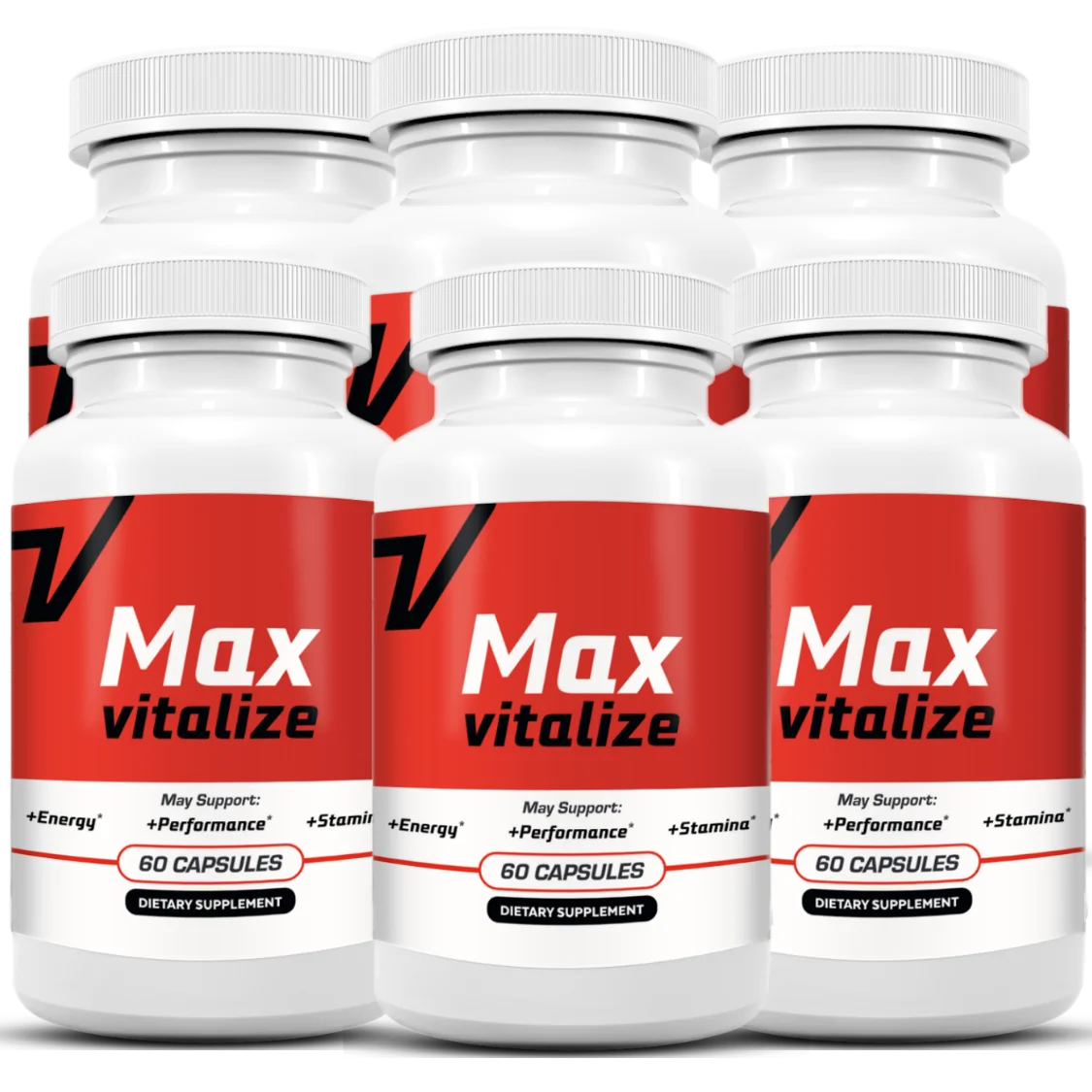
Review note: This review covers the Max Vitalize sold through the short "SELECT YOUR PACKAGE" checkout page as it appeared in October 2026, the version subheadlined "Supplement Caps for Erectile Disfunction" (the page's spelling), showing white bottles with red "Max vitalize" labels, 60-day guarantee badges, a BuyGoods retailer footer, and dead footer legal links. The persuasive long-form version of this page appears to live at a different URL and was not reviewed here. Lookalike sites under the same product name may differ, and page content changes over time.
Fact-checked by the SupplementDecoded Research Editorial Team