
Table of ContentsShow ChaptersHide Chapters
Medical Disclaimer
This article is for informational purposes only and does not constitute medical advice. Always consult with a qualified healthcare professional before starting any new supplement regimen.
Read our Medical / Expert Review Policy and Medical Disclaimer for details.
Key takeaways: NMN (nicotinamide mononucleotide) is a molecule your cells turn into NAD+, a helper involved in energy production and DNA repair. Human trials show it reliably raises blood NAD+ levels, but the health benefits are thin: one small 2021 trial improved muscle insulin sensitivity in prediabetic women, while larger pooled analyses found no meaningful effects on blood sugar, cholesterol, or muscle strength in adults over 60. The FDA banned it from supplements in 2022, then reversed course on September 29, 2025, making it lawful to sell again. Short-term trials found no serious safety signals, but no human trial has run longer than 24 weeks, so long-term safety is genuinely unknown.
Contents
- The verdict
- What NMN is, in plain language
- The FDA saga: banned in 2022, legal again in 2025
- What the human trials actually show
- What the pooled analyses say
- Safety: what we know and what we don't
- Safety notes for older adults
- If you still want to try it: buy less blindly
- The bottom line
- Sources
The verdict
NMN is one of the rare supplement trends with real human trials behind it, and the trials tell a humbler story than the ads. It does raise NAD+ levels in the blood. It does not reliably improve blood sugar, cholesterol, muscle strength, or physical performance in the people most likely to buy it: adults over 60.
The single best trial found better muscle insulin sensitivity in 25 prediabetic women. Every pooled analysis since has landed in the same place: small, short trials, mixed or null results. If you buy NMN today, you are paying $40 to $80 a month for a biochemical change with no proven health payoff.
Our verdict: interesting science, early evidence, longevity claims far ahead of the data. It is not a scam ingredient, but it is an expensive bet. Talk with your doctor before spending that money, especially if you take prescriptions or have a cancer history.
What NMN is, in plain language
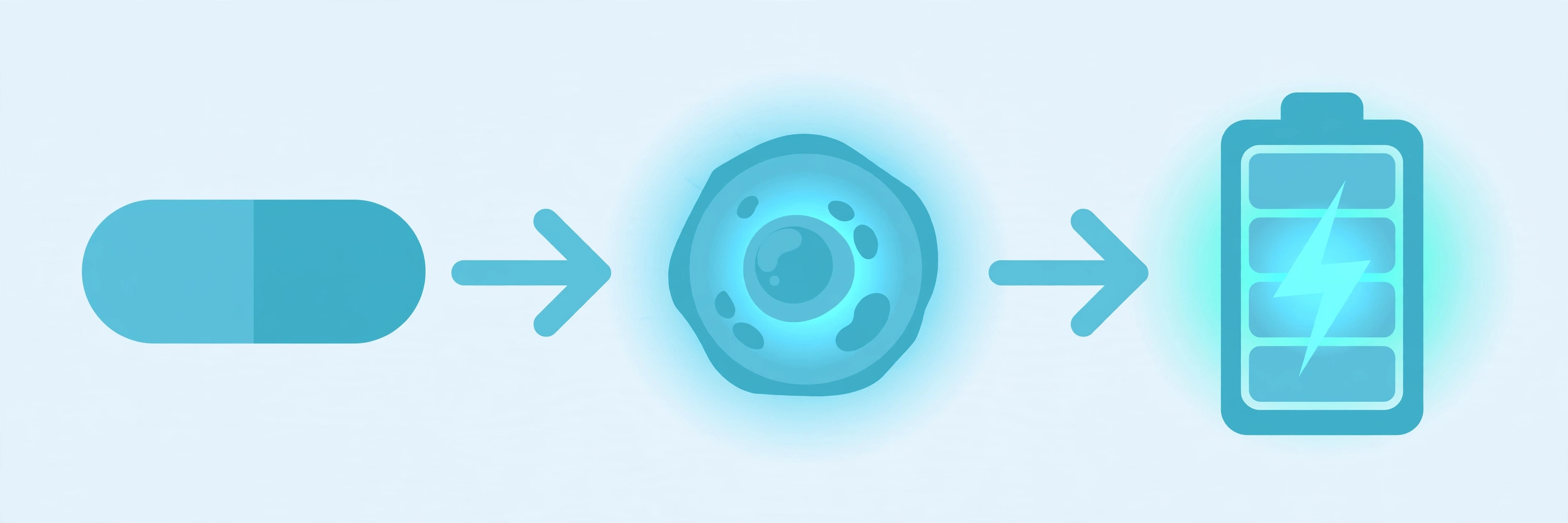
NMN stands for nicotinamide mononucleotide. Your cells convert it into NAD+ (nicotinamide adenine dinucleotide), a molecule involved in hundreds of reactions, including turning food into energy and repairing damaged DNA.
The pitch goes like this: in animal studies, NAD+ production falls with age, and giving old mice NMN improved metabolism, blood vessels, and aspects of aging. If the same worked in people, NMN could be a shortcut to healthier aging. That is a big if.
One caution on the premise itself: the age-related NAD+ decline is well documented in rodents, but the evidence that it drives aging in humans is still limited. Much of the excitement is borrowed from mice, and mice are not small humans.
The FDA saga: banned in 2022, legal again in 2025
NMN's regulatory story matters because sellers use it as marketing. Here is the honest version, confirmed against the FDA's own letters.
In 2022, the FDA said NMN could not be sold as a supplement. The reason was a legal technicality called drug preclusion: a company had authorized NMN for investigation as a new drug, and the law says an ingredient investigated as a drug first generally cannot also be a supplement.
On September 29, 2025, the FDA reversed itself. Responding to industry citizen petitions, the agency concluded NMN is not excluded from the dietary supplement definition, because evidence showed it was marketed as a supplement in the United States as early as 2017, before the drug investigation began.
On December 2, 2025, the FDA reinstated its acknowledgment letters for manufacturers' new-dietary-ingredient notifications for NMN. Shelves and online marketplaces filled back up through 2026.
What sellers will not tell you: "lawful" is not "approved." The FDA does not review supplements for safety or effectiveness before sale. The reversal was a legal ruling about which shelf NMN can sit on, not a judgment that it works.
What the human trials actually show
About a dozen randomized trials have tested NMN in people. Here are the ones that matter most, described exactly as their authors reported them.
| Trial | Who and how much | What it found |
|---|---|---|
| Yoshino et al., Science, 2021 | 25 postmenopausal women with prediabetes; 250 mg/day for 10 weeks | Muscle insulin sensitivity rose about 25%; muscle insulin signaling and remodeling genes improved. The most cited NMN trial in humans. |
| Liao et al., J. Int. Soc. Sports Nutrition, 2021 | 48 amateur runners; 300, 600, or 1,200 mg/day for 6 weeks | Ventilatory threshold improved at the two higher doses. No change in VO2max, oxygen pulse, or peak power. |
| Igarashi et al., npj Aging, 2022 | Healthy men aged 65 and older; 250 mg/day for 6 or 12 weeks | Safe and well tolerated; blood NAD+ and related metabolites rose. Small, nominal gains in walking speed and grip strength that the authors said need validation in larger studies. |
| npj Aging, 2026 (high-dose trial) | Healthy adults 65 and older; 1,250 mg/day for 24 weeks | Well tolerated and NAD+ rose robustly, but no significant improvement in the main goal (hearing) or in physical performance measures. The longest, highest-dose human trial so far, and the benefits did not scale with the dose. |
An honesty note about the flagship trial: after the 2021 Science paper, another scientist published a comment noting the NMN and placebo groups started with very different liver-fat levels, which raised questions about the randomization. The study authors replied that muscle insulin sensitivity, the main outcome, was identical in both groups at baseline. The finding stands, but it is worth knowing the debate exists.
NAD+ levels: yes, NMN raises them. Multiple trials confirm that daily NMN, typically 250 to 500 mg, raises blood NAD+ and related metabolites, and the levels stay up while people keep taking it. This is the one claim the evidence fully supports.
What the raised NAD+ does for health: unclear. The trials show signals in small groups (prediabetic women, runners, healthy older men) but nothing consistent, and the longest trial at the highest dose found no physical-performance benefit.
Nobody has tested what buyers actually want to know. No trial has measured whether NMN prevents disease, slows aging in any clinical sense, or extends life. Those studies would take years and thousands of participants. None exist.
What the pooled analyses say
When trials are small, researchers pool them. Four recent meta-analyses of NMN trials all point the same direction: safe in the short term, unimpressive on outcomes.
| Pooled analysis | Scope | Bottom line |
|---|---|---|
| Blood sugar and lipids, 2024 | 8 trials, 342 adults, 250 to 2,000 mg/day | No significant benefit for fasting glucose, fasting insulin, HbA1c, insulin resistance, or cholesterol. |
| Muscle and function, 2025 | Trials in adults averaging over 60 | No significant effects on muscle mass, grip strength, walking speed, or chair-stand performance. The authors concluded the evidence does not support NMN for preserving muscle in older adults. |
| Blood pressure, 2026 | 10 trials, 349 participants | A small drop in diastolic pressure (about 2 points); systolic pressure unchanged overall, with a modest dip only in the over-60 subgroup. Described as preliminary. |
| Safety and metabolism, 2026 | 15 trials; safety data on 383 people, up to 2,000 mg/day for 24 weeks | No increase in overall or serious side effects, no liver-enzyme changes. No significant effects on weight, blood sugar, HbA1c, or cholesterol. |
The pattern is consistent. NMN changes the blood marker. The blood marker does not reliably change the person. That gap is the whole story of this supplement right now.
Safety: what we know and what we don't
Short-term safety looks reassuring, as far as it goes. Across the pooled trials, NMN at 250 to 2,000 mg a day for up to 24 weeks did not raise overall or serious adverse events and did not disturb liver enzymes. Mild stomach upset is the most commonly reported complaint.
But "as far as it goes" is doing heavy work. Here is what is genuinely unknown:
No human trial has run longer than 24 weeks. Anyone taking NMN for years is running an experiment on themselves with no published data behind it. The 2026 safety review explicitly called for larger, longer trials before long-term safety can be judged.
The cancer question is unresolved, not answered. NAD+ is a resource that both healthy and cancerous cells use: it supports the DNA-repair systems that prevent cancer, but tumors also rely on NAD+ pathways to grow. Reviews of the science describe potentially opposite effects at different stages of cancer development, and note that no animal study of NMN or its close cousin NR has reported increased cancer incidence. That is reassuring but not the same as human proof.
Interaction data barely exists. We found no published trials testing NMN alongside the drugs older adults commonly take: blood thinners, blood pressure drugs, diabetes drugs, statins. Anyone on prescriptions is in uncharted territory. Our supplement interactions guide explains why this gap matters.

Safety notes for older adults
NMN marketing targets healthy aging, which means it targets you. A few senior-specific cautions:
- If you have a personal history of cancer, or are in active treatment, discuss NMN with your oncologist first. The NAD+ and cancer question is exactly the kind of unresolved science where a specialist's judgment matters.
- Do not let a supplement displace the things with proven benefit: regular movement, blood pressure and blood sugar control, and the medications your doctor prescribed. NMN has no evidence of replacing any of them.
- Doses in trials ran from 250 to 1,250 mg a day; store products vary widely in dose and quality, and more was not better in the high-dose trial. Our supplement dosage guide covers how to read a label against what was actually studied.
- The honest price math: at trial-level doses, a month typically costs $40 to $80 or more. Over a year, that is $500 to nearly $1,000 for an unproven benefit.
If you still want to try it: buy less blindly
We do not recommend NMN, but if you decide to try it anyway, reduce your risk of wasting money or worse:
- Look for a certificate of analysis for a named production batch, showing the batch number, test date, the laboratory, and the measured NMN content. Most brands do not publish one; treat that as information.
- Be skeptical of "pharmaceutical grade," "FDA approved," or "clinically proven" on the label. The FDA approves no supplements, and no NMN product has clinical proof of anti-aging effects.
- Avoid sellers pushing NMN alongside IV NAD+ drips, "longevity protocols," or subscriptions you did not ask for. Those are upsell funnels, not healthcare.
- Start any new supplement conversation with your doctor or pharmacist, and bring the bottle. They need the dose and the full ingredient list to judge interactions.
The bottom line
NMN is a legitimate molecule with a legitimate mechanism and a marketing story that has sprinted ahead of the science. It raises NAD+ levels. Everything after that sentence is, at best, a small short trial or an honest "we don't know yet."
The FDA's 2025 reversal made it legal to sell. It did not make it proven, safe for long-term use, or worth $80 a month. Until larger, longer trials exist, the most evidence-based longevity strategy remains the unglamorous one: move daily, eat sensibly, sleep, and keep your doctor's appointments.
If you found this review useful, our guide to supplement interactions is the natural next read before adding any new bottle to your routine.
Sources
- U.S. Food and Drug Administration, letter re: NMN new dietary ingredient notification and response to citizen petition on drug preclusion (December 2, 2025) (the FDA's own document confirming NMN is not excluded from the dietary supplement definition).
- Yoshino M. et al., "Nicotinamide mononucleotide increases muscle insulin sensitivity in prediabetic women," Science, 2021 (PubMed)
- Brenner C., Comment on "Nicotinamide mononucleotide increases muscle insulin sensitivity in prediabetic women," Science, 2021 (PubMed)
- Liao B. et al., "Nicotinamide mononucleotide supplementation enhances aerobic capacity in amateur runners," J. Int. Soc. Sports Nutr., 2021 (PubMed)
- Igarashi M. et al., "Chronic nicotinamide mononucleotide supplementation elevates blood nicotinamide adenine dinucleotide levels and alters muscle function in healthy older men," npj Aging, 2022 (PubMed)
- "Sustained NAD+ augmentation by high-dose nicotinamide mononucleotide supplementation in older adults: a 24-week randomized, double-blind, placebo-controlled trial," npj Aging, 2026
- Yang W. et al., "Safety and metabolism-related outcomes of oral nicotinamide mononucleotide supplementation in adults: a systematic review and meta-analysis," Nutrients, 2026
- "Effects of nicotinamide mononucleotide on glucose and lipid metabolism in adults: a systematic review and meta-analysis of randomised controlled trials," Curr. Diabetes Rep., 2024 (PubMed)
- "The effect of nicotinamide mononucleotide and riboside on skeletal muscle mass and function: a systematic review and meta-analysis," J. Cachexia Sarcopenia Muscle, 2025 (PubMed)
- "Effects of nicotinamide mononucleotide supplementation on blood pressure: a systematic review and meta-analysis of randomized controlled trials," Nutrients, 2026 (PubMed)
- Palmer R., "Nicotinamide adenine dinucleotide and the sirtuins caution: pro-cancer functions," Aging Medicine, 2021
- "Current uncertainties and future challenges regarding NAD+ boosting strategies," review of NAD+ precursor safety questions including carcinogenesis
Fact-checked by the SupplementDecoded Research Editorial Team