
Table of ContentsShow ChaptersHide Chapters
Medical Disclaimer
This article is for informational purposes only and does not constitute medical advice. Always consult with a qualified healthcare professional before starting any new supplement regimen.
Read our Medical / Expert Review Policy and Medical Disclaimer for details.
Key takeaways
Verdict: be cautious with concentrated curcumin capsules if you take warfarin. The evidence of harm is thin, but warfarin leaves almost no room for error, so even a small interaction risk deserves respect.
Food is a different story. The small amounts of turmeric used in cooking carry far less curcumin than capsules and are not the concern here.
Know the bleeding warning signs: unusual bruising, nosebleeds that will not stop, blood in urine or stool, coughing up blood, or a severe headache. Seek care promptly if any of these appear.
Talk to your clinician first. Tell your doctor and pharmacist about every supplement you take, including turmeric, and never stop or change warfarin on your own.
Contents
The short answer
What the evidence actually shows
Food turmeric vs curcumin capsules
Warning signs of bleeding to know
Other medicines with the same concern
What to do
Sources
The short answer
Is turmeric safe with warfarin? It depends on the form. Turmeric used as a spice in food is a different matter from concentrated curcumin capsules, and the distinction is what keeps you safe.
If you take warfarin and use turmeric only in cooking, continue as usual and mention it at your next appointment. If you take, or are thinking about taking, curcumin capsules or high-dose turmeric extracts, talk to your doctor or pharmacist first. Do not start or stop either product on your own.
Pharmacists hear this question constantly, because both warfarin and turmeric are common among older adults. Warfarin is one of the most prescribed blood thinners for seniors, and turmeric is one of the most popular supplements. That overlap is exactly why the question deserves a careful, honest answer rather than a yes or no.
What the evidence actually shows
Here is the honest grading, because you deserve to know how strong the evidence is, not just the conclusion.
The concern about turmeric and warfarin rests on thin but real evidence. One published case report described a spike in INR, a blood-clotting measure used to monitor warfarin, in a patient taking warfarin who also took turmeric. Separately, laboratory studies have shown that curcumin, the active compound in turmeric, can slow platelet clumping in test tubes. Platelets are the blood cells that start clots, so anything that affects them matters for someone on a blood thinner.
That is the full list. No large human trial has tested turmeric or curcumin together with warfarin. The table below summarizes where things stand.
Evidence type | What it found | Strength |
|---|---|---|
Case report | An INR spike in one warfarin patient taking turmeric | Weak: a single patient cannot prove cause |
Laboratory studies | Curcumin slowed platelet clumping in test tubes | Weak and indirect: test tubes are not people |
Large human trials | None have tested turmeric with warfarin | Absent: the key evidence does not exist |
So why be cautious over such thin evidence? Because of how warfarin works. Warfarin has what clinicians call a narrow therapeutic index, which means the dose that prevents dangerous clots and the dose that causes dangerous bleeding are close together. Small changes, from a new supplement, a diet shift, or a missed dose, can swing clotting too far in either direction. That is why warfarin patients get regular INR blood tests. With a drug that unforgiving, even thin evidence of an interaction deserves respect.
This is the site's standard approach: report what the evidence actually is, including its limits, and let the stakes guide the caution. For a detailed look at turmeric itself, see our full turmeric guide.
Food turmeric vs curcumin capsules
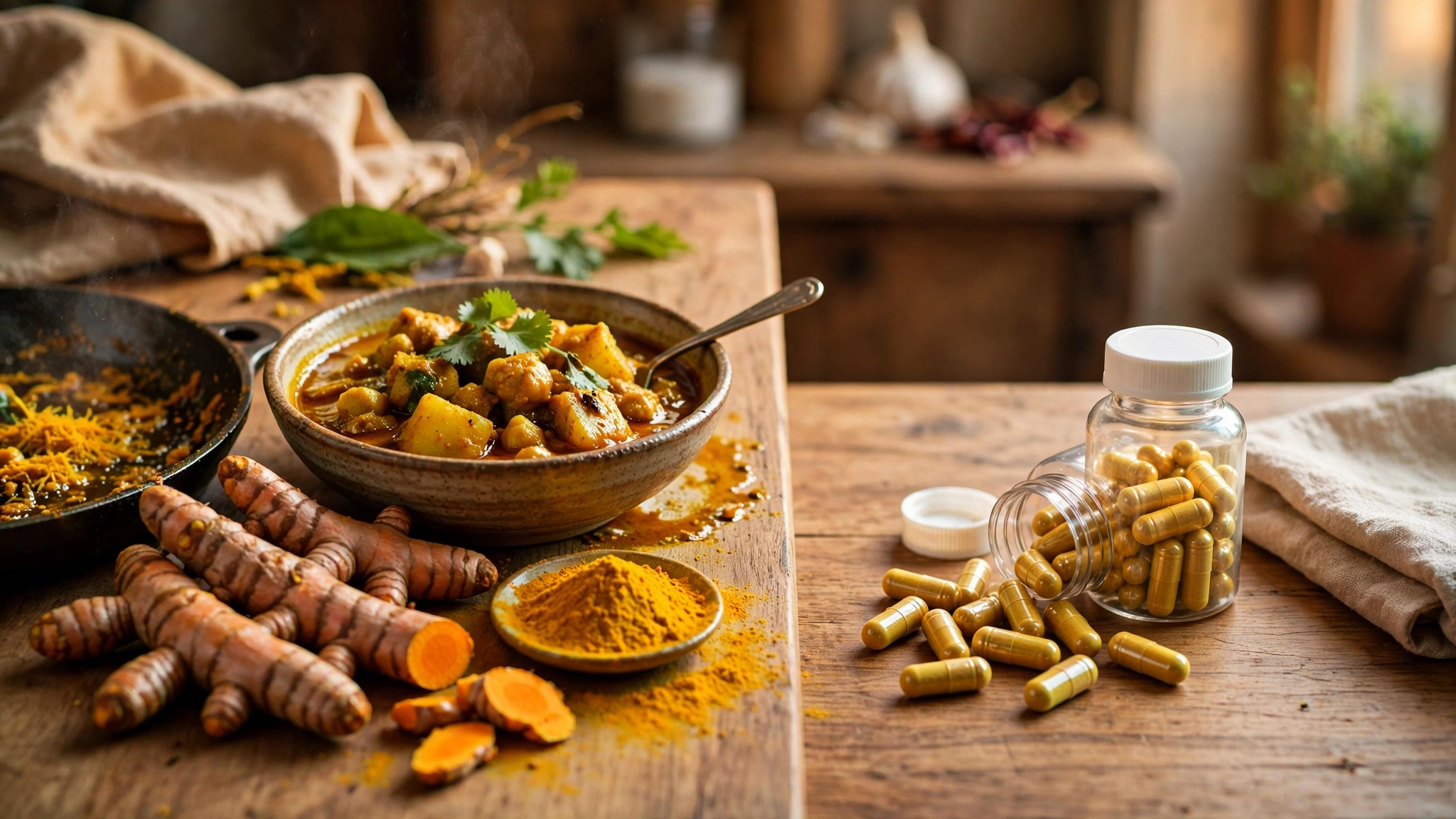
This distinction is the heart of the matter, so it is worth making clearly.
Form | What it looks like | Why it matters |
|---|---|---|
Turmeric in food | A teaspoon in curry, a sprinkle in soup, a cup of golden milk now and then | Far less curcumin, and the body absorbs even less from food; not the concern in this article |
Curcumin capsules and high-dose extracts | Concentrated capsules or extracts, designed for maximum uptake | This is the form the case report and the laboratory findings point to, not your curry |
Turmeric in food means the amounts used in cooking: a teaspoon in curry, a sprinkle in soup, a cup of golden milk now and then. Culinary turmeric contains only a small fraction of curcumin by weight, and the body absorbs even less of it from food. These are the amounts humans have eaten for centuries, and they are not the concern in this article.
Curcumin capsules and high-dose extracts are a different product entirely. A single capsule can deliver many times the curcumin of a heavily spiced meal, in a concentrated form designed for maximum uptake. When the case report and the laboratory findings raise flags, this is the form they point to, not your curry.
The practical rule is simple. Keep cooking with turmeric as you always have. Treat concentrated curcumin capsules the way you would treat any new medicine alongside warfarin: as something to discuss with your doctor or pharmacist before starting, not after.
Warning signs of bleeding to know
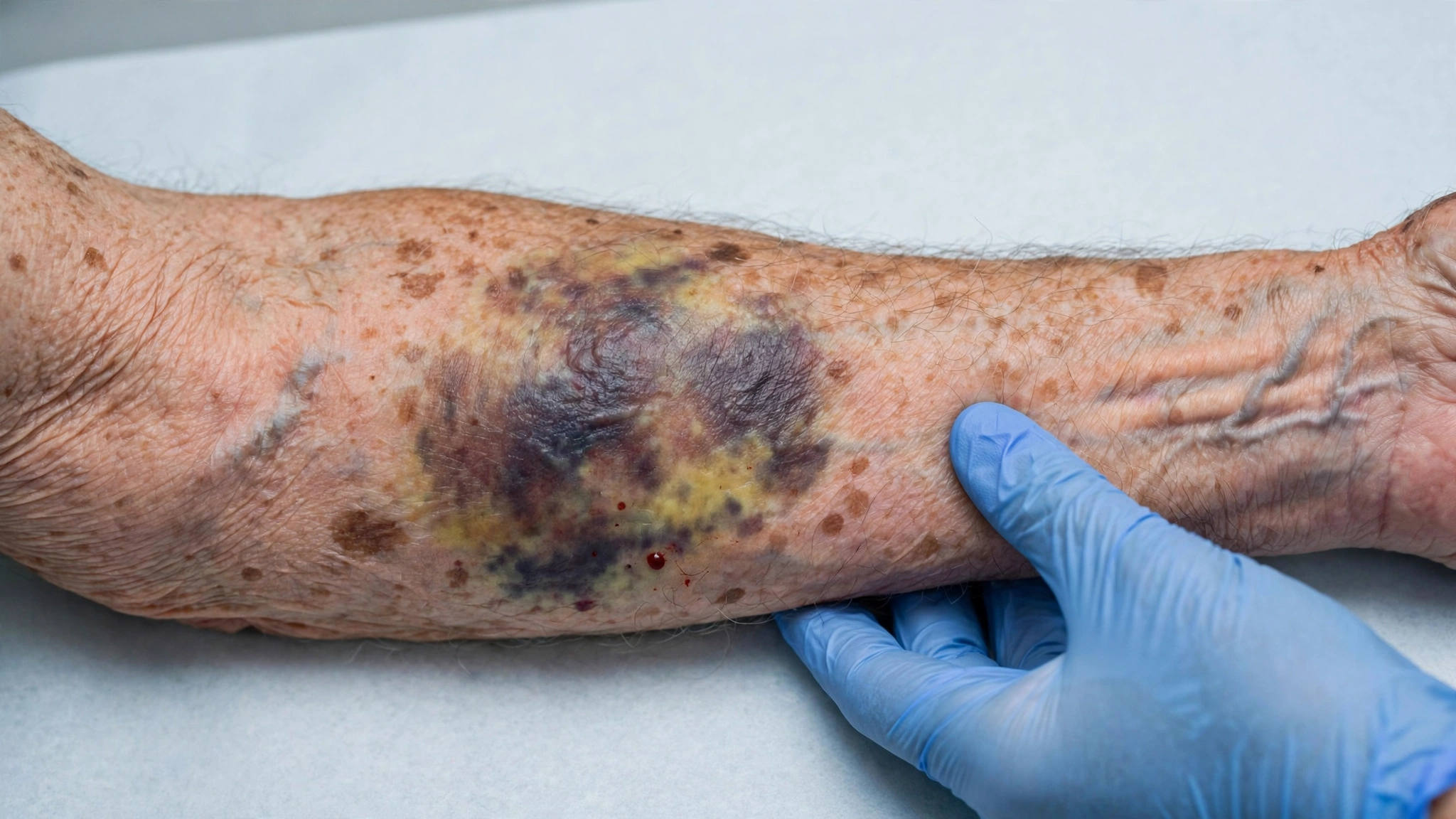
Whether or not you take turmeric, anyone on warfarin should know these warning signs. They are the signals that bleeding may be going too far, and they warrant prompt medical attention:
Unusual bruising. Bruises that are very large or appear without a known bump deserve attention, because they can mean blood is not clotting normally under the skin.
Nosebleeds that will not stop. A nosebleed that keeps going well past the usual few minutes is a sign to contact your doctor promptly, not to wait it out.
Blood in urine or stool. Pink or red urine, or red blood or dark, tarry stools, can signal internal bleeding that you cannot see and should never ignore.
Coughing up blood. Even small amounts of blood when coughing warrant urgent medical attention for anyone on a blood thinner.
A severe or unusual headache. This can signal bleeding in rare cases, so a headache that feels different from your usual kind is worth a prompt call to your clinician.
If any of these appear, do not wait for your next scheduled appointment. Contact your doctor promptly or seek urgent care, and mention every medicine and supplement you take, including turmeric.
Other medicines with the same concern
Warfarin is not the only medicine where turmeric or curcumin deserves a conversation first. The same bleeding concern applies to:
Clopidogrel, an antiplatelet drug often prescribed after heart procedures. Like warfarin, it reduces clotting, so adding curcumin's platelet effects means one more conversation with your clinician.
Apixaban and other direct blood thinners, the newer alternatives to warfarin. They work differently from warfarin, but the caution about combining them with concentrated curcumin still applies.
NSAID painkillers such as ibuprofen, which already raise bleeding risk on their own and are common in medicine cabinets. Pairing them with curcumin capsules stacks two bleeding risks at once.
Two more notes for readers managing other conditions. Turmeric and curcumin may also lower blood sugar and blood pressure slightly, which matters if you take diabetes or blood pressure medicines. This is not a reason for alarm, but it is a reason to mention turmeric to the clinician who manages those prescriptions. Our supplement interactions guide covers how to think through these overlaps systematically.
What to do

If you take warfarin, or any blood thinner, and you use or are considering turmeric supplements, here are the concrete steps:
Tell your doctor and pharmacist about every supplement you take, including turmeric, curcumin, and anything else from the health food aisle. Supplements count as medicines for interaction purposes.
Bring the bottles to your appointments. The exact product and dose matter, because a concentrated extract and a cooking spice are not the same thing. Showing the label removes all guesswork.
Never stop or change warfarin on your own. Stopping warfarin suddenly can leave you unprotected against clots, which is the danger the drug was prescribed to prevent. Any change goes through your clinician.
Ask for a pharmacist medication review. Pharmacists are the most accessible experts on interactions, and a full review of your prescriptions plus supplements, with doses, is one of the highest-value appointments in senior health care. Our dosage guide explains how to prepare a complete list.
Keep your INR appointments. Regular monitoring is how your care team catches small shifts before they become problems, whatever their cause.
The bottom line is reassuring in its simplicity. Food turmeric stays on the menu. Concentrated curcumin capsules get a conversation with your clinician first. And warfarin keeps doing its job, monitored and uninterrupted, while you stay alert to the warning signs above.
Sources
National Center for Complementary and Integrative Health (NCCIH). Turmeric page, nccih.nih.gov.
National Institutes of Health, Office of Dietary Supplements. Turmeric fact sheet, ods.od.nih.gov.
Published case report describing INR elevation in a warfarin patient taking turmeric, in the PubMed-indexed medical literature.
NHS Wales, Welsh Medicines Advice Service. Turmeric interactions monograph.
Fact-checked by the SupplementDecoded Research Editorial Team