
Table of ContentsShow ChaptersHide Chapters
Medical Disclaimer
This article is for informational purposes only and does not constitute medical advice. Always consult with a qualified healthcare professional before starting any new supplement regimen.
Read our Medical / Expert Review Policy and Medical Disclaimer for details.
Key takeaways
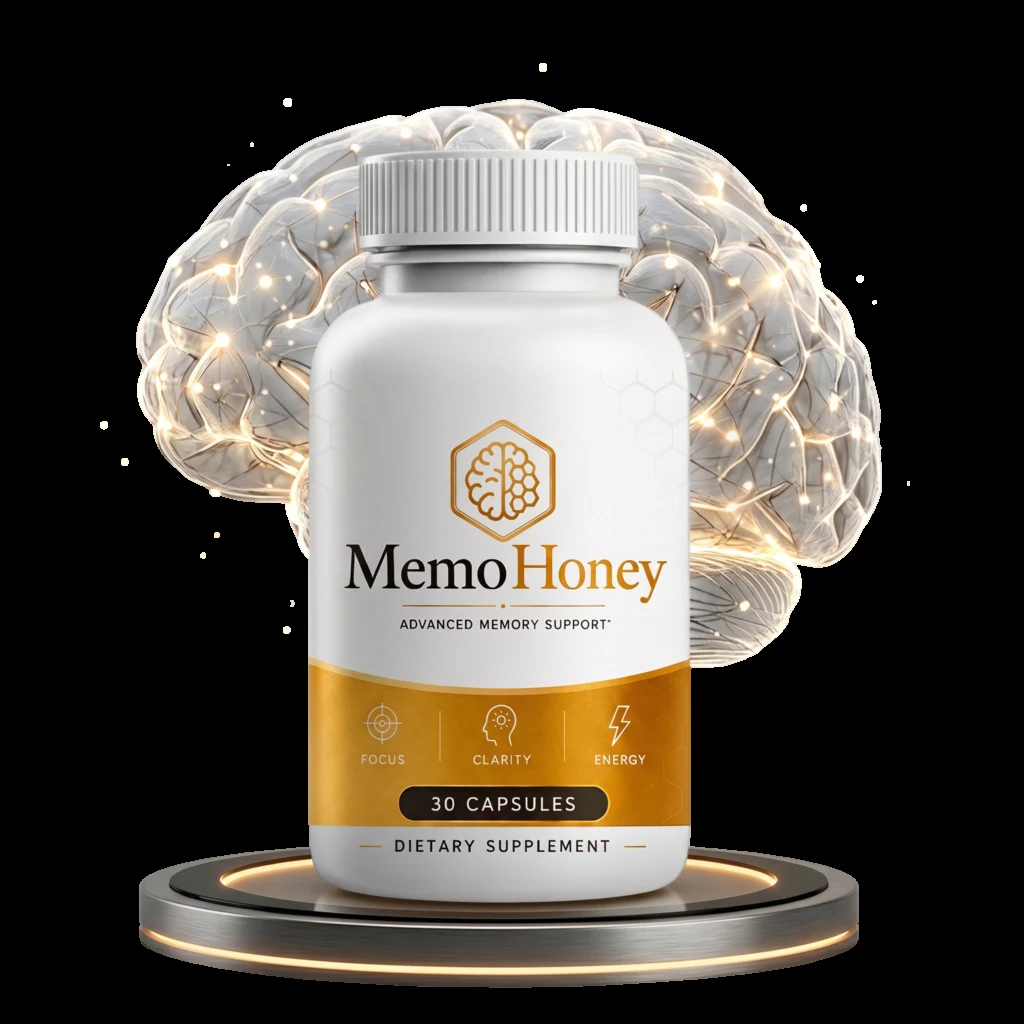
- MemoHoney sells a memory pitch, but the capsule is a circulation amino-acid blend. The label lists L-arginine (200 mg base plus 200 mg AKG), L-citrulline (100 mg HCl plus 100 mg malate), beta-alanine (40 mg), niacin (7.5 mg), and calcium (18 mg). There is no honey, no ginkgo, no bacopa, and no other ingredient researched for memory.
- The doses are a small fraction of what studies used. The amino acids in the capsule were studied in grams per day for exercise performance, not memory, and even there the evidence is thin. One capsule holds milligrams.
- The name is the biggest claim on the page. "Honey" appears in the branding and the gold artwork, but honey is not on the ingredient list at all.
- A badge problem. The page text says the product is made in an "FDA-registered facility," but a badge on the same page visually reads "FDA APPROVED." The FDA does not approve dietary supplements before sale; registration is not approval.
- No independent lab test of this product has been published. Nobody outside the maker has publicly verified what is in the capsule, and independent lab studies of the memory-supplement category have repeatedly found missing, substituted, or mis-dosed ingredients.
- Talk to your doctor first, especially on heart or blood pressure medicines. L-arginine can lower blood pressure and interact with several common senior prescriptions.
Contents
- The short version
- What the page claims
- What is actually in the capsule
- The doses vs the research
- Has anyone actually tested this product?
- What the company tells you (and what it does not)
- Price, guarantee, and the fine print
- Safety notes for older adults
- The name game: MemoHoney, MindHoney, MemoVance
- Bottom line
- Sources
The short version
MemoHoney is pitched as a memory and concentration supplement for adults. The pitch rests on a theory: more nitric oxide means more blood flow to the brain, which means better memory.
The problem is the arithmetic. The capsule contains amino acids that researchers studied in gram quantities for exercise performance, and even at those doses the evidence for blood-flow benefits is thin. One MemoHoney capsule holds a few hundred milligrams, a small slice of the studied amounts.
There is no published trial of the MemoHoney formula itself, no memory-botanical ingredient in the capsule, and no honey despite the name. The distributor named on the label, Instituto Experience of Ogden, Utah, sits behind a whole family of affiliate supplement brands our site has covered before, and the page itself runs a high-urgency funnel: countdown timers that reset on every visit, triple-repeated pricing blocks, and a badge that says "FDA APPROVED" for a product category the FDA never approves. If you are evaluating it, judge the panel, not the pitch.
What the page claims
The page opens by calling MemoHoney "the best option for supporting brain health, improving memory and focus in a natural way," and describes "a meticulously developed natural formula" of "6 vital nutrients found in nature." It promises to "transform your mental health."
The ingredient section says the formula is "a neuroactive combination that directly targets the real causes of memory loss, lack of focus, and that 'brain fog' sensation," with each ingredient "selected for its ability to increase cerebral blood flow, deliver energy to neurons, and protect the connections that time and stress have weakened."
| What the page says | What the evidence says |
|---|---|
| "Directly targets the real causes of memory loss" | The causes of memory loss and dementia are complex and not fully understood; no capsule ingredient has been shown to target them. NCCIH: "direct evidence that dietary supplements can prevent Alzheimer's disease or other forms of dementia is lacking." |
| "Increase cerebral blood flow" via nitric-oxide precursors (arginine, citrulline) | NIH Office of Dietary Supplements: arginine shows "little to no effect on vasodilation, blood flow, or exercise metabolites" even at studied doses of grams per day; citrulline has "little research support." Both were studied for exercise, not cognition, and never at 400 mg and 200 mg. |
| "Protect the connections that time and stress have weakened" (beta-alanine) | Beta-alanine research is about muscle carnosine and high-intensity exercise, at 1,600-6,400 mg/day (ISSN position stand). There is no human evidence it protects neural connections, and the capsule holds 40 mg. |
| "Deliver energy to neurons" (niacin) | Niacin corrects deficiency; severe deficiency can impair cognition (NIH ODS). For adults who already get enough niacin from food, a 7.5 mg top-up (47% of the daily value) has no demonstrated memory effect. |
| Unattributed expert quote: "I thoroughly examined several supplements... MemoHoney is really unique" | No doctor is named, no credentials are given, and the site's own Terms admit the company "may in the future use actors and/or voice actors to present our products." An unnamed endorsement is not evidence. |
| "Scientific References" journal logos (NEJM, Nature, and others) | The section shows journal logos with no actual citations, followed by a disclaimer that the company "is not endorsed by, sponsored by, or affiliated with any of these organizations." Logos are decoration, not references. |
Two honesty notes. The page never says "clinically proven" or "scientifically proven," which is to its credit. And it makes no direct Alzheimer's or dementia claims; its five benefit bullets stay in structure/function language (memory function, cognitive health, mental clarity, focus). The page does show three 5-star testimonials (a 66-year-old, a 79-year-old, a 51-year-old), all marked "Verified Purchase," but the site's own footer admits names were changed and the stories "may not reflect the typical buyer's experience." The problems are the unattributed expert, the journal-logo strip, and the nitric-oxide theory dressed up as a memory mechanism.
What is actually in the capsule
The page does show a Supplement Facts panel, once, above the "Scientific References" section. Here is what the label says, line by line:
| Label line | Amount per capsule |
|---|---|
| Serving size / servings per container | 1 capsule / 30 |
| Niacin | 7.5 mg NE (47% Daily Value) |
| Calcium (as calcium carbonate) | 18 mg (1.5% Daily Value) |
| L-Arginine (base) | 200 mg (Daily Value not established) |
| L-Arginine AKG 2:1 extract | 200 mg (Daily Value not established) |
| L-Citrulline HCl | 100 mg (Daily Value not established) |
| L-Citrulline malate | 100 mg (Daily Value not established) |
| Beta-alanine | 40 mg (Daily Value not established) |
| Other ingredients | Hypromellose (vegetable capsule), vegetable stearate, silicon dioxide |
Directions: one capsule daily with an 8 oz glass of water, 20-30 minutes before a meal. The front of the bottle reads "MemoHoney ADVANCED MEMORY SUPPORT" with "FOCUS | CLARITY | ENERGY" and "30 CAPSULES / DIETARY SUPPLEMENT." Credit where it is due: every dose is printed, there is no hidden proprietary blend, and the capsule shell is plant-based. That is better labeling than most of the affiliate funnels we review.
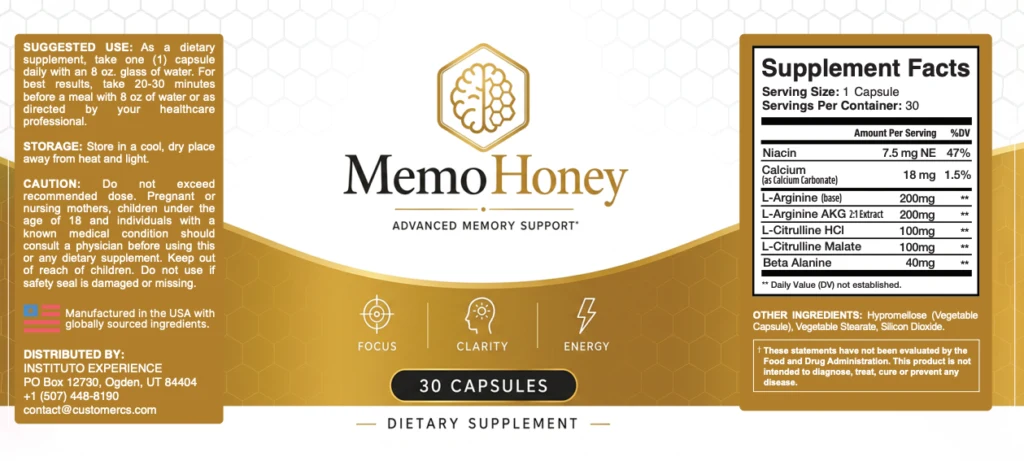
The standout fact is what is missing. Honey does not appear anywhere in the ingredient list. Neither does ginkgo, bacopa, phosphatidylserine, or any botanical with memory research behind it.
Every active ingredient is an amino acid, a B vitamin, or a mineral, the same categories found in pre-workout powders and circulation formulas. This is a workout-ingredient capsule wearing a memory costume.
The doses vs the research
Even where the ingredients are real, the amounts matter. Here is one capsule next to the smallest doses researchers actually used.
| Ingredient | One capsule | Smallest studied dose | What the studies were for |
|---|---|---|---|
| L-arginine (both forms) | 400 mg | Grams per day in trials (NIH ODS: “little to no effect” on vasodilation or blood flow even at these doses) | Exercise performance, not memory |
| L-citrulline (both forms) | 200 mg | 3,000-9,000 mg/day (Barkhidarian 2019 meta-analysis; NIH ODS: “little research support”) | Exercise/circulation, not memory |
| Beta-alanine | 40 mg | 1,600-6,400 mg/day (ISSN position stand) | High-intensity exercise, not memory |
| Niacin | 7.5 mg NE | 16 mg NE/day is the adult male RDA (NIH ODS) | Correcting deficiency, not boosting memory in well-fed adults |
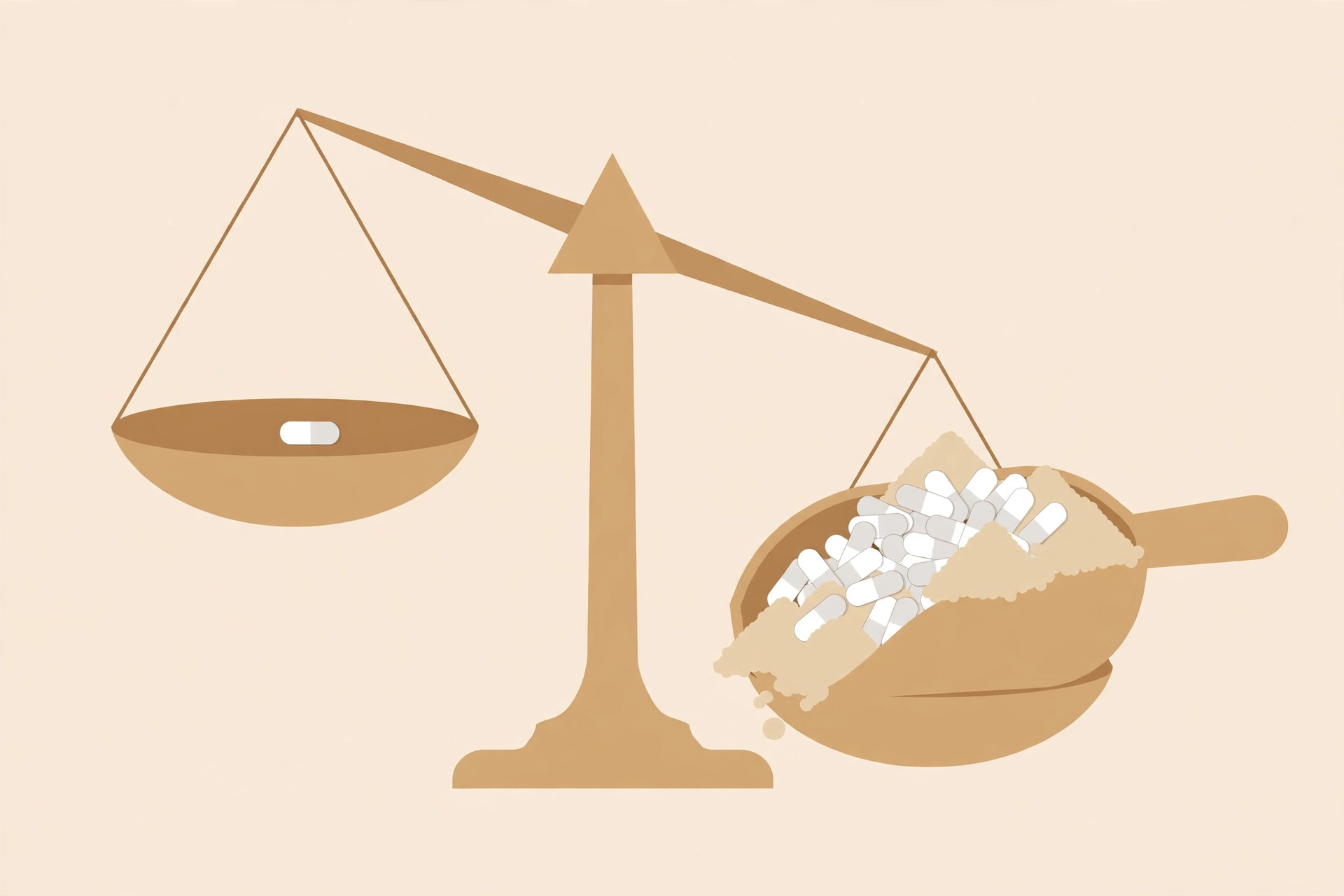
The pattern is consistent across all four ingredients: the capsule holds a small fraction of the research doses, and the research itself was about exercise performance, not memory. Arginine deserves a special note: even at the multi-gram doses researchers used, NIH's Office of Dietary Supplements found "little to no effect" on blood flow, which undercuts the page's whole nitric-oxide theory at any dose. NIH also adds a caution that applies here: the effects and safety of combinations of ingredients cannot be predicted from single-ingredient studies unless the combination itself was tested. This combination has not been tested.
Has anyone actually tested this product?
No. We found no published independent laboratory test of MemoHoney: no FDA lab analysis, no ConsumerLab report, no peer-reviewed test, and no USP or NSF certification listing under this name. That is itself a finding. The only public information about what is in the capsule comes from the seller's own label.
What independent labs have found in the memory-supplement category is not reassuring:
- The U.S. Government Accountability Office had memory supplements lab-tested (GAO-19-23R). Of three products tested by a vetted laboratory, one marketed ginkgo product contained no ginkgo at all, just an unknown substitute. A multi-ingredient memory product contained lower amounts than claimed for at least two of the three ingredients tested, and its ginkgo was also adulterated with unknown substitutes. GAO sent the results to the FDA and FTC.
- Researchers tested 10 memory/cognition supplements for hidden drugs (Cohen et al., Neurology: Clinical Practice, 2020). They found five unapproved pharmaceutical drugs across the products, including phenibut and picamilon. Several detected drugs were not declared on labels, several declared drugs were not detected, and 75% of declared quantities were inaccurate. Consumers could be exposed to up to four times pharmaceutical dosages.
- A JAMA study compared galantamine supplements against the prescription drug version (Cohen et al., JAMA, 2024). Nine of ten supplement brands had inaccurate amounts, ranging from under 2% to 110% of the label claim, and three were contaminated with bacteria. The generic drugs were 97.5-104.2% accurate with no contamination.
None of those studies tested MemoHoney itself. They describe the category it sells into, and they are the reason third-party certification matters. NCCIH puts the general warning bluntly: "What's on the label may not be what's in the product," noting the FDA has found prescription drugs hidden in products sold as dietary supplements. Lead researcher Dr. Pieter Cohen of Harvard Medical School and Cambridge Health Alliance urges buyers to look for certification seals from vetted independent bodies such as USP or NSF, and to talk to a doctor before taking any supplement. MemoHoney's page shows a "GMP Certified" badge and a "DOCTOR FORMULATED" icon, but no doctor is named and no independent lab or auditor is identified.
What the company tells you (and what it does not)
| What we checked | What we found |
|---|---|
| Distributor on the label | Instituto Experience, PO Box 12730, Ogden, UT 84404. The same distributor and PO box sit behind the Cognizil, Hawaiian Harmony, Retra Burn, Quiet Tone, and Max Vitalize pages we have reviewed; the pattern is now more than a dozen products deep. |
| Operating company | The label says Instituto Experience. The Returns page browser title says "Eagle Labs." No explanation of the relationship between the two names. |
| Street address | None anywhere. Only the PO box. |
| Phone | The label lists +1 (507) 448-8190. The Contact page lists a different number, SMS support at +1 (855) 889-3137. Inconsistent. |
| [email protected] on the page, the label, the FAQ, and the legal pages. No separate returns email. | |
| Legal pages | All five footer links (Terms, Privacy, Returns, Disclaimer, Contact) point to lp.institutoexperience.com.br, the distributor's Brazilian domain, not the MemoHoney site. The Terms admit testimonials "are exceptional results" that "do not reflect the typical purchaser's experience," and that the company "may in the future use actors and/or voice actors to present our products." |
| Checkout retailer | None named on the page; the order buttons are script elements, not links to a named processor. |
| Template artifacts | The testimonial section heading reads "See how MemoHoney is helping men regain their freedom, confidence and vitality - naturally," copy written for a men's-health product, not a memory capsule. The site's page locale is set to Brazilian Portuguese (pt_BR), and right-click is disabled by script. |
The transparency picture is mixed. The label itself is unusually complete for this family of products: every dose printed, no hidden blend, a distributor name and PO box. Everything around it is thinner: no street address, two inconsistent phone numbers, two company names with no explanation, legal pages hosted on a Brazilian domain, and recycled funnel copy.
Price, guarantee, and the fine print
There is no single-bottle option. The pricing block appears three times on the page with identical tiers:
| Tier | Per bottle | Total | "Savings" theater | Shipping |
|---|---|---|---|---|
| Try Two (2 bottles, 60 days) | $79 | $158 | $358 struck through, "YOU SAVE $200" | Added at checkout |
| Good Value (3 bottles, 90 days) | $69 | $207 | $537 struck through, "YOU SAVE $330" | Free US shipping |
| Best Value (6 bottles, 180 days) | $49 | $294 | $1,074 struck through, "YOU SAVE $780", "BIGGEST DISCOUNT" | Free US shipping |
That works out to about $2.63, $2.30, and $1.63 per day. The 3- and 6-bottle tiers add five bonus e-books with a claimed combined value of $255. No subscription or auto-ship: the FAQ says it is a one-time order with no automatic renewals, which is genuinely buyer-friendly.
The urgency machinery is not. Each pricing block carries a 30:00 countdown timer that restarts on every page load; when it hits zero it shows "Its your last chance, buy now." The page claims "96% Of Customers Orders 6 Bottles" and warns stock is limited due to small-batch production with imported ingredients. Artificial deadlines plus scarcity claims are the classic funnel playbook.
The guarantee is 60 days, but read the start date carefully. The homepage and FAQ promise 60 days "from the date of purchase" and ask you to try the product at least 30 days before requesting a refund. The Returns page starts the same 60-day clock "with the day the order has been delivered." Those are different dates, and shipping time eats the difference. The refund process is an email to support with "Refund Request" in the subject; there is no RMA number, no restocking fee, and no statement about who pays return shipping. The Privacy Policy notes a "video statement" may be submitted with a refund request, reviewed by support staff only.
Safety notes for older adults
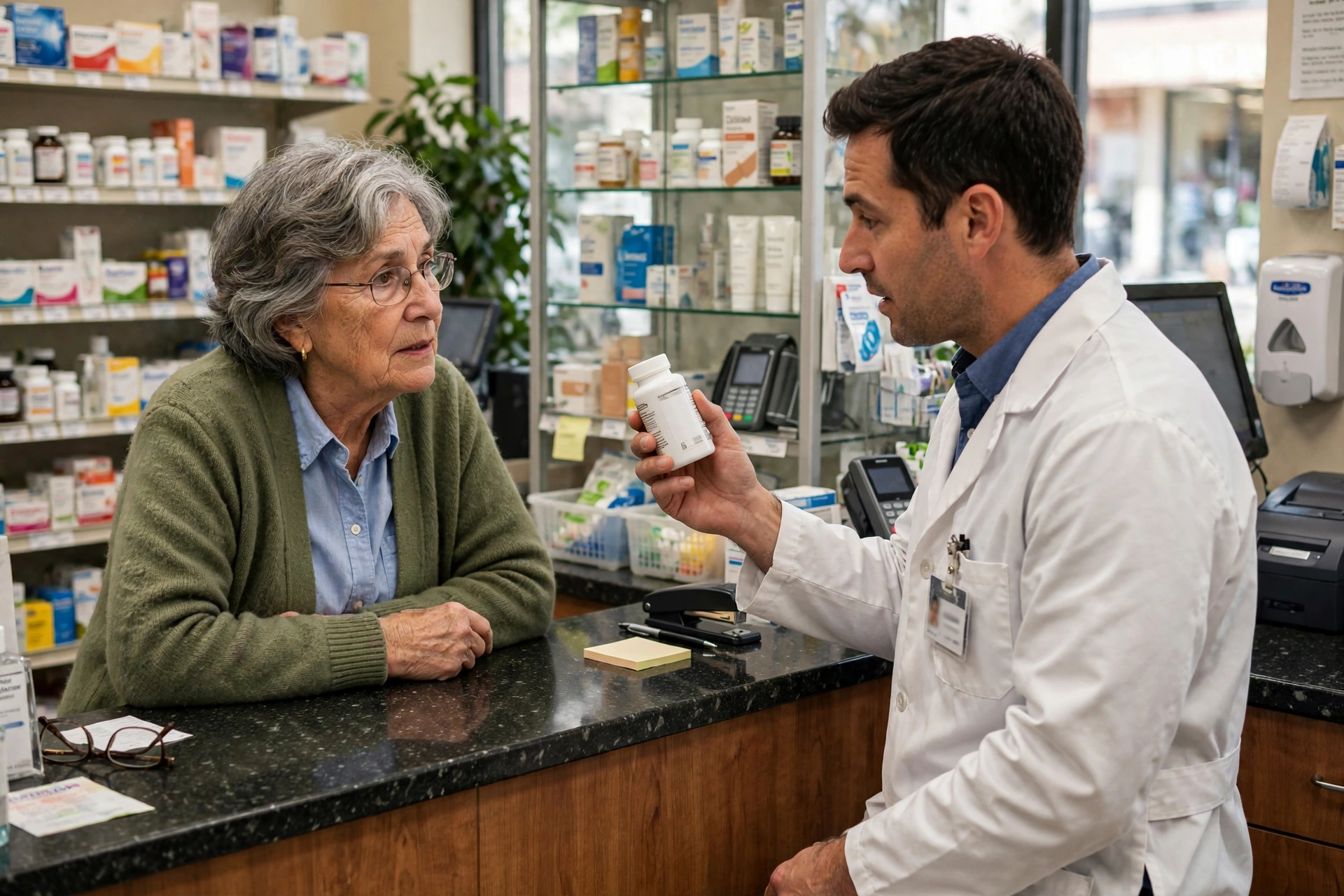
The arginine content is the main reason to check with your doctor or pharmacist first. Mayo Clinic advises that L-arginine can lower blood pressure and interact with blood pressure drugs, nitrates, and erectile-dysfunction drugs such as sildenafil. It also advises against L-arginine after a recent heart attack and notes it can trigger cold sores in susceptible people.
None of that means a single low-dose capsule is dangerous for a healthy adult. It means the "talk to your doctor" line on the label is doing real work here, especially for seniors who take heart or blood pressure medicines. Bring the actual label to the appointment, since the dose details matter.
Our supplement interactions guide explains how to check a new product against your prescriptions, and our dosage guide explains why the amount on the panel matters as much as the ingredient name.
The name game: MemoHoney, MindHoney, MemoVance
MemoHoney is the third similarly named memory-pitch capsule our site has reviewed. MindHoney Pro and MemoVance pitch the same kind of memory promise, and their labels carry the same amino-acid formula family (arginine, citrulline, beta-alanine, niacin) at the same small doses. Different names, different bottles, same capsule story.
Copycat naming cuts both ways. Separate web shops use the MemoHoney name with different formulas, and other "Memo" products (MemoPryl, MemoCept, MemoGenesis) are unrelated formulas entirely. If you compare products, compare the Supplement Facts panels, not the brand names. The page we reviewed is the version as it appeared in October 2026: the white bottle with the honey-gold "ADVANCED MEMORY SUPPORT" band, triple-repeated pricing blocks with 30:00 countdown timers, the "FDA APPROVED" badge, and legal pages on the distributor's Brazilian domain.
Bottom line
MemoHoney asks memory-seekers to pay a premium for an amino-acid capsule that research never connected to memory. The ingredients are real, the doses are small, the honey is missing, and no independent lab has verified the bottle. The strongest thing about the product is its name.
If memory is the concern, the honest move is a conversation with your doctor, not a checkout page. NCCIH is blunt: direct evidence that supplements prevent Alzheimer's or dementia is lacking, and supplements should never delay a memory checkup.
Sources
- NCCIH: 7 Things To Know About Dietary Supplements for Cognitive Function, Dementia, and Alzheimer's Disease
- NIH Office of Dietary Supplements: Dietary Supplements for Exercise and Athletic Performance
- Mayo Clinic: L-arginine
- NIH Office of Dietary Supplements: Niacin
- International Society of Sports Nutrition position stand: Beta-alanine (PMC4501114)
- Barkhidarian et al. 2019: Effects of L-citrulline on vascular function (meta-analysis, PMC6369322)
- U.S. Government Accountability Office: Memory Supplements, Results of Testing for Selected Supplements (GAO-19-23R)
- Cohen et al. 2020: Five Unapproved Drugs Found in Cognitive Enhancement Supplements (Neurology: Clinical Practice; PubMed 34484905)
- Cohen et al. 2020 full text (PMC8382366)
- Cohen et al. 2024: Accuracy of Labeling of Galantamine Generic Drugs and Dietary Supplements (JAMA)
- NCCIH: Using Dietary Supplements Wisely
Review note: This review covers the MemoHoney page as it appeared in October 2026: the white bottle with the honey-gold "ADVANCED MEMORY SUPPORT" band, triple-repeated pricing blocks with 30:00 countdown timers, the "FDA APPROVED" badge, and legal pages on the distributor's Brazilian domain. Lookalike sites under the same product name exist and may show different content; the content fingerprint above outlasts the domain. The seller's page URL is research material and is never published or linked here.
Fact-checked by the SupplementDecoded Research Editorial Team