
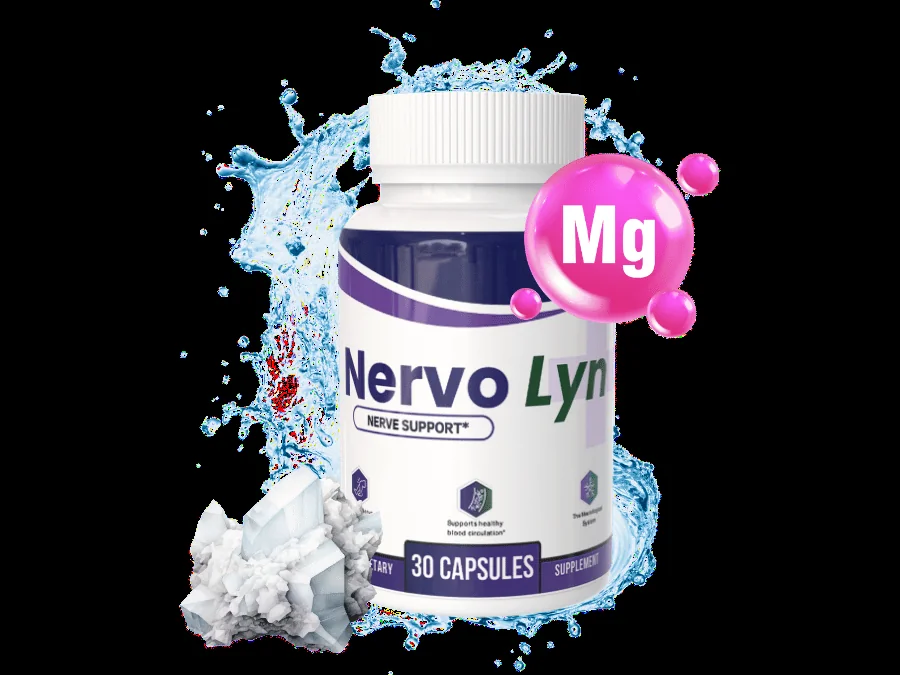
Table of ContentsShow ChaptersHide Chapters
Medical Disclaimer
This article is for informational purposes only and does not constitute medical advice. Always consult with a qualified healthcare professional before starting any new supplement regimen.
Read our Medical / Expert Review Policy and Medical Disclaimer for details.
Key takeaways
- NervoLyn is sold as a nerve-support capsule for tingling, numbness, and poor circulation, at $158 to $294 for 2 to 6 bottles.
- The page lists one formula in its copy (a 575 mg proprietary blend of alpha lipoic acid, butcher's broom, L-carnitine, turmeric, and CoQ10, plus 80 mg magnesium glycinate) and a different formula in its own ingredients graphic (which adds bacopa and rhodiola and drops alpha lipoic acid and L-carnitine). There is no Supplement Facts panel anywhere to settle the question.
- Because every blend ingredient's amount is hidden, none of the "scientifically-selected" claims can be checked against the trial doses. The strongest-studied ingredient, alpha lipoic acid, was tested at 600 mg a day; the whole blend is 575 mg.
- The refund terms contradict the sales page: the FAQ says you do not need to return the bottles, while the refund policy requires shipping every bottle back at your own expense. The 60-day guarantee also ends before the page's own recommended 90 to 180 days of use.
- No independent lab test of NervoLyn has been published, and the page's References link is broken, so the "most researched" claim cannot be checked.
Contents
- The short verdict
- What the page promises
- One product, two different formulas
- Claim vs evidence, ingredient by ingredient
- The dose math problem
- Has anyone actually tested this product?
- What it costs, and what the guarantee really says
- Who is actually behind it
- What older adults should know first
- Sources
The short verdict
NervoLyn is a nerve-support capsule sold online to older adults dealing with tingling, numbness, and cold hands and feet. The sales page keeps its health claims modest and carries the required FDA disclaimer, which is more than many sellers manage.
But the product has a problem no disclaimer can fix. The page describes one formula in its written copy and a different formula in its own ingredients graphic, and it publishes no Supplement Facts panel anywhere, so a buyer cannot know what is actually in the bottle. Every active ingredient sits inside a 575 mg proprietary blend with no individual amounts disclosed, which means none of the page's research claims can be checked against the doses used in real trials.
For a product whose whole pitch is "scientifically-selected nutrients," the science cannot be selected, weighed, or verified. That is the finding of this review.
What the page promises
The headline reads "CALM YOUR NERVES & MOVE WITH CONFIDENCE AGAIN." The page opens with an unattributed statistic: "Over 50 million Americans over 45 quietly struggle with tingling, numbness, and weak grip." No source is given for that number, and the page's References link is broken (more on that below), so it cannot be checked.
The promised results are structure-function claims, each marked with an asterisk: supports healthy nerve function and signaling, promotes healthy blood circulation to the hands and feet, and helps the buyer "sleep through the night without tingling or discomfort." The page says most customers notice early improvements in 3 to 4 weeks, with fuller results building over 8 to 12 weeks, and adds that "clinical protocols suggest at least 90-180 days of daily use."
Credit where it is due: the FAQ answers "Will this treat my neuropathy or a diagnosed nerve condition?" with a clear statement that the product is not intended to diagnose, treat, cure, or prevent any disease, and the footer carries the standard FDA non-evaluation statement. The page does not claim the product itself is "clinically proven," names no endorsing doctors, and states "No Subscriptions - No Auto-Billing." The 60-day money-back guarantee is stated plainly on the sales page.
So the claims are soft. The evidence behind them is where the trouble starts.
One product, two different formulas
The page's written copy lists a simple formula: 80 mg of magnesium glycinate (19% of the daily value) plus a 575 mg proprietary blend of five ingredients: alpha lipoic acid, butcher's broom root extract, L-carnitine, turmeric (95% curcuminoids), and coenzyme Q10 (as ubiquinone). One capsule a day, 30 capsules per bottle.
But the page's own ingredients graphic, the illustrated panel meant to showcase the formula, lists a different six-ingredient lineup: magnesium glycinate, bacopa monnieri, rhodiola rosea, turmeric extract, coenzyme Q10, and butcher's broom. Bacopa and rhodiola appear here and nowhere else on the page. Alpha lipoic acid and L-carnitine, the two ingredients the copy discusses most, are missing from the graphic entirely.
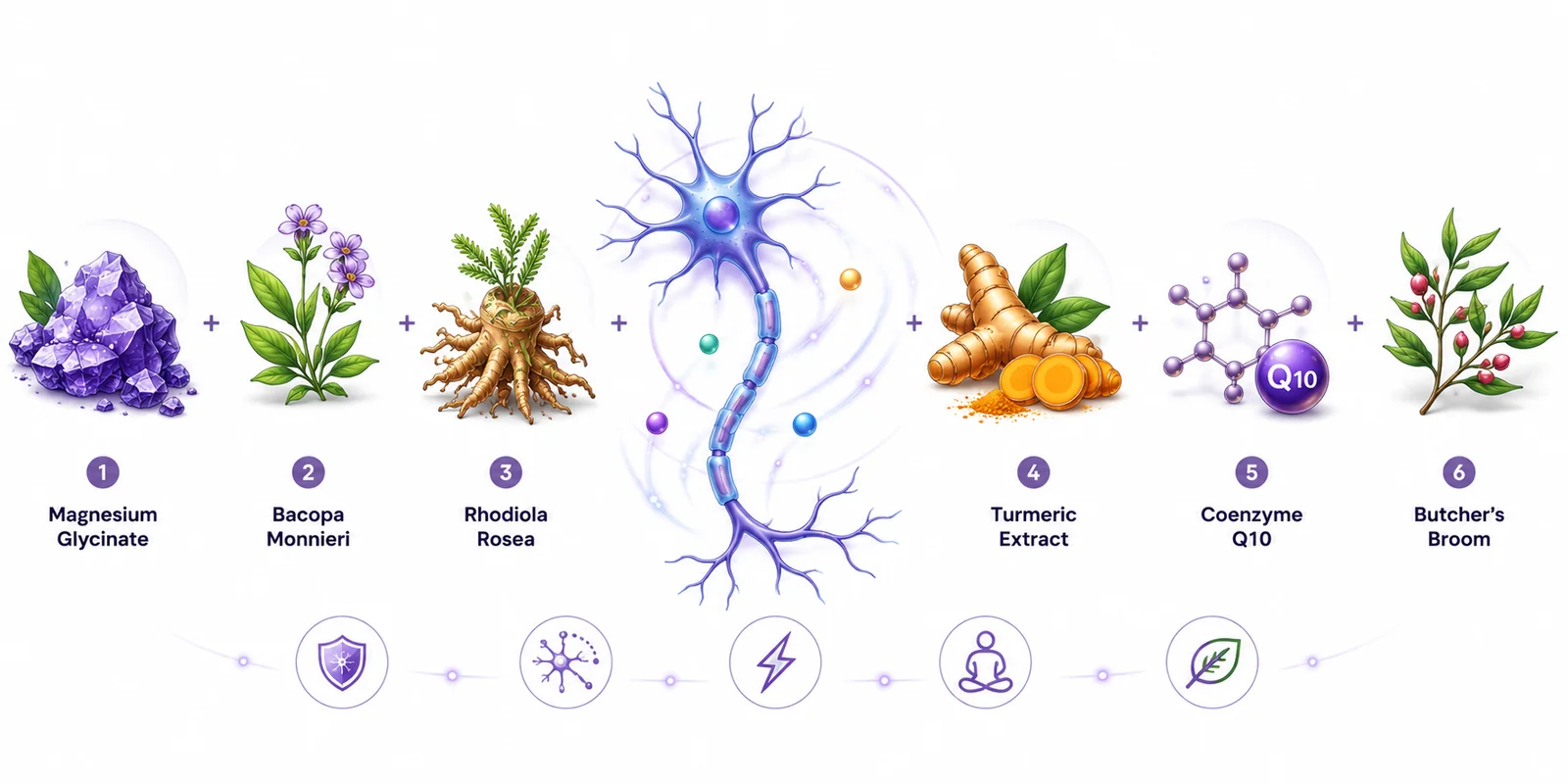
Which list is in the bottle? There is no way to know, because the page publishes no Supplement Facts panel or label image anywhere. Not in a lightbox, not in the footer, nowhere. The FAQ even tells readers that their doctor can "review the full ingredient list (available on the supplement facts label)." That label does not appear to exist on the site.
Small inconsistencies add up. The bottle renders spell the brand "Nervo Lyn" (two words) while the site calls it "NervoLyn." The 2-bottle tier is labeled "30 Day Supply, 2 Bottles," which is internally inconsistent: at one capsule a day, two 30-capsule bottles are a 60-day supply (the 3- and 6-bottle tiers are correctly labeled 90 and 180 days). None of these alone proves anything about the capsules. Together, they show a page assembled without much care for accuracy, which is not what a buyer wants to see from a health product.
Claim vs evidence, ingredient by ingredient
The page calls these "scientifically-selected nutrients" and "NATURE'S MOST RESEARCHED NERVE & CIRCULATION SUPPORT." Here is what published research actually says about each named ingredient. Every trial below was run in people with diagnosed diabetic neuropathy, not in the general "tingling hands" population the page targets, and every dose comparison is approximate, because the page hides all individual amounts inside its 575 mg blend.
| Ingredient (as listed in copy) | What the trials actually tested | Verdict |
|---|---|---|
| Alpha lipoic acid | SYDNEY 2 trial: 181 patients with diabetic polyneuropathy, 600, 1200, or 1800 mg/day for 5 weeks. Symptom scores fell about 51% on 600 mg vs 32% on placebo; 600 mg judged the best risk-benefit dose. | Real evidence, but only in diagnosed diabetic neuropathy, and the 600 mg trial dose alone exceeds the entire 575 mg blend. |
| L-carnitine | The positive neuropathy trial used acetyl-L-carnitine, a different compound, at 1000 mg three times daily for 52 weeks in about 1,257 patients. Pain improved in a subgroup; nerve conduction did not. | Form switch: the page lists plain L-carnitine, for which we found no neuropathy trials. The acetyl form's 3000 mg/day trial dose dwarfs the whole blend. |
| Butcher's broom | Studied for chronic venous insufficiency (leg swelling and heaviness), not nerve pain: 166 women, ruscus extract for 12 weeks, reduced leg volume vs placebo. | Wrong condition. No published trial tests butcher's broom for neuropathy. |
| Turmeric (95% curcuminoids) | One small 8-week trial of 80 mg/day nano-curcumin in 80 patients reported reduced neuropathy scores vs placebo; a later 16-week trial in 97 patients found no difference in pain, disability, or exam scores. NCCIH: not enough evidence to conclude turmeric helps any health condition. | Mixed and unsettled. Two small trials point in opposite directions. |
| Coenzyme Q10 | One small 12-week trial (49 patients, 400 mg/day) reported improved symptom scores; a second trial found no improvement in signs and symptoms. | Mixed, small, and contradictory. |
| Magnesium glycinate, 80 mg | Magnesium is essential for nerve function, but we found no trial testing magnesium as a neuropathy treatment. 80 mg is a modest dose (19% of the daily value). | Supportive nutrient, not a tested nerve treatment. |
| Bacopa, rhodiola (graphic only) | These appear only in the page's ingredients graphic, with no doses and no cited evidence on the page. | Unverifiable. The broken References link means the page's research claims cannot be checked at all. |
- Alpha lipoic acid is the strongest ingredient on paper, and it still does not fit. The SYDNEY 2 trial is genuine randomized evidence, but it studied diagnosed diabetic polyneuropathy for 5 weeks at 600 mg a day, and it found dose-dependent nausea, vomiting, and vertigo at higher doses. NervoLyn's entire proprietary blend is 575 mg, so even if alpha lipoic acid were the only ingredient in the blend, it would fall short of the studied dose. And the page cannot say how much is in there, because the blend hides every amount.
- The carnitine on the label is not the carnitine in the trial. This is a common supplement-industry switch. The published neuropathy evidence is for acetyl-L-carnitine, a distinct compound, at 3000 mg a day for a full year. The page lists plain L-carnitine, for which we found no neuropathy trials, at an undisclosed amount. A buyer reading "carnitine" and thinking of the published trial is being pointed at the wrong molecule.
- Butcher's broom is a leg-vein ingredient in a nerve-pain pitch. Its published trial measured leg swelling in women with chronic venous insufficiency. That is a circulation-adjacent finding, but it is not a neuropathy finding, and the page presents it inside a nerve-support formula without that distinction.
- The turmeric evidence cancels itself out. The 2019 nano-curcumin trial (80 patients, 8 weeks) reported improved neuropathy scores vs placebo, but the 2025 trial (97 patients, 16 weeks, same 80 mg daily dose) found no difference in pain, disability scores, or clinical exam results. One small positive, one negative. NCCIH's overall position is that the evidence is not enough to conclude turmeric helps any health condition. NCCIH also warns that highly bioavailable curcumin formulations have been linked to liver-injury reports, and that curcumin can interact with blood thinners.
The dose math problem
The proprietary blend is the hinge of the whole pitch, and it makes the pitch uncheckable. Consider the arithmetic the page invites but cannot complete:
- The blend totals 575 mg across five ingredients, an average of 115 mg each if split evenly (blends are rarely even).
- Alpha lipoic acid's trial dose was 600 mg a day. The entire blend is smaller than that one dose.
- Acetyl-L-carnitine's trial dose was 3000 mg a day, more than five times the entire blend, and the product lists the plain form anyway.
- CoQ10's positive trial used 400 mg a day, over two-thirds of the blend by itself.
A proprietary blend is legal, but it means the buyer is asked to trust that "scientifically-selected" amounts are inside a capsule that physically cannot hold the studied amounts of even two of the named ingredients at once. The page could resolve this in one line by publishing the per-ingredient amounts. It does not.
Has anyone actually tested this product?
No. As of October 2026, we found no published independent laboratory test of NervoLyn itself: no ConsumerLab review, no USP or NSF certification listing, and no FDA laboratory finding naming it. The absence of any independent test is itself a finding, because the page leans on research language ("most researched," "scientifically-selected") while offering nothing verifiable about what is in its own bottle.
Seller materials claim the product is "third-party tested," but they name no laboratory, display no certification seal, and publish no certificate of analysis. A bare "third-party tested" claim with no named certifier and no document is unverifiable. As Harvard Medical School researcher Dr. Pieter Cohen has advised, buyers should look for certification seals from vetted independent third parties such as USP or NSF International, and talk to their doctor before taking any supplement.
What published lab testing of the same category has found is worth knowing, because it is the reason independent testing matters:
- An analysis of the FDA's tainted-supplements database covering 2007 to 2016 found 776 adulterated dietary supplements (746 distinct products), and in 97.6% of cases the unapproved drug ingredients were not declared on the label (Tucker et al., JAMA Network Open, 2018).
- A 2024 JAMA analysis of galantamine brain supplements found 9 of 10 products inaccurately labeled, with actual contents ranging from under 2% to 110% of the label claim, and 3 of 10 contaminated with bacteria.
- In October 2026, the FDA flagged a product called Ultra Bon, marketed for arthritis and pain, after lab analysis found hidden diclofenac, a prescription-strength NSAID with heart, stroke, and bleeding risks.
None of these tested NervoLyn. They are category context, and they are the reason a proprietary blend with no published certificate of analysis asks for more trust than the evidence supports. Cleveland Clinic's position on peripheral neuropathy is also relevant: treatment focuses on the underlying cause, first-line options are prescription medicines and non-drug strategies, and no dietary supplement is listed as a recommended treatment.
What it costs, and what the guarantee really says
The pricing section is fully visible on the page. Three tiers, one-time purchase, no subscription:
| Tier | Price | Per bottle | Per day (1 capsule/day) | Struck-through "regular" price |
|---|---|---|---|---|
| 2 bottles (labeled "30 Day Supply") | $158 | $79 | $2.63 | $358 |
| 3 bottles ("Popular," 90-day) | $207 | $69 | $2.30 | $537 |
| 6 bottles (180-day) | $294 | $49 | $1.63 | $1,074 |
Free US shipping applies only to the 3- and 6-bottle orders. The struck-through anchors imply a regular price of $179 per bottle, though no evidence is shown that the product ever sold at that price.
The 60-day money-back guarantee is counted from the date of purchase, not delivery. Two problems follow. First, the page itself says "clinical protocols suggest at least 90-180 days of daily use," which means the guarantee expires before the page's own recommended course is finished. Second, the terms contradict the sales pitch: the FAQ says "You don't even need to return the bottles," while the refund policy requires the buyer to contact support, obtain an authorized return address, and ship every bottle (empty, full, and partial) back via USPS to a warehouse in Aurora, Colorado, at the buyer's own expense, with a tracking number and full order details. Missing bottles or details can mean a partial refund or none.
On urgency: the page shows "LIMITED STOCK - ONLY 287 UNITS REMAINING." That count did not change after a full page reload, so it is not a live inventory figure. There is no countdown timer and no pop-up discount, and the page states plainly that there is no subscription and no free trial.
Who is actually behind it
The page is thin on company identity. The terms say the site is owned and operated by "NervoLyn," with no named people. The mobile-messaging terms name a different operator, "Nature's Formulas." The contact page gives a phone number (+1 720 619 8477) that differs from the number in the terms and refund pages (+1 720 513 2923). The footer carries an Orlando, Florida address, while refunds ship to 19655 E 35th Dr, Suite 100, Aurora, Colorado, the same Aurora fulfillment address used by a whole family of similarly structured supplement funnels.
The checkout is handled by BuyGoods, a Delaware retailer that disclaims endorsement of the product and its claims. Disputes are governed by the laws of Barbados, with binding arbitration and a class-action waiver. The footer includes an affiliate-signup link, which means the product is promoted through affiliate marketers. The page claims "Over 25,000 Americans have tried NervoLyn" and shows six five-star testimonials (first name, last initial, city), each marked "Verified Purchase." No reviewer is verifiable, no third-party review platform is cited, and the legal pages contain no admission about whether testimonials are typical or compensated.
No FDA warning letter and no FTC enforcement action naming NervoLyn was found as of October 2026. That is a neutral fact, not an endorsement: most products in this category never attract an agency action, and the FDA generally acts after products reach the market rather than approving them beforehand.
What older adults should know first
- Get the cause diagnosed before buying a bottle. Tingling and numbness have many treatable causes, including vitamin B12 deficiency, which affects an estimated 5 to 20 percent of older adults and can cause permanent nerve damage if missed. Cleveland Clinic notes that a proper neuropathy workup includes B12 testing. A supplement cannot substitute for that workup.
- Talk to your doctor or pharmacist about interactions. Curcumin has blood-thinning activity in laboratory research, so anyone on warfarin, clopidogrel, aspirin, or other blood thinners should check first (our guide on turmeric and warfarin explains why). Alpha lipoic acid can affect blood sugar, which matters for readers on diabetes medicines. Our supplement interactions guide covers the common clashes.
- Do not stop prescribed treatment for a supplement. Nerve pain medicines exist with real trial evidence behind them. Nothing on this page shows NervoLyn was tested against them, alongside them, or at all. Related reading: our reviews of Quiet Nerves, NeuroPulse Pro, and Neuralisse, three more nerve-support pitches we have examined the same way.

Sources
- NCCIH: Turmeric (reviewed April 2025; not enough evidence to conclude turmeric benefits any health condition; liver-injury reports with highly bioavailable curcumin; herb-drug interaction warning)
- NCCIH: Type 2 Diabetes and Dietary Supplements (alpha-lipoic acid evidence summary)
- NIH Office of Dietary Supplements: Magnesium fact sheet (nerve function role; no neuropathy-treatment trials identified)
- NIH Office of Dietary Supplements: Vitamin B12 fact sheet (deficiency causes numbness and tingling; 5 to 20 percent of older adults affected)
- FDA: Dietary Supplements (manufacturers responsible for safety and labeling; FDA acts against adulterated or misbranded products after marketing)
- FDA medication health fraud notification: Ultra Bon (October 2026; hidden diclofenac found by FDA lab analysis)
- Cleveland Clinic: Peripheral Neuropathy (treat the underlying cause; B12 workup; no supplement listed as recommended treatment)
- Ziegler et al., Diabetes Care 2006 (SYDNEY 2) (alpha lipoic acid 600 mg/day in diabetic polyneuropathy; PMID 17065669)
- Sima et al., Diabetes Care 2005 (acetyl-L-carnitine 1000 mg three times daily in diabetic peripheral neuropathy; PMID 15616239)
- Vanscheidt et al., Arzneimittelforschung 2002 (butcher's broom extract in chronic venous insufficiency, not neuropathy; PMID 12040966)
- Asadi et al., Complement Ther Med 2019 (80 mg/day nano-curcumin, 8 weeks, reduced neuropathy scores vs placebo in 80 patients; PMID 30935539)
- Mansour et al., Nutr J 2025 (80 mg/day nanocurcumin, 16 weeks, no difference vs placebo in pain, disability, or exam scores)
- Tucker et al., JAMA Network Open 2018 (776 adulterated supplements in FDA database 2007-2016; 97.6% with undeclared ingredients)
- Cohen et al., JAMA 2024 (galantamine supplements: 9 of 10 inaccurately labeled, 3 of 10 contaminated)
- Inflammopharmacology 2022 (palmitoylethanolamide 600 mg/day in diabetic peripheral neuropathic pain; PMID 36057884)
- Nutrients 2023 (palmitoylethanolamide meta-analysis, 11 trials; PMID 36986081)
- Harvard Health (Dr. Pieter Cohen) (look for USP/NSF certification seals; talk to your doctor before taking any supplement)
Review note: This review covers the page variant as it appeared in October 2026, the version showing the "CALM YOUR NERVES & MOVE WITH CONFIDENCE AGAIN" headline, the 575 mg proprietary blend in the written copy, and the contradictory six-ingredient graphic. Lookalike sites using the NervoLyn name exist and may show different content.
Fact-checked by the SupplementDecoded Research Editorial Team