
Table of ContentsShow ChaptersHide Chapters
Medical Disclaimer
This article is for informational purposes only and does not constitute medical advice. Always consult with a qualified healthcare professional before starting any new supplement regimen.
Read our Medical / Expert Review Policy and Medical Disclaimer for details.
Key takeaways: Psyllium husk is a soluble, gel-forming fiber with the best trial evidence of any fiber supplement. A 2025 pooled analysis of 41 randomized trials found it lowers LDL cholesterol by about 8 to 9 mg/dL. Blood sugar benefits concentrate in people with type 2 diabetes. The effect on blood pressure is small. The safety rules matter most after 65: a full glass of water with every dose, at least 2 hours away from prescription medicines, and a low starting dose.
Contents
- The verdict for people over 65
- What psyllium actually is
- Cholesterol: modest, real LDL lowering
- Blood sugar: helps when glucose is high
- Blood pressure: a small systolic dip
- Regularity: why it helps constipation
- How to take it after 65
- Safety rules for older adults
- What psyllium does not do
- Sources
The verdict for people over 65
Psyllium husk is one of the few supplements where the marketing roughly matches the research. It is a bulk-forming fiber that eases occasional constipation, and large pooled analyses show it modestly lowers LDL cholesterol, fasting blood sugar, and systolic blood pressure.
The benefits are real but small, and they come with real rules. Take it with a full glass of water, keep it at least 2 hours away from prescription medicines, start at a low dose, and talk to your doctor first if you have diabetes, take blood pressure medicine, or have any trouble swallowing.
What psyllium actually is
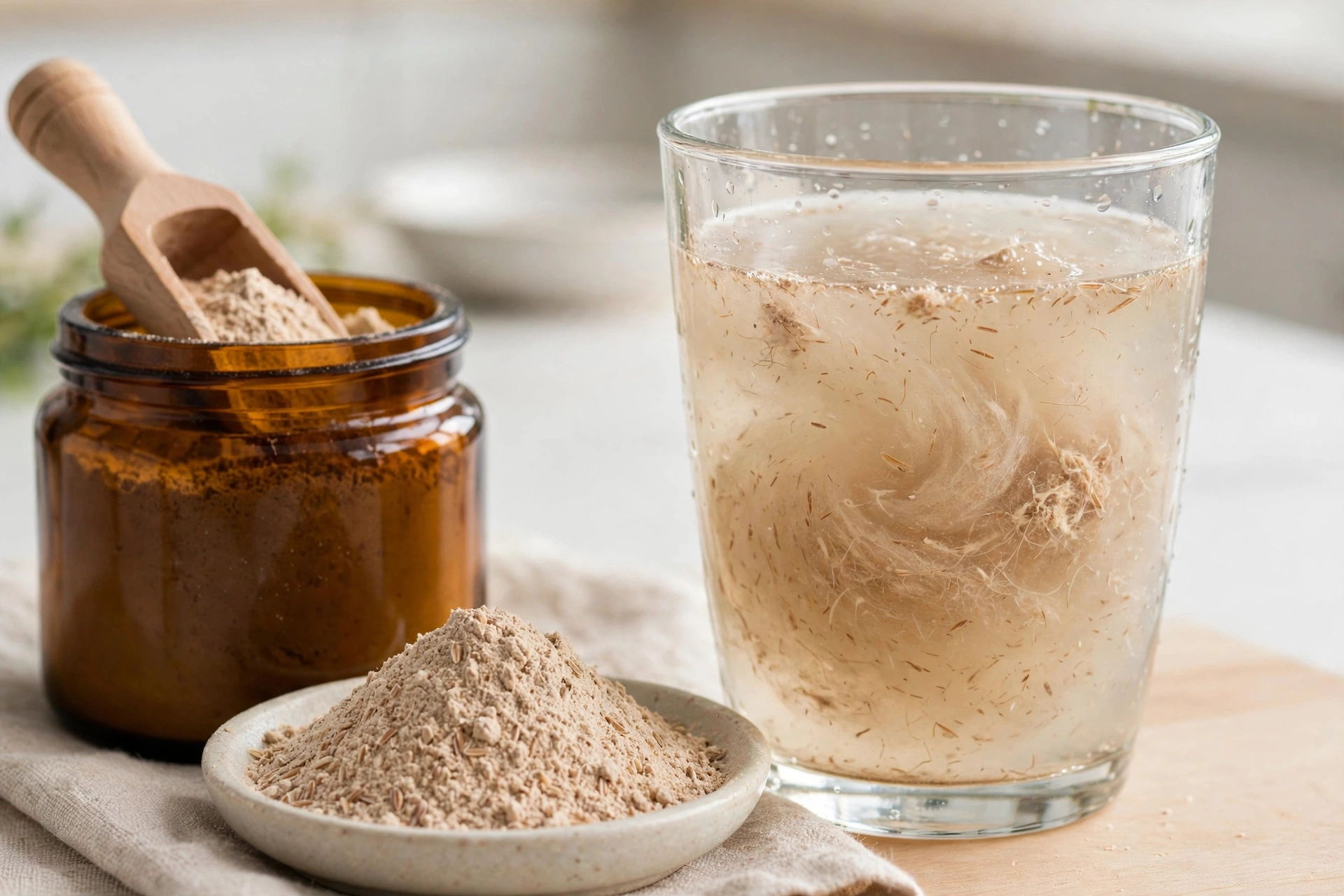
Psyllium is the husk of the seeds of Plantago ovata, a plant grown mostly in India. It is mostly soluble, viscous fiber, which means it absorbs water and forms a gel in the gut.
It is sold as powder, capsules, and chewable tablets, often under familiar store-brand names. Capsules typically hold about half a gram of husk each, so the dose in powder form is usually larger.
Cholesterol: modest, real LDL lowering
A 2025 systematic review pooled 41 randomized controlled trials with 2,049 participants. It found psyllium lowered LDL ("bad") cholesterol by an average of 8.55 mg/dL and total cholesterol by 9.05 mg/dL compared with control.
HDL ("good") cholesterol and triglycerides did not change significantly. So the benefit is specific: LDL down a little, the rest of the lipid panel mostly untouched.
| What is claimed | What the trials show |
|---|---|
| Psyllium lowers cholesterol | True, but modest: about 8 to 9 mg/dL of LDL in pooled trials |
| It raises good cholesterol | No significant effect on HDL in the pooled analysis |
| It lowers triglycerides | No significant effect on triglycerides |
| It replaces a statin | Not supported; the effect is a fraction of what statins achieve |
The FDA allows products to carry a specific claim: diets low in saturated fat and cholesterol that include 7 grams of soluble fiber per day from psyllium husk may reduce the risk of heart disease by lowering cholesterol. That is an unusual level of official backing for a fiber product.
If you take a statin for cholesterol, psyllium does not replace it. Our guide on CoQ10 and statin muscle pain covers what is and is not supported for people on cholesterol medicine.
Blood sugar: helps when glucose is high
The glucose evidence is honest in an interesting way. A 2015 meta-analysis of 35 randomized trials found that in people being treated for type 2 diabetes, psyllium taken before meals lowered fasting blood glucose by 37.0 mg/dL and HbA1c by 0.97 percentage points.
In people with normal blood sugar, the same analysis found no significant glucose lowering. The benefit was proportional: the worse the baseline control, the larger the improvement.
A newer 2024 analysis of 19 trials and 962 adults reported smaller but still significant average effects: fasting blood sugar down 6.89 mg/dL, HbA1c down 0.75 points, and improved insulin resistance scores.
This matters after 65 because many people in this age group take diabetes medicines. Psyllium adds a glucose-lowering effect on top of those drugs, so blood sugar should be monitored and the medicine plan reviewed with a doctor.
Blood pressure: a small systolic dip
A 2022 systematic review pooled 14 randomized trials with 802 participants and found psyllium lowered systolic blood pressure by 2.24 mmHg on average.
Diastolic pressure did not change significantly. A reduction of about 2 points in systolic pressure is real but small, and it is not a treatment for high blood pressure.
Regularity: why it helps constipation
Psyllium is a bulk-forming laxative. It soaks up water, swells, and makes stool softer and bulkier, which helps it pass more easily. It does not force the colon to contract the way stimulant laxatives do.
Constipation is one of the most common complaints in older adults. The Mayo Clinic notes that as people age, the muscles of the digestive tract become less active, and medicines for pain, blood pressure, and other conditions are common causes.
Fiber guidelines from the National Institute of Diabetes and Digestive and Kidney Diseases suggest adults aim for 22 to 34 grams of fiber per day, and recommend adding fiber gradually so the body adjusts. Read our breakdown of the 2026 fiber trend for how psyllium fit into the wider conversation.

How to take it after 65
- Start low and go slow. Begin with one dose per day and increase gradually over one to two weeks if you tolerate it. Sudden jumps cause gas and bloating, which the Mayo Clinic warns can be unpleasant in the first days.
- Always use a full glass of liquid. Mix powder with at least 8 ounces (one full glass) of water or another drink, stir, and drink it promptly before it thickens. This is the most important safety rule on the product label.
- Take capsules one at a time, with water. The label directions say to swallow capsules one at a time with 8 ounces of liquid. Do not swallow the dry powder.
- Time it away from medicines. Fiber can blunt how well other medicines are absorbed. The FDA label directions say to take psyllium at least 2 hours before or after any prescription medicine taken by mouth. See our supplement interactions guide for why timing matters.
- Give it a few days. Regularity usually takes several days of consistent use. Do not raise the dose because day one felt like nothing.
- Check the dose on the label. Most cholesterol and blood sugar trials used around 10 grams of psyllium per day in divided doses, often before meals. A label dose of one rounded teaspoon up to three times daily gets you into that range.
Safety rules for older adults
- Water is not optional. Taking psyllium without enough fluid can make it swell in the throat or esophagus and cause choking. The FDA label carries a formal choking warning, and Cleveland Clinic dietitians warn that fiber supplements without enough fluid can actually make constipation worse.
- Do not use it if swallowing is difficult. The label says not to take the product if you have difficulty swallowing. Seek immediate medical attention for chest pain, vomiting, or trouble swallowing or breathing after taking it.
- Medicine timing needs a routine. Many older adults take several morning prescriptions. Place psyllium at a fixed time of day at least 2 hours away from those medicines, and ask your pharmacist to review the schedule.
- Fluid restrictions come first. Some heart failure or kidney conditions require limiting fluids. Because psyllium demands extra liquid with every dose, talk to your doctor before starting if you are on a fluid limit.
- Allergies are possible. The label warns the product may cause an allergic reaction in people sensitive to inhaled or ingested psyllium.
- Call your doctor first if something changed. The label advises asking a doctor before use if there has been a sudden change in bowel habits lasting 2 weeks, or if you have abdominal pain, nausea, or vomiting. Stop use and ask a doctor if constipation lasts more than 7 days or if rectal bleeding occurs.
What psyllium does not do
- It does not lower triglycerides or raise HDL cholesterol, per the 41-trial pooled analysis.
- It has not been shown to prevent heart attacks or strokes; the trials measured blood numbers, not hard outcomes.
- It does not lower blood sugar in people whose glucose is already normal.
- It is not a weight-loss supplement; none of the pooled analyses found meaningful weight effects.
- It does not work instantly, and more is not better: the pooled cholesterol analysis found no consistent dose-response advantage from going higher.
One more honest note: psyllium helps occasional constipation. Constipation that has lasted months, comes with weight loss or bleeding, or started suddenly needs a doctor visit, not a fiber aisle solution.
Sources
- https://pmc.ncbi.nlm.nih.gov/articles/PMC12690803/ - Psyllium supplementation and lipid profiles: systematic review and dose-response meta-analysis of 41 randomized controlled trials, 2,049 participants (Genes & Nutrition, 2025). LDL cholesterol down 8.55 mg/dL, total cholesterol down 9.05 mg/dL; no significant change in HDL or triglycerides.
- https://pubmed.ncbi.nlm.nih.gov/26561625/ - Psyllium fiber improves glycemic control proportional to loss of glycemic control: meta-analysis of 35 randomized trials (American Journal of Clinical Nutrition, 2015). In type 2 diabetes, fasting glucose down 37.0 mg/dL and HbA1c down 0.97%; no significant lowering in euglycemic subjects.
- https://pubmed.ncbi.nlm.nih.gov/38844885/ - Effect of psyllium on fasting blood sugar, HbA1c, HOMA-IR, and insulin: systematic review and meta-analysis of 19 randomized controlled trials, 962 participants (BMC Endocrine Disorders, 2024). Fasting blood sugar down 6.89 mg/dL, HbA1c down 0.75%.
- https://pmc.ncbi.nlm.nih.gov/articles/PMC11521634/ - Effect of psyllium consumption on blood pressure: systematic review and dose-response meta-analysis of 14 randomized controlled trials, 802 participants (2022). Systolic blood pressure down 2.24 mmHg; diastolic change not significant.
- https://dailymed.nlm.nih.gov/dailymed/fda/fdaDrugXsl.cfm?setid=4ed99635-9cec-4ce6-976f-76878a348c74 - Psyllium fiber powder FDA label (DailyMed, U.S. National Library of Medicine): choking warning, take with at least 8 ounces of liquid, at least 2 hours before or after prescription medicines, start with 1 dose per day, up to 3 times daily, and the FDA heart-disease claim wording for 7 grams of soluble fiber per day from psyllium husk.
- https://dailymed.nlm.nih.gov/dailymed/lookup.cfm?setid=32a2ffe1-8785-4241-847b-8b139d9b803d&version=5 - Psyllium husk capsule FDA label (DailyMed, U.S. National Library of Medicine): allergy alert, ask-a-doctor conditions, stop-use conditions, 0.52 g husk per capsule.
- https://www.mayoclinic.org/diseases-conditions/constipation/symptoms-causes/syc-20354253 - Constipation symptoms, causes, medicines that cause constipation, and when to see a doctor (Mayo Clinic).
- https://mcpress.mayoclinic.org/healthygut/understanding-constipation-why-it-happens-and-how-to-treat-it/ - Understanding constipation (Mayo Clinic Press): aging and slower digestive-tract muscles as a cause.
- https://health.clevelandclinic.org/fiber - Fiber: what it is and what it does (Cleveland Clinic): soluble fiber helps constipation, stabilizes blood sugars, lowers cholesterol.
- https://health.clevelandclinic.org/how-to-get-rid-of-constipation - Home remedies for constipation (Cleveland Clinic): start fiber supplements slowly, increase fluids, or constipation may worsen.
- https://www.niddk.nih.gov/health-information/digestive-diseases/constipation/eating-diet-nutrition - Eating, diet, and nutrition for constipation (NIDDK, National Institutes of Health): 22 to 34 grams of fiber per day, add fiber gradually, drink liquids to help fiber work.
Fact-checked by the SupplementDecoded Research Editorial Team