
Table of ContentsShow ChaptersHide Chapters
Medical Disclaimer
This article is for informational purposes only and does not constitute medical advice. Always consult with a qualified healthcare professional before starting any new supplement regimen.
Read our Medical / Expert Review Policy and Medical Disclaimer for details.
Key takeaways
- Rhodiola is riding the "cortisol supplement" wave, but only one small trial ever measured cortisol directly.
- The best human trials (all small, 2 to 6 weeks) show modest improvements in fatigue and stress-related symptoms, not the transformation social media promises.
- The federal NCCIH says there is not enough reliable evidence to call rhodiola useful for any health purpose.
- Seniors should pay attention to the cautions: blood pressure and diabetes drugs, antidepressants, and a published case of mania linked to rhodiola use.
Contents
- The short verdict
- What rhodiola is, and what "adaptogen" really means
- What the human trials actually found
- The "cortisol" claim, checked honestly
- Side effects
- Drug interactions older adults must know
- Who should skip rhodiola
- What dose did the trials use
- How to spot rhodiola marketing tricks
- The bottom line for older adults
The short verdict
Rhodiola rosea is one of the most talked-about "cortisol supplements" of 2026. The marketing promises calmer stress hormones, sharper focus, and steady energy.
The actual research is thinner than the hype. Small, short human trials show modest benefits for fatigue and stress-related symptoms. That is a long way from proof that rhodiola balances cortisol or fixes burnout.
Our verdict: weak-to-moderate evidence for fatigue and stress, almost no direct evidence for the cortisol claims, and real interaction cautions that matter more for older adults than the benefits do. If you take blood pressure drugs, diabetes drugs, or antidepressants, talk to your doctor or pharmacist before trying it.
What rhodiola is, and what "adaptogen" really means
Rhodiola rosea is a flowering plant that grows in cold, high-altitude regions of Europe, Asia, and North America. It is also called arctic root, golden root, or rose root. In Russia and Scandinavia it has a long traditional history of use for work performance, endurance, fatigue, and altitude sickness.
Today it is sold as an "adaptogen." That word sounds scientific, but it is not a regulated drug category. It is a marketing and traditional-medicine term for herbs claimed to help the body handle stress. Products are usually capsules of dried root extract, standardized to compounds called rosavins and salidroside, though the actual amounts vary widely between brands.
The U.S. National Center for Complementary and Integrative Health (NCCIH) gives the sober summary: there is not enough reliable evidence to determine whether rhodiola is useful for any health-related purpose, and most of the human research is low-to-moderate quality.
What the human trials actually found
The evidence base is small. Nearly every positive trial tested the same manufacturer's standardized extract (called SHR-5), lasted 2 to 6 weeks, and enrolled fewer than 100 people. Here is what the main trials actually did and found.
| Trial | Who and how long | Dose | What it found |
|---|---|---|---|
| Darbinyan 2000 | 56 physicians on night duty, 2 weeks | 170 mg/day | Fatigue index and mental performance tests improved versus placebo |
| Olsson 2009 | 60 adults with stress-related fatigue, 4 weeks | 576 mg/day | Burnout scores and attention test results improved versus placebo; morning cortisol response differed between groups |
| Darbinyan 2007 | 89 adults with mild to moderate depression, 6 weeks | 340 or 680 mg/day | Depression scores improved versus placebo; no serious side effects reported |
Two systematic reviews have pooled this kind of small-trial evidence. Hung and colleagues (2011) reviewed the randomized trials of rhodiola's effectiveness and efficacy. Ishaque and colleagues (2012) reviewed the trials on physical and mental fatigue specifically.
A few honest caveats the marketing leaves out. In the Olsson trial, the placebo group improved too; rhodiola only beat placebo on some measures. The depression trial was small and short, and it is not a reason to replace prescribed antidepressants. And no trial has tested rhodiola in older adults specifically.
The "cortisol" claim, checked honestly
This is the claim driving most 2026 sales: that rhodiola "balances" or "lowers" cortisol, the stress hormone. Here is the uncomfortable fact behind it.
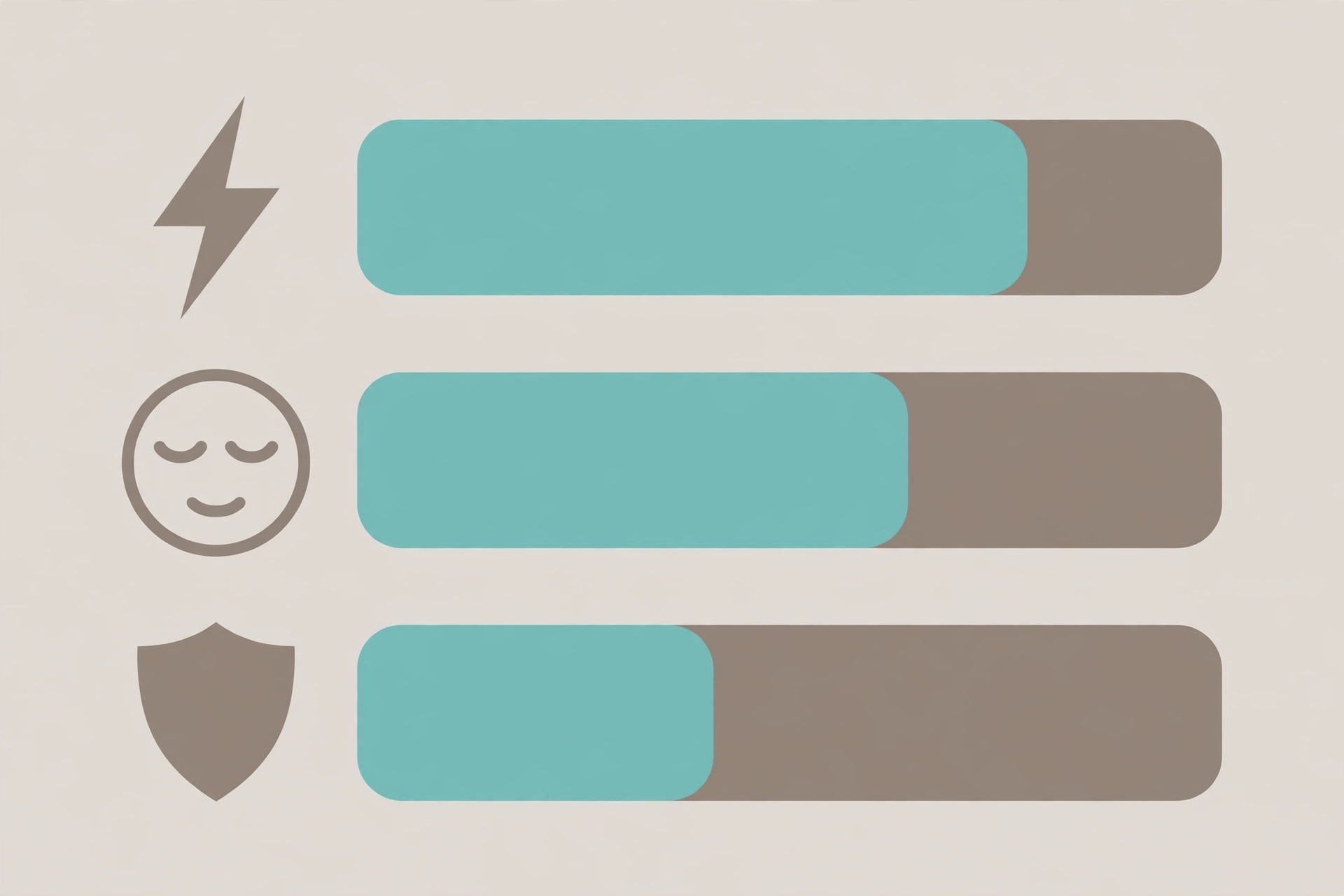
Only one human trial ever measured cortisol directly. That was the Olsson 2009 trial of 60 adults, which took morning saliva samples and found the waking cortisol response changed differently in the rhodiola group than in the placebo group after four weeks.
One small trial is not proof that rhodiola fixes high cortisol. No trial we found tested rhodiola as a treatment for people with documented high cortisol. The "cortisol support" language on product pages is marketing built on a single data point, stretched far beyond what the study showed.
Side effects
NCCIH describes rhodiola as possibly safe for up to 12 weeks of use. Reported side effects in the research include:
- Dizziness and headache. These are among the most commonly reported complaints, usually mild.
- Insomnia and restlessness. Rhodiola can feel mildly stimulating, which is why taking it late in the day is a bad idea.
- Dry mouth or excessive saliva. An odd but documented pair of possible effects.
Longer-term safety data is thin. Almost no trial lasted beyond a few weeks, so "possibly safe for up to 12 weeks" is about as far as the evidence goes.
Drug interactions older adults must know
This section matters more than the benefits section for most of our readers. Older adults take more prescription drugs, and rhodiola touches several of the same systems those drugs target.
| Medicine | What the evidence says | What to do |
|---|---|---|
| Losartan and other blood pressure drugs | NCCIH notes that interactions with losartan have been reported. A small human study found rhodiola slowed how the body processes losartan. | Talk to your doctor or pharmacist before combining; keep checking your blood pressure readings |
| Diabetes medications | Lab and animal studies hint rhodiola may nudge blood sugar downward. Human evidence is thin. | Watch for signs of low blood sugar and discuss it with your doctor first |
| Antidepressants (SSRIs, MAOIs) | A theoretical concern based on lab research into how rhodiola affects brain chemicals. Never stop a prescribed antidepressant to try an herb. | Do not combine without your doctor's guidance |
| Stimulants and excess caffeine | Rhodiola can feel mildly stimulating on its own. | Combining may add jitteriness, restlessness, or insomnia |
| Drugs processed by liver enzymes (CYP2C9, CYP3A4) | Lab studies show rhodiola can slow these enzymes, which process many common prescriptions. | Tell your pharmacist about every prescription so they can check for conflicts |
If you take several daily medications, a quick pharmacist review is the safest step before adding any new supplement. Our supplement interactions guide explains how to have that conversation.

Who should skip rhodiola
- People with bipolar disorder. A 2022 case report in a peer-reviewed psychiatry journal described a 58-year-old man who developed mania requiring hospitalization after using rhodiola. The authors called it the first published case linking rhodiola to a manic episode. Anyone with bipolar disorder should avoid it.
- People who are pregnant or breastfeeding. NCCIH states that little is known about safety in pregnancy or while breastfeeding. Avoid it.
- Children and teenagers. The trials enrolled adults only. Keep all supplements out of children's reach.
- Anyone tempted to self-treat depression. One small 6-week trial is not a treatment plan. If you have symptoms of depression, talk to your health care provider about your options rather than experimenting on your own.
What dose did the trials use
There is no established standard dose for rhodiola. The trials used 170 mg to 680 mg per day of a standardized extract, and products on store shelves vary far more than that range suggests.
Most products are standardized to rosavins and salidroside, but the percentages differ by brand, and some products contain a different species (Rhodiola crenulata) than the one tested in most trials (Rhodiola rosea). A label that does not state the species and the standardization tells you very little about what is inside.
Because insomnia is a reported side effect, morning use makes more sense than evening use. Our supplement dosage guide covers how to read these labels critically. And the standing advice applies: talk to your doctor before starting, especially if you take prescription drugs.
How to spot rhodiola marketing tricks
- "Balances cortisol." One small trial measured cortisol once. That is the entire foundation of this claim.
- "Clinically proven." NCCIH's actual position: not enough reliable evidence for any health purpose. "Clinically studied" and "clinically proven" are not the same thing.
- Species swapping. Check the label for the full Latin name. Most trials tested Rhodiola rosea; some products sell the related species Rhodiola crenulata instead.
- Proprietary blends that hide the dose. If the label will not tell you how many milligrams of rhodiola are inside, you cannot compare it to anything the trials tested.
- "Adaptogen" as a science word. It is a traditional and marketing term, not a medical category. It guarantees nothing about effectiveness or safety.
The bottom line for older adults
Rhodiola has more human research than many trending herbs, and the small trials on fatigue and stress lean modestly positive. That is the most generous honest reading.
It is not a cortisol fix, not a proven stress treatment, and not risk-free. For older adults, the interaction cautions with blood pressure drugs, diabetes drugs, and antidepressants deserve more weight than the modest benefits. The published mania case is a serious red flag for anyone with bipolar disorder.
If stress and fatigue are the concern, the evidence-backed basics still win: sleep, movement, and talking to your doctor about what is actually causing the fatigue. If you are comparing popular adaptogens, we also reviewed ashwagandha, which has its own thin-evidence problems.
Curious but cautious is the right posture. Bring the bottle to your pharmacist, ask for an interaction check, and decide with real information rather than a social media testimonial.
Sources
- National Center for Complementary and Integrative Health: Rhodiola, Usefulness and Safety
- Olsson EM, von Scheele B, Panossian AG. A randomised, double-blind, placebo-controlled, parallel-group study of the standardised extract SHR-5 of the roots of Rhodiola rosea in the treatment of subjects with stress-related fatigue. Planta Med. 2009;75(2):105-112.
- Darbinyan V, Kteyan A, Panossian A, et al. Rhodiola rosea in stress induced fatigue: a double blind cross-over study of a standardized extract SHR-5 with a repeated low-dose regimen on the mental performance of healthy physicians during night duty. Phytomedicine. 2000;7(5):365-371.
- Darbinyan V, Aslanyan G, Amroyan E, et al. Clinical trial of Rhodiola rosea L. extract SHR-5 in the treatment of mild to moderate depression. Nord J Psychiatry. 2007;61(5):343-348.
- Hung SK, Perry R, Ernst E. The effectiveness and efficacy of Rhodiola rosea L.: a systematic review of randomized clinical trials. Phytomedicine. 2011;18(4):235-244.
- Ishaque S, Shamseer L, Bukutu C, Vohra S. Rhodiola rosea for physical and mental fatigue: a systematic review. BMC Complement Altern Med. 2012;12:70.
- Whig R, Leo RJ. Mania associated with Rhodiola rosea: an adaptogen with antidepressant effects. Prim Care Companion CNS Disord. 2022;24(2):21cr02980.
Fact-checked by the SupplementDecoded Research Editorial Team
Review note: This review covers Rhodiola rosea supplements generally, not any single brand's product. Evidence summarized as of October 2026. This article is for information only and is not medical advice; talk to your doctor or pharmacist before starting or stopping any supplement.