
Table of ContentsShow ChaptersHide Chapters
- Sodaboost sells red men's-health gummies promising virility, energy and vitality.
- We checked the claims against the evidence, the label, and the price.
Medical Disclaimer
This article is for informational purposes only and does not constitute medical advice. Always consult with a qualified healthcare professional before starting any new supplement regimen.
Read our Medical / Expert Review Policy and Medical Disclaimer for details.
Key takeaways
- Sodaboost is a red gummy sold online for men's virility, energy and vitality. One gummy a day costs $1.63 to $2.63 depending on the package.
- The label names six ingredients but lists no doses, no blend total and no Supplement Facts panel, so no claim can be checked against a studied amount.
- The strongest human evidence behind any ingredient (maca) comes from four small, underpowered trials. The rest ranges from weak to nonexistent.
- The sales page carries contradictions worth knowing: a "risk free trial" that is actually a $158-plus purchase, a 180-day recommended supply under a 60-day guarantee, and testimonials showing the same man under three different names.
- No company name or address appears anywhere; the legal pages sit on a third-party template domain. We found no FDA or FTC action against Sodaboost as of October 11, 2026.
Contents
- The verdict
- What Sodaboost claims vs what the evidence shows
- What is actually in it: the label analysis
- The contradictions on the sales page
- The price reality
- Who is really behind it
- The ingredients, one by one
- The category warning every buyer should know
- Senior safety: the stimulant question
- What to do instead
- Sources
The verdict
Sodaboost is a men's-health gummy whose marketing outruns its evidence by a wide margin. The sales page promises "maximum male health" and "the world's number one natural formula" for virility, energy and vitality, but it names six ingredients without a single disclosed dose.
Without doses, none of those claims can be checked against the amounts actually studied in humans. The best-supported ingredient in the formula, maca, has only weak human evidence behind it. Several of the others have essentially none.
The page also asks buyers to trust a company it never names, backs claims with an unnamed "doctor," and shows the same man's photo under three different reviewer names. None of this proves the product does nothing. It does mean an older buyer is being asked to spend $158 to $294 on promises the company has not substantiated.
What Sodaboost claims vs what the evidence shows
These are the page's central claims, checked against published research and federal health sources. We are not accusing anyone of anything; we are showing what the evidence actually supports.
| The claim | What the evidence says | Grade |
|---|---|---|
| "The world's number one natural formula" for men's virility | No ranking body, sales data or clinical trial is cited. This is a marketing superlative, not a measurable fact. | Unverifiable |
| Selected ingredients with "proven ability" in the "ideal dosage" | No doses are disclosed anywhere, so "ideal dosage" cannot be verified against any study. Several ingredients have no meaningful human data at all. | Unverifiable |
| Increased libido and sexual desire | Maca has the most human data here: a 2010 systematic review found limited evidence from four small trials suggesting improved sexual desire after at least six weeks, but the trials were underpowered. Muira puama and catuaba have essentially no controlled human data. | Weak |
| Improved circulation and sexual health | No cited study, no disclosed dose of any circulation-relevant ingredient. Nothing to grade against. | Unverifiable |
| Enhanced physical stamina and vigor | Green tea extract and caffeine may have modest short-term effects on energy and metabolism (NCCIH), but the caffeine dose is undisclosed, so no comparison to studied amounts is possible. | Modest at best |
| "Doctor formulated," endorsed by a doctor who examined "numerous" men's-health supplements | The endorsing "doctor" is unnamed and uncredentialed. No verifiable medical professional is attached to the product. | Unverifiable |
| Benefits that build "solidly and permanently in your system" over six months | No study of this product exists, and the formula's ingredients have no long-term permanence data. This is a sales timeline, not a finding. | Unverifiable |

What is actually in it: the label analysis
The page lists six named ingredients with short marketing descriptions. That is the entire label disclosure. Here is what is missing:
- No doses. Not one ingredient has a milligram amount. You cannot compare anything in this bottle to the amounts used in actual trials.
- No blend total. The page calls it a "proprietary blend," but a proprietary blend is required to state its total weight. None is given.
- No Supplement Facts panel. We found no serving size, no daily value percentages and no "other ingredients" list anywhere on the page.
- No caffeine amount. Caffeine is listed as an ingredient and the page admits the formula is "an active, stimulating supplement," yet the caffeine dose is undisclosed.
This matters more than it sounds. Supplement research is dose research. A 2010 systematic review of maca found possible effects only at studied doses of 1.5 to 3 grams per day. If a product does not tell you its dose, you cannot know whether you are getting a studied amount, a fraction of it, or a trace.
The six named ingredients are muira puama extract, maca extract, catuaba extract, green tea extract, caffeine and ashwagandha. What each one actually has behind it is covered in detail below.
The contradictions on the sales page
We read the full sales page and every footer legal page. Several things on the page do not line up with each other.
- A "100% risk free trial" that is not a trial. The badge promises a risk free trial, but the actual offer is a paid purchase starting at $158 for two bottles, backed by a 60-day money-back guarantee. A guarantee is not a free trial, and calling it one sets the wrong expectation.
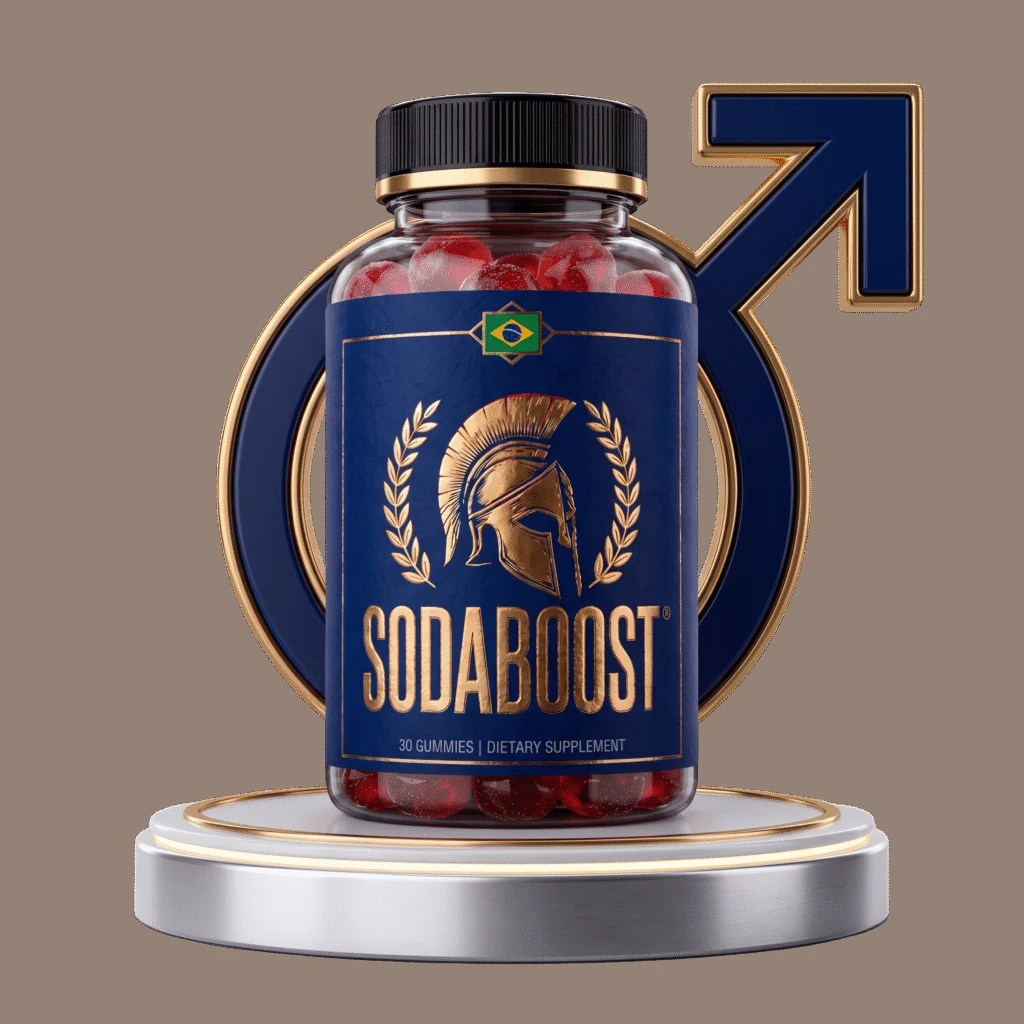
- A gummy sold as capsules in its own image code. The FAQ says to chew one gummy a day, and the bottle label shown says "30 GUMMIES." But the hero product image's own alt text describes "SODA BOOST MALE FORMULA DIETARY SUPPLEMENT 60 CAPSULES." That is leftover copy from a different product's template, and it raises a basic question: how carefully was this page built?
- A 180-day "recommended option" under a 60-day guarantee. The page says 96% of customers order the 6-bottle, 180-day supply and calls it the recommended option. The money-back guarantee lasts 60 days from the date of purchase and requires at least 30 days of use. If you follow the recommendation, your guarantee expires about four months before your supply runs out.
- The guarantee's own pages disagree. The main guarantee section requires "at least 30 days of use" before a refund. The FAQ's guarantee answer omits that requirement entirely. The returns paperwork contradicts itself too: one document says email for an "RMA number," another describes a different email-approval flow, and the window is measured from the purchase date in one place and the delivery date in another.
- Three reviewers, one face. The page shows three 5-star "Verified Purchase" reviews from Michael Thompson of Houston, James Miller of Denver and Robert Anderson of San Diego. All three photos appear to show the same man in different shirts holding the same dark-blue bottle. The footer separately admits that "some names and personally identifying information on this site have been changed to protect individuals' privacy."
- "Doctor formulated" with no doctor. A badge claims the formula is doctor formulated, and a photo of an unnamed woman described as a doctor endorses the product. No name, no specialty, no license, no clinic. There is no verifiable medical professional anywhere on the page.
- A countdown timer that is not counting down to anything. Each pricing block sits under a roughly 30-minute timer that resets when you reload the page. It is pressure, not a deadline.
To be fair, the page does carry proper disclaimers: results are not typical, the statements have not been evaluated by the FDA, and the product is not intended to diagnose, treat, cure or prevent any disease. Those disclaimers are legally required, and they are there.
The price reality
The pricing section appears three times down the page, with identical tiers. Here is the actual math:
| Package | You pay | Per bottle | Per day (1 gummy) | Struck-through "regular" price |
|---|---|---|---|---|
| 2 bottles, 60-day supply | $158 plus shipping | $79 | $2.63 | $358 |
| 3 bottles, 90-day supply | $207 | $69 | $2.30 | $537 |
| 6 bottles, 180-day supply | $294, free US shipping | $49 | $1.63 | $1,074 |
A few things to notice. The struck-through "regular" prices imply a normal price of about $179 per bottle, which would make the 6-bottle tier a 73% discount. No evidence is offered that anyone ever paid $179 a bottle.
The bonuses bundled with 3- and 6-bottle orders, "365 Positions of the Kama Sutra" ($69), "Master of Orgasm" ($97), "Memorable Preliminaries" ($77), "The Power Challenge" ($49) and a "Personalized Usage Guide" ($39), are assigned a combined value of $331. These are digital extras used to make the larger packages feel like deals. They have nothing to do with whether the gummy works.
One honest point in the page's favor: the FAQ explicitly says the purchase is one-time, with "no auto-ship, recurring charges, or hidden fees." Subscription traps are common in this category, and this page at least denies one in writing.
Who is really behind it
We could not find a company behind Sodaboost. That is not an accusation; it is a description of what the footer legal pages contain and omit.
- No legal company name (no LLC, Inc. or Corp.) appears anywhere on the site.
- No physical company address appears anywhere.
- The only company-like name we found is "Eagle Labs," used as a heading on the Returns page.
- Contact is a support email and an SMS support number: +1 (855) 889-3137.
- All five footer legal links point to an external Brazilian template domain, not to the seller's own site. The Terms page even links to a Google Doc titled "Returns" that reads like an internal template draft, with a Portuguese header explaining it is placeholder text for the Returns page.
The refund process, as written, asks buyers to email for approval and follow support's instructions, with one document mentioning a "video statement" as part of a refund request. The documents do not say whether opened bottles qualify, who pays return shipping, or whether restocking fees apply.
If a product disappoints you, the company behind it is the entity your refund comes from. Here, that entity is effectively a support inbox.
The ingredients, one by one
Each ingredient is graded on the human evidence behind the claims made for it, using only federal health sources and peer-reviewed research. Remember: no doses are disclosed, so even the best-studied ingredient here cannot be tied to a studied amount in this product.
Muira puama extract
The page presents this Amazonian plant as a natural stimulant supporting strength and circulation. A 2014 peer-reviewed review of sexual-enhancement products notes that few clinical studies have examined muira puama's prosexual effects, and controlled human trials establishing benefit are essentially absent.
Grade: not proven in humans.
Maca extract
This is the best-supported ingredient in the formula, which says more about the formula than about maca. A 2010 systematic review in BMC Complementary and Alternative Medicine looked at four small randomized trials and found limited evidence suggesting maca may improve sexual desire after at least six weeks of use. The reviewers stressed the trials were underpowered and that more research is needed to identify an effective dose.
Studied doses in those trials were around 1.5 to 3 grams per day. Sodaboost discloses no dose, so there is no way to know whether its maca content resembles a studied amount.
Grade: weak, small trials, no established dose, and no dose disclosed here.
Catuaba extract
A traditional Brazilian tonic the page credits with increasing endurance. We found no controlled human trials establishing that catuaba does what the page implies. Traditional use is real; clinical evidence is not.
Grade: not proven in humans.
Green tea extract
The page calls it a potent antioxidant supporting metabolic rate. The National Center for Complementary and Integrative Health (NCCIH) says the catechins and caffeine in green tea and its extracts may have a modest effect on body weight, but that definite conclusions cannot yet be reached for most of the purposes green tea is used for.
Grade: modest at best, and only at studied compositions this product does not disclose.
Caffeine
The one ingredient whose effect nobody disputes: caffeine is a real stimulant that temporarily increases alertness. But the dose is undisclosed, so it cannot be compared to any studied amount, and buyers sensitive to stimulants cannot judge their exposure. The page's own FAQ admits this is "an active, stimulating supplement" and tells people with heart problems or high blood pressure to consult a professional first.
Grade: real stimulant, unknown dose.
Ashwagandha
The page calls it a time-tested adaptogen. NCCIH reports that many ashwagandha trials have been small and used varying preparations, that some preparations may help with stress and insomnia, and that there is only limited evidence suggesting 2 to 4 months of use may increase testosterone and sperm quality. Our own ingredient review covers ashwagandha in more depth.
Grade: modest for stress, limited for testosterone, and again no dose disclosed here. Read our full review: Ashwagandha: benefits, evidence and safety.
The category warning every buyer should know
This section is not about Sodaboost specifically. We found no evidence that this product contains anything undeclared, and we are not suggesting it does. It is about the product category it belongs to, because the pattern is well documented and older buyers should know it.
Men's sexual-enhancement supplements are the single most adulterated supplement category in the FDA's records. A 2018 analysis in JAMA Network Open examined 776 dietary supplements the FDA had found to contain undeclared drug ingredients: 353 of them, about 46 percent, were marketed for sexual enhancement. The hidden drugs were most often sildenafil or tadalafil, the prescription ingredients in Viagra and Cialis, or chemical analogues designed to dodge standard screens.
This is not history. In September 2026 alone, the FDA warned consumers about DEEP, a sexual-enhancement product containing undeclared amino tadalafil, and listed recalls of X10 and biQ-FEL for undeclared sildenafil and tadalafil. The FDA's own health-fraud recall table from the same month includes "Business Pill" and "Branch Manager for Men," marketed for male sexual enhancement, for undeclared yohimbine.
The practical habit this pattern teaches: before buying any men's-performance product online, check the product name against the FDA's tainted-supplements and health-fraud recall pages. It takes two minutes, and it is the single most useful safety step in this category. Our guide to choosing supplements safely walks through the full checklist: how to choose a men's-health supplement safely.
Senior safety: the stimulant question
The senior-specific concern with Sodaboost is not exotic. It is the undisclosed stimulant load in a product marketed heavily to older men.
- Undisclosed caffeine plus a "natural stimulant." The formula contains both caffeine and muira puama, which the page itself describes as "a natural stimulant." Neither dose is disclosed. Older adults are more sensitive to stimulants, and stimulants can raise blood pressure and heart rate.
- Heart and blood pressure medications. Many men over 65 take blood pressure drugs, blood thinners or heart medications. The page's own FAQ flags "heart problems or high blood pressure" as reasons to consult a professional first. That warning deserves to be taken seriously, because stimulant and medication interactions are a real category of risk. Our guide covers the general principles: supplement interactions to watch for.
- No dose means no conversation with your doctor can be specific. A doctor asked "is this safe with my medications?" cannot answer well without knowing how much caffeine and how much of each herb is in each gummy. That information simply is not provided. On dosing in general, see how to read a supplement dose.
If you are considering this product or one like it, bring the ingredient list to your doctor or pharmacist and ask specifically about stimulant interactions with your current medications. That conversation is worth more than any review.

What to do instead
Low energy and reduced libido in older men are real concerns, and they deserve real answers rather than proprietary blends.
- Start with a medical checkup. Fatigue, low libido and erectile difficulty can signal cardiovascular disease, diabetes, low testosterone, depression, medication side effects or sleep apnea. Each of these has evidence-based treatment. A doctor visit addresses the cause; a gummy addresses the marketing.
- Review your medications. Many common prescriptions, including blood pressure drugs and antidepressants, affect energy and sexual function. A pharmacist can spot these interactions in minutes.
- If you still want a supplement, buy one with a real label. Look for a full Supplement Facts panel with disclosed doses, third-party testing seals (USP, NSF), and a named company with a real address. Our choosing guide explains exactly what to look for.
Sources
- https://pubmed.ncbi.nlm.nih.gov/30646238/ - Tucker J, Fischer T, Upjohn L, Mazzera D, Kumar M. Unapproved pharmaceutical ingredients included in dietary supplements associated with US Food and Drug Administration warnings. JAMA Network Open. 2018;1(6):e183337. (776 FDA-identified adulterated supplements; 353 marketed for sexual enhancement.)
- https://www.fda.gov/drugs/medication-health-fraud-notifications/deep-may-be-harmful-due-hidden-ingredient - FDA notification, September 15, 2026: DEEP sexual-enhancement product found to contain undeclared amino tadalafil.
- https://www.fda.gov/consumers/health-fraud-scams/recalls-health-fraud - FDA health fraud recalls table, checked October 11, 2026 (includes 2026 sexual-enhancement product actions).
- https://link.springer.com/content/pdf/10.1186/1472-6882-10-44.pdf - Shin BC et al. Maca (L. meyenii) for improving sexual function: a systematic review. BMC Complementary and Alternative Medicine. 2010;10:44.
- https://onlinelibrary.wiley.com/doi/10.1155/2014/841798 - Peer-reviewed review of sexual enhancement products for sale online, covering muira puama and related botanicals (BioMed Research International, 2014).
- https://www.nccih.nih.gov/health/ashwagandha - National Center for Complementary and Integrative Health: Ashwagandha, usefulness and safety.
- https://www.nccih.nih.gov/health/green-tea - National Center for Complementary and Integrative Health: Green Tea, usefulness and safety.
Regulatory check: we searched FDA warning letters, FTC enforcement actions and the FDA Health Fraud Product Database for "Sodaboost" and found no FDA or FTC action against this product or seller as of October 11, 2026. Product claims, pricing and company details in this article were taken from the product's own sales and legal pages, read directly on October 11, 2026. Those pages are research material and are not linked here.
Fact-checked by the SupplementDecoded Research Editorial Team