
Table of ContentsShow ChaptersHide Chapters
Medical Disclaimer
This article is for informational purposes only and does not constitute medical advice. Always consult with a qualified healthcare professional before starting any new supplement regimen.
Read our Medical / Expert Review Policy and Medical Disclaimer for details.
Key takeaways
- Urolithin A is a real compound with a plausible mechanism: it helps cells recycle worn-out mitochondria, the energy factories inside muscle cells.
- A 2026 meta-analysis pooled 5 human trials (236 people) and found the walking-distance benefit inconclusive: plus 17 meters on the 6-minute walk test, not statistically significant, with low certainty of evidence.
- In the two best trials, the main outcomes researchers set out to prove (walking distance, peak power) did not improve significantly versus placebo. Secondary measures like muscle endurance and strength did show gains.
- Only about 40 percent of people can make urolithin A from pomegranate juice, according to a 100-person study; the rest would need the supplement to get meaningful blood levels.
- Short trials found no more side effects than placebo, but no trial lasted longer than 4 months, and no trial tested frailty, falls, disease, or lifespan.
- The biggest proven risk is financial: the leading brand costs around $80 a month for evidence the reviewers call inconclusive.
Contents
- The short verdict
- What urolithin A actually is
- The 2026 meta-analysis: the headline finding
- What the two key trials found
- The pomegranate problem: most people cannot make it themselves
- Marketing claims vs. what the evidence shows
- Safety: what the trials actually tested
- Who should talk to their doctor first
- The money question
- What actually works for aging muscles
- The bottom line
- Sources
The short verdict
Urolithin A is one of the more interesting supplements to come along in years. It has a real biological mechanism, small but genuine human trials, and honest researchers who reported their misses along with their hits.
But interesting is not the same as proven. The most current summary of all the human evidence, a 2026 meta-analysis of 5 randomized trials, concluded the muscle benefits are inconclusive, with low certainty. The biggest outcomes the trials set out to prove did not beat placebo.
If you are an older adult hoping this pill will rebuild strength on its own, the evidence says: not yet. If you see it as an expensive experiment in mitochondrial biology with encouraging secondary signals, that is closer to the truth.
What urolithin A actually is
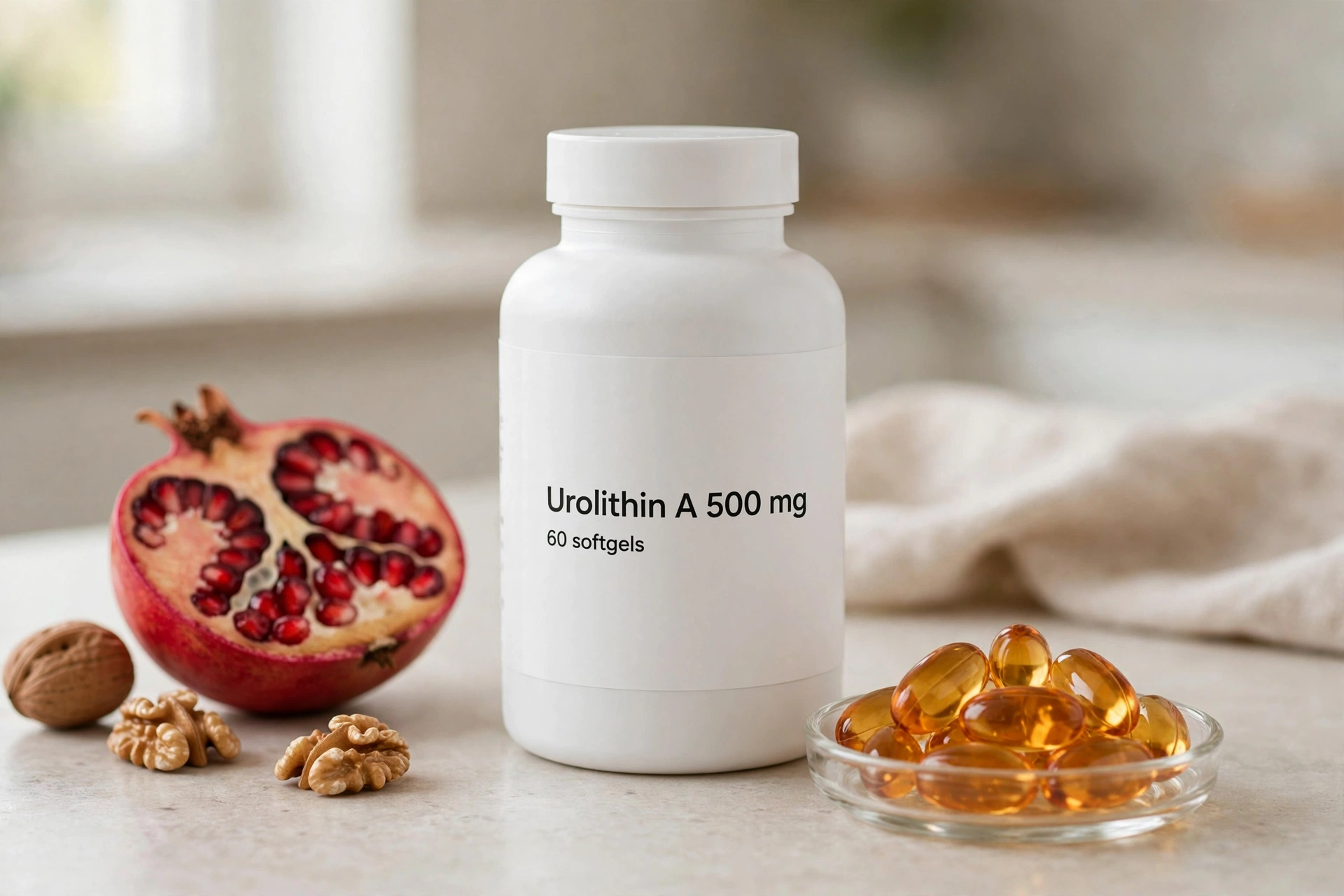
Urolithin A is not a vitamin, a herb, or something anyone discovered in a rainforest. It is a postbiotic: a compound your gut bacteria manufacture when they digest certain plant polyphenols called ellagitannins.
The idea behind it is called mitophagy. Mitochondria are the tiny energy factories inside your cells, and they wear out with age. Mitophagy is the cell's recycling program: it breaks down tired mitochondria and replaces them with fresh ones. Urolithin A appears to nudge that program into gear, at least in cells and in animals.
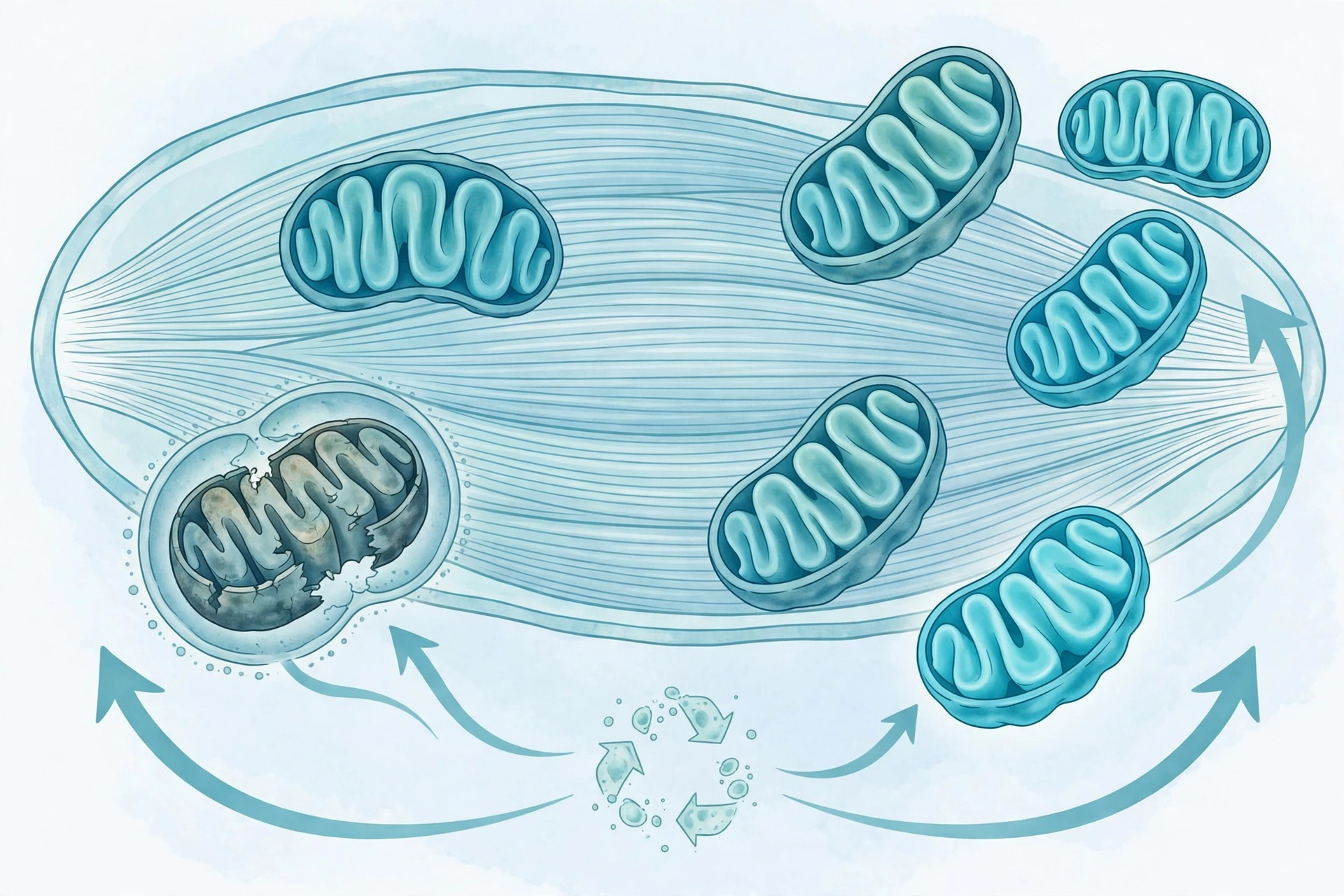
Because muscle cells are packed with mitochondria, researchers guessed that better recycling could mean better muscle endurance and strength in aging. That is a reasonable hypothesis. Whether the supplement delivers it is what the trials tested.
The 2026 meta-analysis: the headline finding
In 2026, independent researchers pooled every randomized controlled trial of urolithin A and muscle health they could find: 5 trials, 236 people total. Pooling trials is the fairest way to judge a young evidence base, because it stops any single small trial from dominating the story.
The one outcome measured the same way across enough trials to pool was the 6-minute walk test: how far someone can walk in 6 minutes. The result:
| Finding | Result |
|---|---|
| Trials pooled | 5 randomized controlled trials, 236 participants |
| Average gain in walking distance | +17 meters vs. placebo |
| Statistical significance | Not significant (p = 0.135, the gap could be chance) |
| Certainty of evidence | Low (GRADE rating) |
| Other outcomes (strength, endurance, aerobic capacity) | Measured too differently to pool; described as exploratory signals, not reproducible evidence |
The authors' conclusion was direct: the currently available randomized human evidence is limited, and the pooled walking-distance effect was not statistically significant. Everything else they could only describe as hypothesis-generating, meaning it suggests ideas for future research, not proof.
Two honesty notes matter here. First, this meta-analysis is the entire human trial literature, not a cherry-picked subset. Second, the trials themselves are small: the largest had 88 people. Small trials produce wide confidence intervals, which is exactly what we see.
What the two key trials found
Both trials were run by the same research network and funded by Amazentis, the company behind the branded ingredient Mitopure. That funding matters because it is a built-in reason to be extra careful, and in this case the researchers deserve credit: they published their primary-outcome misses instead of burying them.
Trial 1: older adults, JAMA Network Open (2022)
This is the trial most relevant to this site's readers. Sixty-six adults aged 65 to 90 (average age about 72) took either 1,000 mg of urolithin A or a placebo daily for 4 months in Seattle.
- Primary outcome (6-minute walk distance): the urolithin A group gained 60.8 meters vs. 42.5 meters for placebo. A real gap, but not statistically significant, so it could be chance.
- Primary outcome (ATP energy production in muscle): no significant improvement vs. placebo.
- Secondary outcome (muscle endurance): significantly improved. At 2 months, the urolithin A group managed about 95 more hand-muscle contractions until fatigue vs. about 12 for placebo, and about 41 more leg-muscle contractions vs. about 6 for placebo.
- Biomarkers: blood markers of inflammation (CRP) and mitochondrial stress (acylcarnitines, ceramides) fell at 4 months.
- Safety: no statistical difference in side effects between the groups; described as safe and well tolerated.
The limitation section is worth reading: three-quarters of participants were women, and all were White, so the results may not apply broadly. Endurance improved, but the two outcomes the trial was designed to prove did not.
Trial 2: middle-aged adults, Cell Reports Medicine (2022)
Eighty-eight overweight, low-fitness adults aged 40 to 64 took 500 mg, 1,000 mg, or placebo daily for 4 months in Canada.
- Muscle strength: significantly improved by about 12 percent (hamstring) at 500 mg and about 10 percent (knee flexion) at both doses. This is the strongest finding in the whole evidence base.
- Aerobic fitness (VO2): improved about 10 percent at 1,000 mg, described as clinically meaningful but not statistically significant.
- Walking distance: plus 33 meters at 1,000 mg, clinically meaningful but not statistically significant.
- Primary endpoint (peak power output): not significantly improved.
- Biomarkers: inflammation and mitochondrial stress markers improved significantly, and muscle biopsies showed increased mitophagy proteins, the first such molecular signature in humans.
| Trial | Who | Main wins | Main misses |
|---|---|---|---|
| JAMA Network Open 2022 (66 people, 1,000 mg, 4 months) | Adults 65 to 90 | Muscle endurance; inflammation and mitochondrial biomarkers | 6-minute walk and ATP production, not significant vs. placebo |
| Cell Reports Medicine 2022 (88 people, 500/1,000 mg, 4 months) | Adults 40 to 64, overweight | Leg strength (about 12 percent); biopsy evidence of mitophagy | Peak power (primary endpoint) not significant; VO2 and walking gains not statistically significant |
The pattern across both trials is consistent: each missed its main target, while secondary measures supplied the encouraging results. That is not fraud; it is how early research often looks. But it means the advertising should not read as if the trials proved what they set out to prove.
The pomegranate problem: most people cannot make it themselves
You may wonder why you would need a supplement when pomegranates and walnuts contain the starting materials. The answer is in your gut bacteria, and a 2021 study of 100 healthy adults measured it precisely.

- Only 12 percent of participants had detectable urolithin A in their blood at baseline.
- After drinking pomegranate juice, only about 40 percent converted the precursors into significant urolithin A. The other 60 percent were low producers or non-producers, and the difference was the gut bacteria they carried.
- A 500 mg supplement produced more than 6 times the blood exposure of an 8-ounce glass of pomegranate juice.
This study was funded by Amazentis, the company selling the supplement, so read it with that in mind. But the finding itself is consistent with other research on "metabotypes": people genuinely differ in which urolithins their gut bacteria make. Eating the fruit still gives you fiber, vitamins, and other compounds. It just probably does not give you much urolithin A.
Marketing claims vs. what the evidence shows
Urolithin A is sold with longevity language: mitochondrial renewal, cellular rejuvenation, healthy aging. Here is how the biggest claims hold up against the published trials.
| The claim | What the trials actually show |
|---|---|
| Rejuvenates mitochondria | Partly supported. Muscle biopsies showed increased mitophagy proteins in humans, and biomarkers of mitochondrial stress fell. This is real cellular evidence, but in small trials. |
| Builds muscle strength | One trial in middle-aged adults found about 12 percent more leg strength. No strength finding in the older-adult trial. No trial in frail or very old adults. |
| Improves walking and physical performance | Not proven. The pooled 2026 result was plus 17 meters, not statistically significant. Individual trials showed gaps over placebo that could be chance. |
| Extends lifespan or healthspan | No evidence. No trial lasted longer than 4 months, and none measured frailty, falls, disease, or lifespan. |
| Clinically proven / first clinically proven supplement | Misleading. It has been clinically tested, which is good, but the tests did not prove the headline benefits. "Tested" is not "proven." |
One more disclosure: most of the human trials were funded by the company behind the branded ingredient, and several authors were company employees or collaborators. That does not make the data fake; the researchers reported their misses. But it means independent replication, by teams with no financial stake, is still missing.
Safety: what the trials actually tested
The honest safety picture is narrow, because the trials themselves were narrow.
- What was tested: in the 4-month trials, side effects were no different from placebo. The FDA reviewed the ingredient's safety as a food ingredient back in 2018 (GRAS Notice 791) for adults 40 and older, at up to about 1 gram a day, with no objections. That review covers safety as a food ingredient, not approval of any health claim.
- What was not tested: anything beyond 4 months. No trial studied people with kidney or liver disease, pregnant women, or people taking multiple prescription drugs. There is no interaction database for urolithin A the way there is for common drugs.
- What that means for you: short-term use looks benign in healthy adults, which is genuinely reassuring. But "safe for 4 months in healthy trial volunteers" is not the same as "safe for years in an 80-year-old on six medications." The long-term picture is simply unknown.
Who should talk to their doctor first
- Anyone on prescription medications, especially heart, blood pressure, diabetes, or blood-thinner drugs. There are no established interaction studies for urolithin A, so "no known interactions" really means "nobody has checked." Your pharmacist deserves a look at the label before you start. Our guide to supplement interactions with common medications explains why this check matters.
- People with kidney or liver disease. These organs process everything you swallow, and they were not represented in the trials. Do not experiment without medical supervision.
- Anyone considering it as a substitute for medical care. Leg weakness, fatigue, or declining mobility can signal heart, thyroid, neurological, or medication problems. A supplement is not a diagnosis, and delaying real care is the costliest mistake of all.
- Anyone expecting dramatic results. The trial participants did not change their exercise habits, and the gains were modest and partial. If a seller promises transformation, that promise is ahead of the evidence.
The money question
The leading brand sells for around $80 a month, and the doses used in trials (500 to 1,000 mg daily) match what the products contain. That is roughly $960 a year for a supplement whose pooled trial evidence the 2026 reviewers rated as low certainty and inconclusive.
Price is not a safety issue, but it is a value issue, and for seniors on fixed incomes it matters. Compare that $960 a year against what the same money buys in proven muscle protection: a year of walking shoes, resistance bands, or a few sessions with a physical therapist, all built on evidence far stronger than any urolithin A trial.
This is not to say the compound is worthless. It is to say the price assumes a level of proof that does not exist yet.
What actually works for aging muscles
If muscle strength and staying independent are the goals, the evidence hierarchy is not close:
- Resistance exercise. No trial has compared urolithin A against resistance training, but training is the intervention with the strongest evidence for age-related muscle loss, by a wide margin. Two or three weekly sessions of progressive resistance work more than any pill tested so far.
- Enough protein. Older adults often eat less protein than they need for muscle maintenance. Fixing that is cheaper than any supplement and better supported.
- Walking and balance work. The 6-minute walk test exists because walking capacity predicts independence. Regular walking, plus balance exercises to prevent falls, targets exactly the function these trials tried to move.
If you want to read about another heavily marketed longevity supplement with a similar "real mechanism, thin evidence" profile, our NMN review walks through the same pattern. And our review of collagen after 60 covers a different anti-aging promise aimed at the same audience.
The bottom line
Urolithin A earns a genuinely mixed verdict, which is rare in the supplement world and worth saying plainly. The mechanism is real. The human data is real but small, mixed, and mostly company-funded. The 2026 pooling of all the trials found the headline benefit inconclusive.
For most older adults, the honest advice is this: it is probably safe to try for a few months if your doctor agrees, but do not expect it to replace exercise, and do not pay premium prices for premium claims the evidence does not support. The interesting science is real. The proof of benefit in people like you is not there yet.
We will update this review if larger independent trials report. Until then, spend the $80 on your muscles the proven way first.
Sources
- Dao et al. (2026). Effects of Urolithin A supplementation on muscle health outcomes in humans from randomized controlled trials. Frontiers in Nutrition.
- Liu et al. (2022). Effect of Urolithin A Supplementation on Muscle Endurance and Mitochondrial Health in Older Adults: A Randomized Clinical Trial. JAMA Network Open.
- Singh et al. (2022). Urolithin A improves muscle strength, exercise performance, and biomarkers of mitochondrial health in a randomized trial in middle-aged adults. Cell Reports Medicine.
- Singh et al. (2021). Direct supplementation with urolithin A overcomes limitations of dietary exposure and gut microbiome variability in healthy adults. European Journal of Clinical Nutrition.
- FDA GRAS Notice No. 791: Urolithin A (Amazentis SA, 2018). Agency review of urolithin A as a food ingredient for adults 40 and older.
Fact-checked by the SupplementDecoded Research Editorial Team