
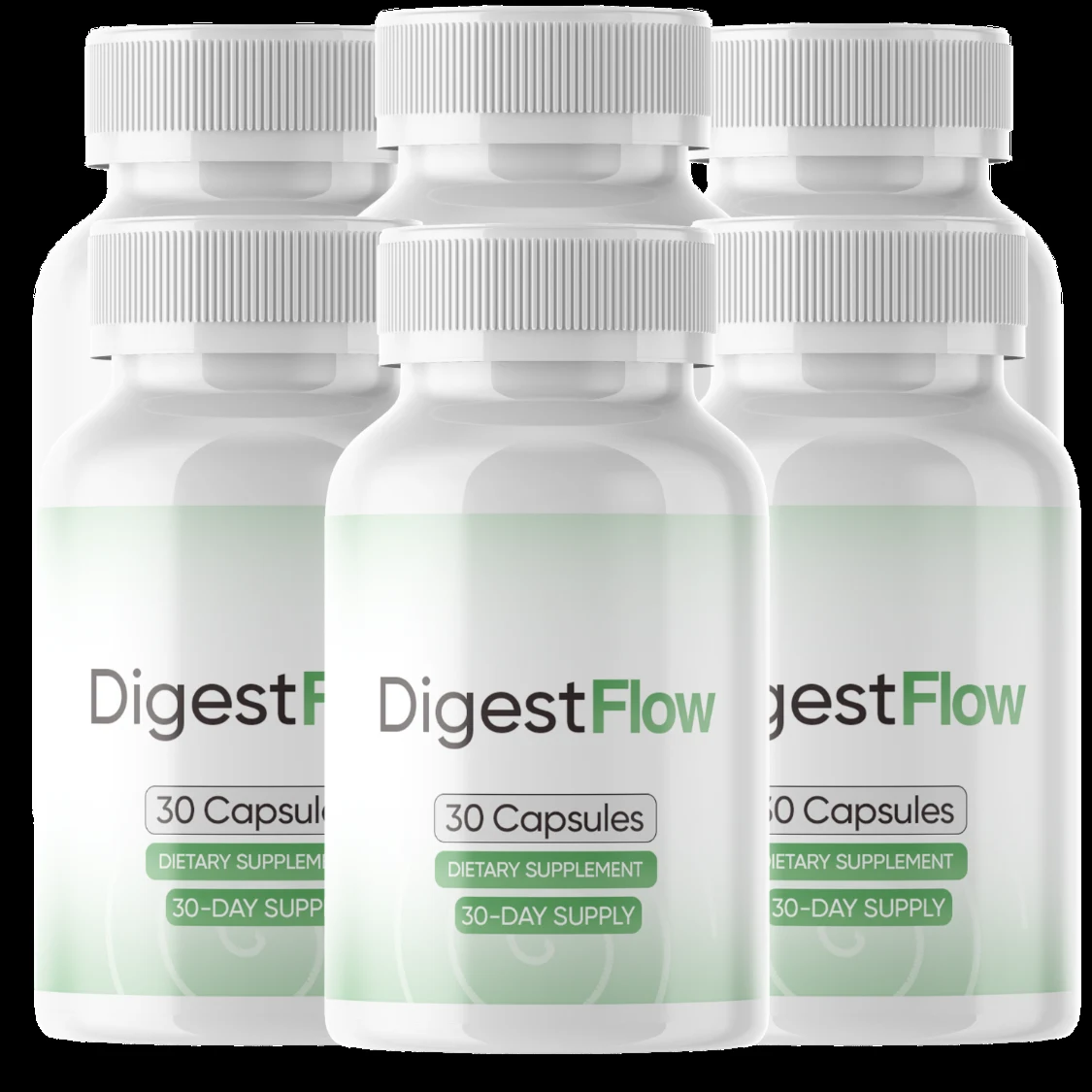
Table of ContentsShow ChaptersHide Chapters
Medical Disclaimer
This article is for informational purposes only and does not constitute medical advice. Always consult with a qualified healthcare professional before starting any new supplement regimen.
Read our Medical / Expert Review Policy and Medical Disclaimer for details.
Key takeaways: Digest Flow is marketed as a digestive-health supplement, but its ingredient label reads like a weight-loss pill: caffeine anhydrous, green coffee bean extract, garcinia cambogia, raspberry ketone, and green tea extract. None of these are digestive-support ingredients in the usual sense (no probiotics, enzymes, or fiber). The best-known human trial behind green coffee bean extract was formally retracted in 2014. Garcinia carries documented liver-injury reports, and concentrated green tea extract is linked to rare but serious liver injury. The total caffeine load is worth tracking against your daily intake, especially for older adults on blood pressure or heart medications.
Contents
- The verdict
- What the page promises
- The label: what is actually in the bottle
- Claim vs evidence, ingredient by ingredient
- The core mismatch: marketed for digestion, formulated for weight loss
- Price and value
- Who is behind Digest Flow
- Senior safety notes
- Regulatory history
- The bottom line
- Sources
The Verdict
Digest Flow is sold as digestive wellness. Its label is a stimulant weight-loss blend.
That mismatch is the whole story. If you bought this for bloating, regularity, or gut comfort, you received a capsule of caffeine, green coffee bean extract, garcinia cambogia, raspberry ketone, and green tea extract. None of these is a digestive-support ingredient in the sense most people mean: no probiotics, no digestive enzymes, no fiber.
The evidence behind the individual ingredients is weak to nonexistent for digestion, and two of the five carry documented liver-injury signals. The caffeine load is the only ingredient likely to produce a noticeable effect, and it is not a digestive benefit.
Bottom line: as a digestive-health product, Digest Flow does not hold up. The Supplement Decoded Team does not recommend it for that purpose.
What the Page Promises
The sales page positions Digest Flow as a digestive wellness product, described as designed to support digestive wellness and address concerns often linked to intestinal health.
The page's own disclaimer admits the obvious: results may vary, the product does not guarantee immediate results, and it suggests following the usage guidelines for at least 180 to 210 days to evaluate effectiveness. That is six to seven months of daily use before judging a bottle whose label you could read in two minutes.
The disclaimer also includes the standard line that the product is not intended to diagnose, treat, cure, or prevent any disease. That is legally required language. It does not make the marketing honest.
The Label: What Is Actually in the Bottle
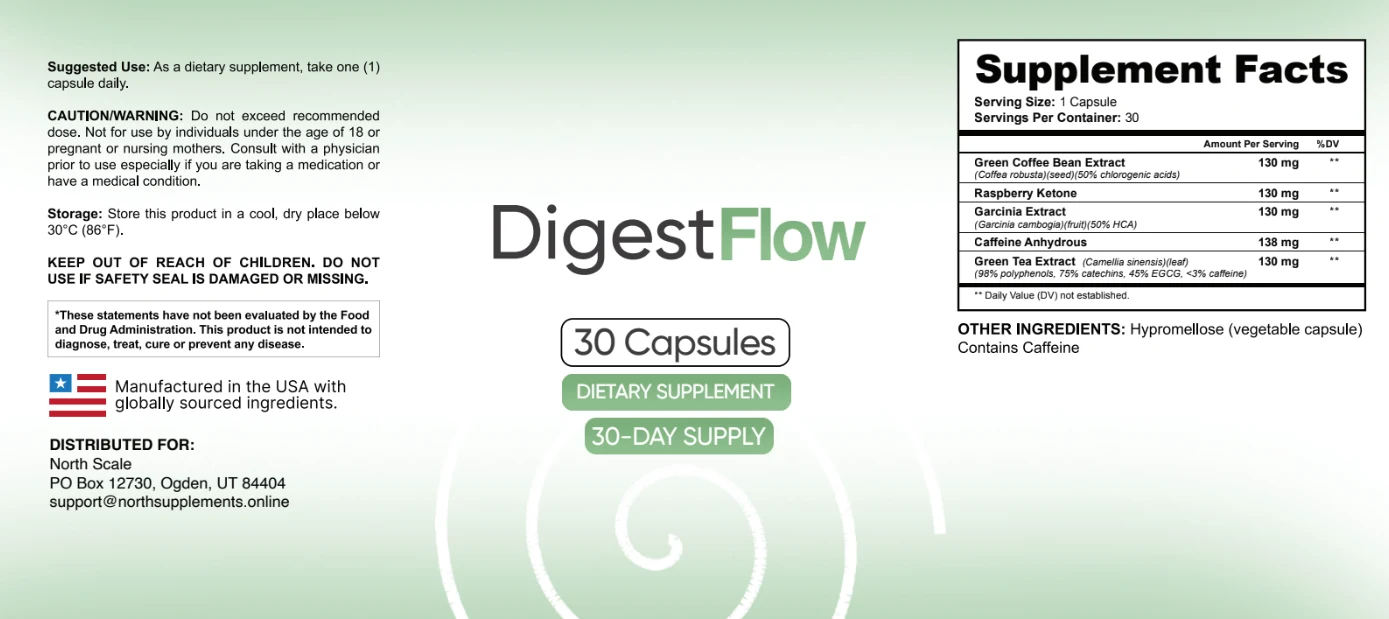
Per the Supplement Facts panel shown on the sales page (serving size: 1 capsule, 30 servings per container), each capsule contains:
| Ingredient | Amount per serving |
|---|---|
| Green coffee bean extract (Coffea robusta seed, 50% chlorogenic acids) | 130 mg |
| Raspberry ketone | 130 mg |
| Garcinia extract (Garcinia cambogia fruit, 50% HCA) | 130 mg |
| Caffeine anhydrous | 138 mg |
| Green tea extract (Camellia sinensis leaf; 98% polyphenols, 75% catechins, 45% EGCG, less than 3% caffeine) | 130 mg |
Read that list again. Green coffee, raspberry ketone, garcinia, caffeine, green tea. This is the classic five-ingredient stimulant weight-loss stack sold under dozens of brand names for the last fifteen years.
What is missing is just as telling. There are no probiotics. No digestive enzymes. No fiber. No ginger, peppermint, or any botanical traditionally used for digestion. A buyer expecting gut support is not getting gut-support ingredients.
Claim vs Evidence, Ingredient by Ingredient
Since the page markets this for digestive wellness, the fair test is simple: does any ingredient have human evidence for digestion? And since the formula is really a weight-loss stack, the second fair test is: does any of it have reliable evidence for weight loss either?
| Ingredient | What the evidence actually shows | Evidence grade |
|---|---|---|
| Green coffee bean extract (130 mg) | The most-cited human trial (Vinson et al., 2012, 16 subjects) was formally retracted in 2014 after the sponsor could not assure the data's validity; the FTC separately charged the study was so flawed that no reliable conclusions could be drawn from it. No digestive benefit has been shown. | F (retracted flagship trial) |
| Raspberry ketone (130 mg) | No published human trial has tested raspberry ketone alone for weight loss. The one human study that included it (Lopez et al., 2013) used a multi-ingredient blend with caffeine, capsaicin, and synephrine, so nothing can be attributed to raspberry ketone itself. Animal doses were far higher than 130 mg. | F (no human data alone) |
| Garcinia cambogia (130 mg, 50% HCA) | NCCIH: it is unclear whether garcinia helps with weight loss; some evidence suggests a modest effect, other evidence shows none. Numerous reports of liver toxicity exist in people taking garcinia products. | D (unclear benefit, real liver risk) |
| Caffeine anhydrous (138 mg) | Roughly one and a half cups of coffee. Mayo Clinic: up to 400 mg/day is safe for most adults, but caffeine can raise heart rate and blood pressure and interfere with sleep and some medications. This is the only ingredient likely to produce a felt effect, and it is stimulation, not digestion. | C (real stimulant, not a digestive aid) |
| Green tea extract (130 mg, 45% EGCG, about 58 mg EGCG) | Concentrated green tea extract is associated with liver injury in animal and human studies; the U.S. Pharmacopeia requires a liver-injury caution on certain products. A drink of green tea is not the same thing as a concentrated extract capsule. | D (no digestive benefit; liver signal) |
Green coffee bean extract: the retracted study problem
The 2012 trial that launched the green coffee weight-loss craze (16 overweight adults, crossover design) was formally retracted in 2014. The retraction notice states the sponsors could not assure the validity of the data.
The FTC went further. In a complaint against the ingredient supplier, the agency charged that the lead investigator repeatedly altered subjects' weights and other key measurements, changed the trial length, and misstated who received placebo. The supplier paid $3.5 million to settle.
That was the best human evidence green coffee ever had. What remains is essentially nothing a buyer should rely on.
Raspberry ketone: zero human trials of the ingredient itself
Raspberry ketone became famous from television, not from science. Every weight-loss claim traces back to mouse and cell studies, at doses that scale to grams per day in humans, not the 130 mg in this capsule.
The single human trial that included raspberry ketone (Lopez et al., 2013) tested an eight-ingredient blend that also contained caffeine, capsaicin, and synephrine, alongside a diet and exercise program. The design cannot tell you whether raspberry ketone did anything at all.
Garcinia cambogia: unclear benefit, documented liver injuries
NCCIH's assessment is blunt: it is unclear whether garcinia products help with weight loss, with some studies showing a modest effect and others showing none. More research is needed.
The safety side is clearer. NCCIH notes numerous reports of liver toxicity in people taking garcinia products. A U.S. Pharmacopeia review identified more than 200 adverse events of liver injury linked to garcinia, including one death and nine liver transplants. For an effect measured in roughly a kilogram over two to three months, that risk profile is poor.

The Core Mismatch: Marketed for Digestion, Formulated for Weight Loss
This is the pattern to recognize. The storefront sells digestive comfort. The warehouse ships a stimulant.
- What the page sells: digestive wellness, intestinal health, comfort after meals, a one-capsule daily routine for gut support.
- What the bottle contains: five stimulant and thermogenic-style ingredients with no probiotics, no enzymes, and no fiber.
- Why it matters: a buyer with real digestive complaints (persistent bloating, irregularity, reflux) may delay real evaluation or treatment while taking a caffeine pill for six months, exactly the 180 to 210 days the page suggests.
This is not a formulation error. The five ingredients are a known weight-loss stack. The digestive framing appears to be a marketing choice, possibly because weight-loss claims attract more regulatory scrutiny.
If you want genuine digestive support, the evidence-backed basics still win: fiber, fluids, movement, and medical evaluation for persistent symptoms. Our fibermaxxing review covers what fiber actually does and how to add it safely.
Price and Value
The page is a short three-step checkout funnel ("Step 1: Select Your Discount Package"), and the pricing is fully visible. Three tiers, all with a 180-day money-back guarantee:
| Package | Total | Per bottle | Shipping | Anchor price shown |
|---|---|---|---|---|
| 2 bottles ("Basic Offer") | $158 | $79 | $9.99 | $358 |
| 3 bottles ("Most Popular") | $207 | $69 | Free | $537 |
| 6 bottles ("Best Offer!") | $294 | $49 | Free | $1,074 |
The $79/$69/$49 tier structure is identical to the sibling products in this seller family we have reviewed (FlexGuard, ProstaFlow, MindHoney, NeuroPulse Pro, Cognizil). The page code carries "full price" values ($358 for 2 bottles, $537 for 3, $1,074 for 6, implying $179 per bottle), though they were not displayed as struck-through prices on the rendered page. Either way, the $179 figure has no verifiable basis.
Price-per-day math: at one capsule daily, the 6-bottle pack costs about $1.63 per day, the 3-bottle about $2.30, and the 2-bottle about $2.80 including shipping. That is the price of a stimulant capsule with no demonstrated digestive benefit.
One detail worth noting: the page suggests using the product for 180 to 210 days before judging it, but the money-back guarantee is 180 days. A buyer who follows the page's own evaluation advice to the full 210 days would be outside the refund window. Checkout runs through Digistore24.
Who Is Behind Digest Flow
The label names the distributor as North Scale, PO Box 12730, Ogden, UT 84404, with the email [email protected]. That is the same PO box and label email behind FlexGuard, ProstaFlow, NeuroPulse Pro, and MindHoney. This is the ninth product we have traced to this family.
The page itself tells a slightly different story. The contact and legal pages list [email protected], a different address from the label. The return address given for refunds is 11870 62nd St N, Largo, FL 33773, not the Ogden PO box. The Max Vitalize label we reviewed earlier also pointed to Largo, FL, so the two addresses appear connected.
So: one product, two support emails, two addresses in two states, no phone number, no named people, no About page. The footer legal links (Terms, Privacy, Refund, Shipping, Contact) open dialogs on the page rather than separate pages, and the page carries the standard FDA evaluation disclaimer. The pricing cards carry "FDA Registered Facility" and "USA Ingredients" badges. An FDA-registered facility is not an FDA-approved product; facility registration is a routine listing requirement, not an endorsement of the product.
On transparency, the page is a quiet checkout funnel: no testimonials, no countdown timers, no fake scarcity, no disease claims, and the disclaimer openly says results vary and the product may not work for everyone. That restraint is better than the hype-driven pages in this space, but it does not fix the formula mismatch.
Senior Safety Notes
Older adults should be especially careful with this formula, and not because of digestion.
- Caffeine plus heart and blood pressure drugs. 138 mg of caffeine anhydrous is a meaningful stimulant dose. Caffeine can raise heart rate and blood pressure and can interact with stimulant-like effects of other medications. If you take blood pressure or heart medicines, count this capsule in your total daily caffeine and talk to your pharmacist first. Our supplement interactions guide explains how to check.
- Two liver-injury signals in one capsule. Both garcinia cambogia and concentrated green tea extract carry documented liver-injury reports. Older adults, who more often take multiple medications processed by the liver, should not stack both casually. Unusual fatigue, nausea, dark urine, or yellowing of the eyes after starting any supplement warrant a prompt call to your doctor.
- Garcinia and mood medications. Garcinia has been flagged for potential interactions with serotonergic drugs (including some antidepressants). NCCIH cautions about herb-drug interactions with garcinia products. If you take an SSRI or similar medication, this ingredient deserves a conversation with your prescriber, not a self-directed trial.
- The 180 to 210 day suggestion. The page suggests using the product for six to seven months before judging it. That is a long time to take a stimulant blend with two liver-risk ingredients for a digestive complaint that deserves a real diagnosis. Persistent bloating or bowel changes in older adults should be evaluated by a clinician, not managed with a caffeine capsule.

Regulatory History
No FDA warning letter or FTC enforcement action naming Digest Flow was found as of October 17, 2026. That is worth stating plainly: this teardown is about the mismatch between marketing and formula, not about a regulator having acted.
What regulators have said about the ingredients is a different matter. The FTC's $3.5 million settlement over the retracted green coffee study (2014) is part of the public enforcement record. NCCIH's liver-toxicity language on garcinia is unusually direct for a federal agency.
The Bottom Line
Digest Flow is a weight-loss-style stimulant capsule wearing a digestive-health costume. None of its five ingredients has meaningful human evidence for digestive wellness. Two carry liver-injury signals. The caffeine is the only ingredient likely to make you feel anything.
If digestive comfort is your goal, skip this and start with fiber, fluids, and movement, or talk to your doctor about persistent symptoms. If weight management is your goal, this formula's evidence is still poor: its flagship study was retracted, and its best-known ingredient has no human trial behind it.
Either way, the label tells the truth the marketing does not. Read labels first. Our supplement dosage guide and our Evo Slim teardown (another stimulant weight-loss product) show how the same label-reading method works on other products.
Sources
- Garcinia Cambogia: Usefulness and Safety, National Center for Complementary and Integrative Health (it is unclear whether garcinia helps with weight loss; numerous reports of liver toxicity)
- Vinson JA, Burnham BR, Nagendran MV. Randomized, double-blind, placebo-controlled, linear dose, crossover study to evaluate the efficacy and safety of a green coffee bean extract in overweight subjects. Diabetes Metab Syndr Obes. 2012;5:21-27 (RETRACTED)
- Retraction notice: the sponsors of the study cannot assure the validity of the data. Diabetes Metab Syndr Obes. 2014;7:467
- Lopez HL et al. Eight weeks of supplementation with a multi-ingredient weight loss product enhances body composition, reduces hip and waist girth, and increases energy levels in overweight men and women. J Int Soc Sports Nutr. 2013;10:22 (raspberry ketone tested only inside a multi-ingredient blend with caffeine, capsaicin, and synephrine)
- Navarro VJ et al. Liver Injury from Herbal and Dietary Supplements. Hepatology. 2017;65(1):363-373 (green tea among the herbal products most often implicated in supplement-related liver injury; concentrated extracts, not brewed tea, drive the signal)
- Caffeine content for coffee, tea, soda and more, Mayo Clinic (up to 400 mg/day safe for most adults)
Fact-checked by the SupplementDecoded Research Editorial Team
Review note: This review covers the Digest Flow page as it appeared in October 2026, the version showing a short three-step checkout ("Step 1: Select Your Discount Package") with $79/$69/$49 tiers via Digistore24, a 180-day guarantee, the five-ingredient label (green coffee bean extract, raspberry ketone, garcinia extract, caffeine anhydrous, green tea extract), and a 180 to 210 day suggested evaluation period. Lookalike sites under the same product name exist and may show different content.