
Table of ContentsShow ChaptersHide Chapters
Medical Disclaimer
This article is for informational purposes only and does not constitute medical advice. Always consult with a qualified healthcare professional before starting any new supplement regimen.
Read our Medical / Expert Review Policy and Medical Disclaimer for details.
Key takeaways: Flow Strong is sold to men over 40 for prostate and urinary comfort with six named botanicals and minerals. The page publishes no doses, no Supplement Facts panel, and no blend total, so its "clinically recognized ingredients" language cannot be checked against the trial doses researchers actually used. The evidence on the headline ingredient, saw palmetto, is settled against it: NCCIH concludes it is probably not helpful for urinary symptoms, and a 2023 Cochrane review of 27 trials found little or no benefit. The 60-day guarantee reads simply on the landing page, but the legal pages add an RMA requirement, customer-paid return shipping, and a processing fee of up to 20 percent. The page tells men the product is safe to take alongside other medications, while Mayo Clinic advises telling your doctor about any herbal product because bleeding risk and drug interactions are real. No FDA or FTC action exists against Flow Strong as of 2026-10-21. The Supplement Decoded Team does not recommend Flow Strong.
Contents
- The verdict
- What the page promises
- The label problem: six names, zero doses
- Claim vs evidence, ingredient by ingredient
- The reference page problem
- Price and value
- Who is behind Flow Strong
- The 60-day guarantee, read carefully
- Senior safety notes
- Regulatory history
- The bottom line
- Sources
The Verdict
Flow Strong promises urinary comfort, normal prostate function, and everyday well-being for men over 40 from six familiar botanicals. The page never says how much of anything is in the capsule.
That omission breaks the central promise of the pitch. The page calls its ingredients "clinically recognized," which invites a direct comparison: what the trials used versus what the bottle contains. With no doses, no Supplement Facts panel, and no blend total anywhere on the page or its legal pages, that comparison is impossible.
What the research does say about these ingredients is not encouraging. The headline botanical, saw palmetto, has been tested in thousands of men and found no better than placebo for urinary symptoms. Two more ingredients have no trusted-source evidence for prostate benefit at all. The honest summary is that this is a hope-priced capsule, not an evidence-priced one.
What the Page Promises
The headline reads: "The Premium Formula Redefining Men's Health Support After 40." The subhead promises "urinary comfort, normal prostate function, and the everyday well-being of the modern man over 40," next to a 4.9 out of 5 customer rating.
The About section says Flow Strong takes "a modern, transparent approach" and, quote, "instead of relying on overcomplicated formulas or hidden blends, it focuses on a carefully selected combination of well-known ingredients." One capsule per day, 30 capsules per bottle.
The page is careful to stay at "support" level language. There are no doctor endorsements, no "clinically proven" claim for the product itself, no before-and-after photos, and no named diseases. That restraint is worth noting, and it is also the ceiling of what the page can honestly claim.
The six named ingredients and the page's exact words for each:
| Ingredient | The page's claim, verbatim |
|---|---|
| Saw Palmetto Extract | "A widely used botanical that helps support healthy prostate function and maintain normal urinary flow." |
| Pumpkin Seed Extract | "Rich in beneficial compounds that help maintain bladder function and urinary health." |
| Stinging Nettle (Leaf) | "Traditionally used to support prostate wellness and help maintain urinary tract health." |
| Tomato Powder | "A natural source of lycopene, the red antioxidant most studied in male well-being research." |
| Pygeum Africanum Bark | "A natural plant extract known for supporting prostate health and promoting comfortable nighttime urinary patterns." |
| Zinc | "An essential mineral that supports hormone balance and plays an important role in male reproductive health." |
The FAQ goes further than the ingredient section. Asked "Will it work for me?", the page answers that "many men report improved urinary comfort, reduced nighttime trips to the bathroom, and an overall increase in vitality and confidence with consistent use." Asked how Flow Strong is different, it cites "clinically recognized ingredients such as Saw Palmetto, Pygeum Africanum, Zinc, and a proprietary blend of natural extracts and antioxidants."
Note the tension in that last sentence: the About section disavows "hidden blends," but the FAQ leans on "a proprietary blend." Both cannot be the whole story, and neither comes with a milligram figure.
The Label Problem: Six Names, Zero Doses
There is no Supplement Facts panel anywhere on the page. Not in the pricing section, not as a popup, not linked from the footer. We checked all seven legal pages too. Nothing.
No per-ingredient dose is stated for any of the six ingredients. The "proprietary botanical blend" is named but its total weight is not given. The capsule's other ingredients are not listed. The copy mentions "plant sterols" and "essential vitamins and minerals," but no sterol and no vitamin or mineral appears in the ingredient list by name or amount.
This matters more than it sounds. Supplement research is dose research. Consider what honest comparison requires:
- Saw palmetto trials used 160 to 960 mg per day. Without a disclosed dose, nobody can tell whether the capsule holds a studied amount or a token dusting. The page gives buyers no way to find out before paying.
- Pygeum trials used about 100 mg per day of standardized extract. The page does not say whether its pygeum is standardized, extracted, or simply ground bark, and it states no amount. Form and dose both change what the evidence means.
- Zinc has a Tolerable Upper Intake Level of 40 mg per day for adult men. A buyer already taking a multivitamin with zinc cannot check whether this capsule pushes total intake past that ceiling, because the zinc dose is undisclosed. That is a safety gap, not just a transparency gap.
For context on why dose disclosure is the bare minimum, see our guide to reading supplement labels and dosages. A prostate product that hides every dose while calling its ingredients "clinically recognized" is asking buyers to trust the adjectives instead of the arithmetic.
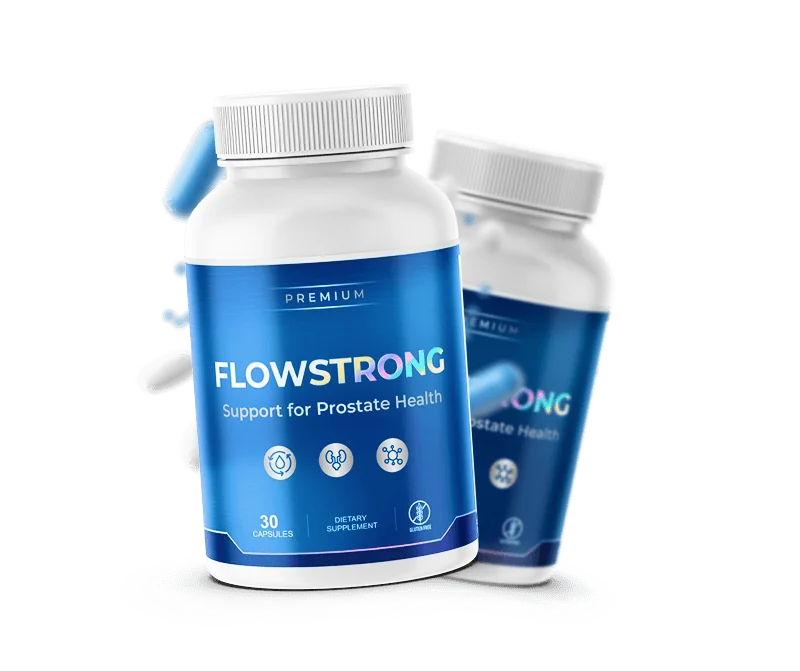
The bottle itself, shown in the hero image, reads "PREMIUM FLOWSTRONG, Support for Prostate Health, 30 CAPSULES, DIETARY SUPPLEMENT" with a gluten-free shield icon. The label photo is the closest thing to documentation the page offers, and it carries no ingredient panel either.
Claim vs Evidence, Ingredient by Ingredient
We checked each of the six ingredients against trusted sources only: NCCIH, NIH Office of Dietary Supplements, Mayo Clinic, Cleveland Clinic, Cochrane reviews, and PubMed-indexed research. Here is the honest scorecard.
| Ingredient | What the trusted sources say | Evidence grade |
|---|---|---|
| Saw palmetto | NCCIH: "probably not helpful" for urinary symptoms; 2023 Cochrane review (27 trials, 4,656 men): little or no benefit vs placebo | Tested and failed |
| Pumpkin seed extract | One large trial (1,431 men): extract capsules no different from placebo on the primary endpoint; whole seed showed a modest unconfirmed edge | Weak |
| Stinging nettle | NCCIH: "some limited evidence" it "may improve some symptoms"; one 620-man trial showed symptom improvement, unreplicated | Limited |
| Pygeum | Cochrane (18 trials, 1,562 men): about twice as likely to report symptom improvement vs placebo, but studies were small, short, and used varied doses | Limited |
| Tomato powder / lycopene | NCCIH: "isn't sufficient evidence to support the use of lycopene for the prevention or treatment of BPH" | Insufficient |
| Zinc | No trusted source evaluates zinc for BPH or urinary symptoms; NIH ODS lists no prostate benefit among zinc's established uses | No evidence |

- Saw palmetto is the most studied and the most settled. The NIH-funded CAMUS trial escalated the dose from 320 mg to 640 mg and finally 960 mg per day, three times the standard dose, over 72 weeks in 369 men, and found no benefit over placebo at any dose level (Barry et al., JAMA 2011). An earlier one-year NEJM trial of 160 mg twice daily in 225 men found no difference in symptom score, urine flow, prostate size, or quality of life (Bent et al., 2006). When the best-funded trials fail at triple doses, an undisclosed dose in a proprietary capsule is not a rebuttal.
- Pygeum has the kindest reading, and it is still thin. The Cochrane review found men on pygeum more than twice as likely to report overall symptom improvement versus placebo, with nocturia down 19 percent and peak urine flow up 23 percent. But the reviewers stress the studies were small, averaged only 64 days, used varied doses and preparations, and rarely used validated symptom measures. No trial compared pygeum against standard prescription BPH drugs, and there is no long-term data. Reviews summarize the studied dose as about 100 mg per day of standardized extract, a figure the Flow Strong page cannot be checked against.
- Nettle's evidence is a single trial. One six-month trial in 620 men found symptom scores fell from 19.8 to 11.8 on nettle versus 19.2 to 17.7 on placebo, with no reported side effects (Safarinejad, 2005). That is a real result from one center, unreplicated, and the published abstract does not state the dose. One study is a lead, not a conclusion.
- Pumpkin seed extract failed its own large trial. In the one-year GRANU trial of 1,431 men aged 50 to 80, the extract capsules did not differ from placebo on the primary responder measure. Whole pumpkin seed showed a modest edge the authors called only "descriptively significant," concluding the findings need a confirmatory study. Neither NCCIH, NIH ODS, Mayo Clinic, nor Cleveland Clinic evaluates pumpkin seed for BPH at all.
- Lycopene and zinc have no BPH evidence in the trusted sources. NCCIH's verdict on lycopene is a clean negative for BPH prevention or treatment. For zinc, no trusted source evaluates it for urinary symptoms; the "prostate concentrates zinc" line you see in marketing is a biochemical fact, not evidence that extra zinc helps the prostate. And zinc carries a caution worth knowing: NIH ODS sets the upper intake level at 40 mg per day for men, and long-term high-dose zinc supplementation has been associated with increased risk of aggressive prostate cancer in large cohort studies. Association is not proof, but it directly undercuts any "more zinc is better for the prostate" pitch.
The big picture, in Mayo Clinic's words: "In the United States, no herbal supplements are approved to treat an enlarged prostate." The American Urological Association's guidelines note that many supplement studies have weaknesses, and that the safety and long-term effectiveness of beta-sitosterol extracts, pygeum, and rye grass "hasn't been proved."
A similar prostate pitch with a very different label was dissected in our ProstaFlow teardown, where the "prostate comfort" capsule turned out to contain only amino acids. Flow Strong at least names real prostate botanicals. Naming them is not the same as dosing them.
The Reference Page Problem
The footer links a Scientific References page citing 10 studies on individual ingredients, which sounds rigorous. Two problems undercut it.
First, the page's own disclaimer admits: "The studies cited refer to the individual ingredients and not to FlowStrong as a finished product." No trial of the finished capsule exists, so the references cannot support claims about the product, only about ingredients in the abstract.
Second, reference number 10 is a 2017 Cancer Prevention Research paper finding that green tea catechins decrease prostate cancer risk. Green tea, green tea extract, and catechins appear nowhere in the product's six-ingredient list. A reference page that cites research on an ingredient the product does not contain is padding, not evidence.
Citing real studies is better than citing none. But a reference list is only as honest as its match to the formula, and here the match breaks on dose (undisclosed for everything) and on ingredient (green tea is not in the bottle).
Price and Value
Three tiers, one capsule per day, 30 capsules per bottle:
| Tier | Price per bottle | Total | Per day | "Regular" anchor |
|---|---|---|---|---|
| Basic: 2 bottles (60 days) | $79 | $158 | $2.63 | $358 |
| Standard: 3 bottles (90 days) | $69 | $207 | $2.30 | $537 |
| Most Popular: 6 bottles (180 days) | $49 | $294 | $1.63 | $1,074 |
The struck-through anchors imply a "regular" price of $179 per bottle, with red starbursts shouting "SAVE $780 TODAY" and "SAVE $330 TODAY" under a "Limited time offer" heading. No countdown timer, stock counter, or pop-up discount appeared. A strip claims "97% Of Customers Order 6 Bottles (Our Recommended Option)," a figure no buyer can verify, and another reads "Above 6 Bottles Comes With FREE US Shipping Too," which is nonsensical since six bottles is the top tier.
Watch the tier inclusion rows. The 6-bottle tier gets green checks for the 60-day guarantee, fast free shipping, and "2 FREE BONUSES!" The 3-bottle tier gets checks for guarantee and shipping. The 2-bottle Basic tier gets red X marks on all three: no guarantee, no free shipping, no bonuses. Yet the FAQ says, quote, "Every order of FlowStrong is covered by a 60-Day Satisfaction Guarantee." Both cannot be true, and the page does not resolve it.
The "2 FREE BONUSES!" are never named or described anywhere on the page. The shipping cost for the 2-bottle tier is not stated either. At $1.63 to $2.63 per day, this is priced like a premium therapy and documented like a mystery.
Who Is Behind Flow Strong
The legal pages name the company as FlowStrong, "Distributed by FlowStrong, Aurora, CO, USA," at 19655 E 35th Drive, Suite 100, Aurora, CO 80011. Contact is a support email ([email protected]) and an SMS number (+1 844-321-1836). No voice phone number is published.
The retailer of record is BuyGoods, "a Delaware corporation located at 1201 N Orange Street Suite #7223, Wilmington, DE, 19801, USA." BuyGoods is a third-party checkout platform for affiliate-marketed products. Its own disclosure states its role as retailer "does not constitute an endorsement, approval or review of this product or any claim, statement or opinion used in promotion of this product."
The legal fine print, all effective January 2026 and all hosted on the same domain: Colorado governing law, binding arbitration in Denver, and a class action waiver. The Terms grant Flow Strong "a perpetual, worldwide, royalty-free license to use, reproduce, and display" any submitted testimonial "in any media for marketing or operational purposes."
This setup, BuyGoods checkout, an Aurora Colorado address, a bg-dot-store landing URL, and a support@[brand].store email, matches the pattern of two earlier teardowns: Mind Wake and our Max Vitalize review. Same rails, different pitch. That does not prove common ownership, but buyers should know the storefront is a template, not a clinic.
The 60-Day Guarantee, Read Carefully
The landing page sells the guarantee in one friendly sentence: "Your purchase is protected by our 60-Day Satisfaction Promise from the original purchase date. If you're not satisfied with your experience, simply contact us through this link to our Contact Page, and our team will make it right."
The legal pages tell a longer story. Side by side:
| The landing page says | The legal pages say |
|---|---|
| 60 days "from the original purchase date" | Terms: 60 days "FROM THE DELIVERY DATE" (the Refund page heading says delivery date while its own body says "within 60 days of the purchase") |
| "Simply contact us... and our team will make it right" | Refunds require prior authorization (RMA); the return must ship within 7 calendar days of receiving the RMA |
| Full satisfaction, full refund implied | Two options: a partial refund of typically 30 to 40 percent without returning anything, or a full refund only upon return of ALL bottles plus any bonuses |
| Nothing about fees | Return shipping is the customer's responsibility; shipping and handling are non-refundable; approved refunds carry a return-processing fee of up to 20 percent of the order value |
| FAQ: "Every order... is covered" | The Basic 2-bottle tier shows a red X on the 60-day guarantee row |
More conditions: only one refund per product per household within 12 months, refunds go to the original payment method only, and cancellation is allowed only within 24 hours of purchase. None of this is unusual for the industry. All of it contradicts the one-sentence version on the landing page.
A 6-bottle buyer testing the full "180-day" supply against a 60-day window should do the calendar math before ordering. The guarantee expires long before the recommended supply runs out.
Senior Safety Notes
The FAQ asks whether Flow Strong can be taken with other medications and answers: "Yes, you can take FlowStrong even if you're currently using other medications, as it's a natural supplement." For an audience of men over 40, many of whom take daily prescriptions, that blanket reassurance is the most concerning sentence on the page.

What the trusted sources actually say:
- Saw palmetto and bleeding risk. Mayo Clinic warns that saw palmetto "might make your risk of bleeding higher if you also take a blood thinner, such as aspirin, clopidogrel, or warfarin." Cleveland Clinic advises not taking it within two weeks of scheduled surgery over bleeding concerns. Many men over 60 take daily aspirin or prescription blood thinners. "Natural" does not override that.
- Zinc and dose ceilings. NIH ODS sets the adult male upper intake level at 40 mg per day from all sources, noting that 50 mg or more over weeks can inhibit copper absorption, reduce immune function, and lower HDL cholesterol. The undisclosed zinc dose means a man already taking a zinc-containing multivitamin cannot check his total.
- Zinc and prostate cancer signals. In the Health Professionals Follow-up Study, supplemental zinc above 100 mg per day was associated with more than double the risk of advanced prostate cancer, and a 30-year follow-up study urged caution about high-dose, long-duration zinc supplementation in men. These are associations, not proof, and the authors note men may have been self-medicating early symptoms. But they argue against megadose zinc, not for it.
- "No reports of side effects" proves nothing. The FAQ states "There have been no reports of side effects." There is also no clinical trial, no post-market surveillance program, and no adverse-event database covering this product that we could find. Absence of reports is absence of looking.
- Nettle, pygeum, pumpkin seed, and lycopene have no trusted-source interaction data. We found no NCCIH, NIH ODS, Mayo Clinic, or Cleveland Clinic data on interactions between these four and blood thinners, blood pressure drugs, or diabetes drugs. That is a gap in the evidence, and it is exactly why the page's "safe with other medications" claim overreaches. Unknown is not the same as safe.
Mayo Clinic's standing advice applies here: "If you take any herbal remedies, tell your health care provider. Certain herbal products might raise the risk of bleeding or affect other medicines that you take." Before adding any prostate supplement, talk with your doctor or pharmacist, especially if you take blood thinners, blood pressure drugs, or diabetes medications. Our guide to supplement interactions is a starting point, not a substitute for that conversation.
Regulatory History
We searched FDA.gov and FTC.gov for "Flow Strong," including warning letters, enforcement actions, recall announcements, and safety alerts. Zero results. No warning letters, no FTC cases, no recalls, no safety alerts mention this product as of 2026-10-21.
That is worth stating plainly, and worth framing honestly: absence of enforcement is not an endorsement. The FDA does not approve dietary supplements for safety or effectiveness before they reach the market, so a clean regulatory record means only that no regulator has acted, not that the product works.
The Bottom Line
Flow Strong is a prostate and urinary comfort pitch built on six familiar botanicals, sold at $1.63 to $2.63 per day, with no disclosed dose for any ingredient and no Supplement Facts panel anywhere. The best-studied ingredient failed its trials. Two ingredients have no prostate evidence in the trusted sources. The guarantee is narrower than the landing page suggests, and the "safe with your medications" reassurance contradicts Mayo Clinic's guidance.
Men bothered by urinary symptoms have better-evidenced paths: talk with your doctor, who can evaluate whether lifestyle changes, prescription options, or a urology referral fit your situation. If you still want to explore supplements, our guide to choosing male-health supplements safely covers the label checks that matter, starting with disclosed doses.
The Supplement Decoded Team does not recommend Flow Strong.
Sources
- NCCIH: Saw Palmetto (concludes saw palmetto is "probably not helpful" for urinary symptoms of prostate enlargement)
- Tacklind et al., Cochrane Database Syst Rev. 2023 (PMID 37345871) (27 trials, 4,656 men: Serenoa repens alone provides little to no benefit for lower urinary tract symptoms)
- Cleveland Clinic: Saw Palmetto Benefits (NIH-funded studies found saw palmetto no more effective than placebo; advises stopping before surgery)
- Bent et al., N Engl J Med. 2006 (PMID 16467543) (160 mg twice daily for one year: no difference from placebo)
- Barry et al., JAMA. 2011 (PMID 21954478) (CAMUS trial: dose escalation to 960 mg/day over 72 weeks, no benefit over placebo)
- NCCIH: Tips on Complementary Approaches for Benign Prostatic Hyperplasia (limited evidence for nettle and pygeum; insufficient evidence for lycopene)
- Vahlensieck et al., Urol Int. 2015 (PMID 25196580) (GRANU trial: 1,431 men; pumpkin seed extract capsules no different from placebo)
- Safarinejad, J Herb Pharmacother. 2005 (PMID 16635963) (620-man nettle trial: symptom improvement vs placebo, single trial)
- Cochrane: Pygeum africanum for benign prostatic hyperplasia (CD001044) (18 trials, 1,562 men; small, short studies with varied doses)
- Chatelain et al., Urology. 1999 (PMID 10475347) (pygeum 100 mg once vs twice daily, similar efficacy)
- NIH Office of Dietary Supplements: Zinc Fact Sheet for Health Professionals (RDA 11 mg/day for men; upper level 40 mg/day; interactions with antibiotics, penicillamine, thiazide diuretics)
- Leitzmann et al., J Natl Cancer Inst. 2003 (via PMC2664741) (supplemental zinc above 100 mg/day associated with advanced prostate cancer risk)
- Zhang et al., 30-year follow-up (via PMC9630799) (caution warranted on high-dose, long-duration zinc supplementation in men)
- Mayo Clinic: Benign Prostatic Hyperplasia, Diagnosis and Treatment ("In the United States, no herbal supplements are approved to treat an enlarged prostate")
- Mayo Clinic: Herbal Supplements and Heart Medicines May Not Mix (saw palmetto may raise bleeding risk with aspirin, clopidogrel, or warfarin)
- FDA: Recalls, Market Withdrawals, and Safety Alerts (checked 2026-10-21; no Flow Strong entry found)
Review note: This teardown covers the Flow Strong page as it appeared in October 2026, the version with the headline "The Premium Formula Redefining Men's Health Support After 40," the gold MOST POPULAR badge on the 6-bottle tier, red SAVE $780 and SAVE $330 starbursts, BuyGoods checkout, and the PREMIUM FLOWSTRONG bottle label reading "Support for Prostate Health, 30 Capsules." Lookalike sites using the Flow Strong name exist and may show different content.
Fact-checked by the SupplementDecoded Research Editorial Team