
Table of ContentsShow ChaptersHide Chapters
Medical Disclaimer
This article is for informational purposes only and does not constitute medical advice. Always consult with a qualified healthcare professional before starting any new supplement regimen.
Read our Medical / Expert Review Policy and Medical Disclaimer for details.
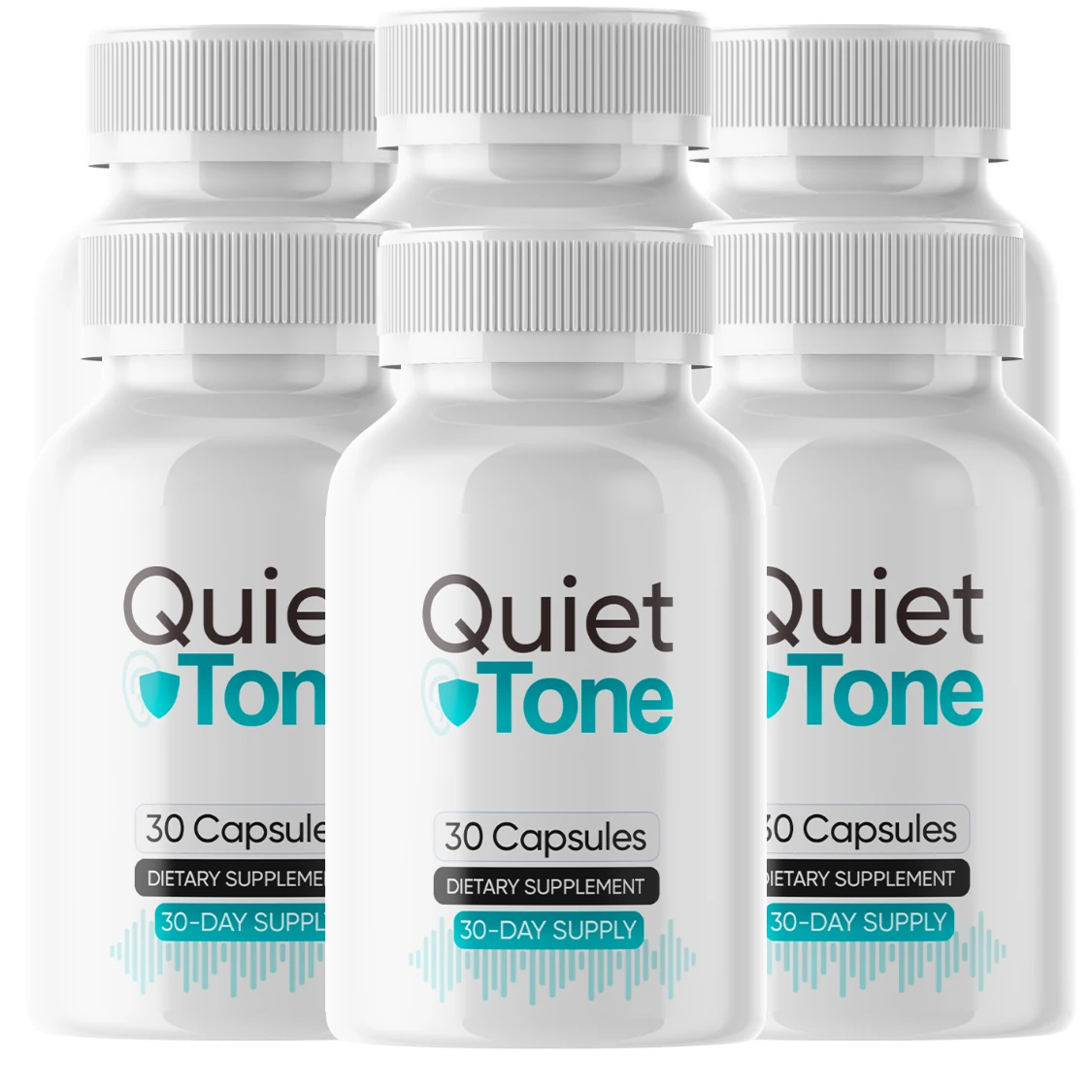
Key takeaways: Quiet Tone is marketed for tinnitus relief and auditory health, but its ingredient label is a calm-and-sleep botanical blend: GABA, L-theanine, valerian, lemon balm, chamomile, passion flower, 5-HTP, ashwagandha, rhodiola, and St. John's Wort. None of the 18 botanicals in its 415.5 mg proprietary blend has established human evidence for tinnitus, and the blend hides every individual dose. The page claims "science-backed ingredients," but no clinical trial of the finished formula has been published. St. John's Wort plus 5-HTP in one capsule is a genuine interaction risk for older adults on antidepressants or multiple prescriptions.
Contents
- The verdict
- What the page promises
- The label: what is actually in the bottle
- Claim vs evidence, ingredient by ingredient
- The core mismatch: marketed for ears, formulated for calm
- Price and value
- Who is behind Quiet Tone
- Senior safety notes
- Regulatory history
- The bottom line
- Sources
The Verdict
Quiet Tone is sold for tinnitus relief. Its label is a calm-and-sleep botanical blend.
That mismatch is the whole story. The capsule contains GABA, L-theanine, valerian root, lemon balm, chamomile, passion flower, 5-HTP, ashwagandha, rhodiola, and St. John's Wort, among others. These are the ingredients of a relaxation formula, not a hearing formula.
None of them has established human evidence for tinnitus. The federal position is clear: the Mayo Clinic says there is little evidence that alternative medicine treatments work for tinnitus, and a 2026 systematic review of over-the-counter tinnitus treatments concluded that no firm conclusions can be drawn about whether any OTC therapy provides symptomatic benefit.
Bottom line: as a tinnitus product, Quiet Tone does not hold up. The Supplement Decoded Team does not recommend it for tinnitus relief.
What the Page Promises
The sales page describes Quiet Tone as "designed to support tinnitus relief and address concerns often linked to auditory health." The terms of use repeat the same phrase: a dietary supplement "designed to support tinnitus relief and wellness related to auditory health concerns."
The page also claims "high-quality, science-backed ingredients." What it never provides is any clinical trial of the finished formula. We found no published human study of Quiet Tone itself, and the page names none. A collection of common botanicals is not the same thing as a tested formula.
The page suggests following the usage guidelines for at least 180 to 210 days to evaluate effectiveness. That is six to seven months of daily use. Keep that number in mind when we reach the price section: the money-back guarantee is 180 days, so the far end of the page's own evaluation advice outlasts the refund window.
The page also carries badges reading "GMP Certified" and "FDA Registered Facility." A registered facility is not an approved product. The FDA does not approve dietary supplements before sale, and a facility registration badge should never be read as an agency endorsement.
The Label: What Is Actually in the Bottle
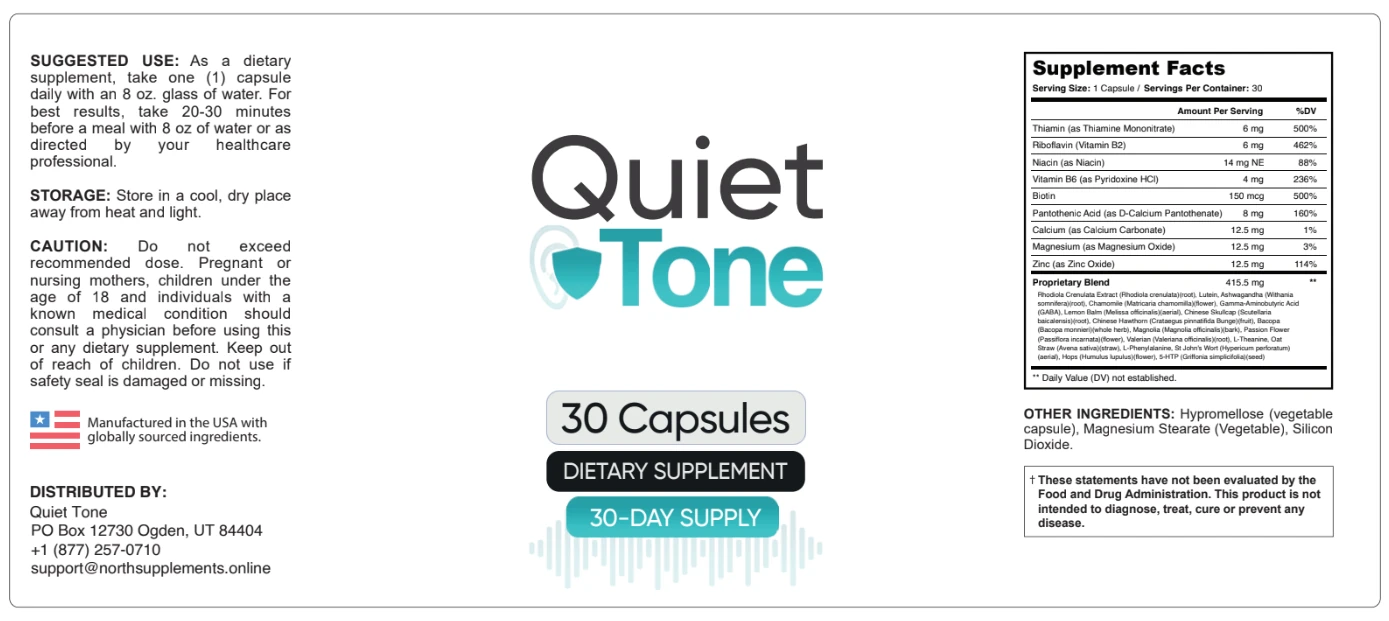
Per the Supplement Facts panel shown on the sales page (serving size: 1 capsule, 30 servings per container, 30-day supply), each capsule contains:
| Ingredient | Amount per serving |
|---|---|
| Thiamin (as Thiamine Mononitrate) | 6 mg (500% DV) |
| Riboflavin (B2) | 6 mg (462% DV) |
| Niacin (as Niacin) | 14 mg NE (88% DV) |
| Vitamin B6 (as Pyridoxine HCl) | 4 mg (236% DV) |
| Biotin | 150 mcg (500% DV) |
| Pantothenic Acid (as D-Calcium Pantothenate) | 8 mg (160% DV) |
| Calcium (as Calcium Carbonate) | 12.5 mg (1% DV) |
| Magnesium (as Magnesium Oxide) | 12.5 mg (3% DV) |
| Zinc (as Zinc Oxide) | 12.5 mg (114% DV) |
| Proprietary Blend (Rhodiola crenulata extract root, Lutein, Ashwagandha root, Chamomile flower, GABA, Lemon Balm aerial, Chinese Skullcap root, Chinese Hawthorn fruit, Bacopa whole herb, Magnolia bark, Passion Flower flower, Valerian root, L-Theanine, Oat Straw straw, L-Phenylalanine, St. John's Wort aerial, Hops flower, 5-HTP from Griffonia seed) | 415.5 mg (daily value not established; individual doses not disclosed) |
The disclosed vitamins and minerals are ordinary multivitamin amounts. Nothing about them targets hearing. The action is all in the proprietary blend: 415.5 mg split across 18 ingredients, which averages about 23 mg per ingredient if divided evenly. But the label discloses no individual amounts, so there is no way to verify that average, or to know whether any ingredient is present at a meaningful dose.
Other ingredients: hypromellose (vegetable capsule), magnesium stearate, silicon dioxide. Directions: one capsule daily with water, 20 to 30 minutes before a meal.
Claim vs Evidence, Ingredient by Ingredient
The fair test is simple: does anything in this capsule have real human evidence for tinnitus? Here is what the trusted sources say.
| Ingredient | What the evidence actually shows | Evidence grade |
|---|---|---|
| Proprietary blend, 415.5 mg total (18 botanicals and compounds, individual doses undisclosed) | No ingredient in the blend has established tinnitus evidence. The blend is a calm-and-sleep formula (GABA, L-theanine, valerian, lemon balm, chamomile, passion flower, 5-HTP, hops, magnolia, oat straw) plus stress botanicals (ashwagandha, rhodiola), a memory herb (bacopa), an eye-health carotenoid (lutein), traditional-use botanicals (Chinese skullcap, Chinese hawthorn), St. John's Wort, and L-phenylalanine. Hidden doses make every ingredient impossible to assess. | F (no tinnitus evidence; doses hidden) |
| Zinc (12.5 mg) | The only human tinnitus trial (Arda et al., 2003) tested 50 mg/day for two months in 41 patients and found the improvement was not statistically significant, with no replication since. The dose here is one quarter of that trial's dose. | D (tiny unreplicated trial; lower dose here) |
| B-vitamin base (thiamin, riboflavin, niacin, B6, biotin, pantothenic acid) | No controlled trial supports a B-vitamin complex for tinnitus. The only controlled trial of a related compound, nicotinamide in 48 patients (1987), found results no better than placebo. | F (no evidence) |
| Magnesium (12.5 mg, 3% DV) | One small early-phase study exists; nothing approaching established evidence for tinnitus treatment. | F (no established evidence) |
| Calcium (12.5 mg, 1% DV) | No human evidence for tinnitus. | F (no evidence) |
The ingredients with the most tinnitus research are not in the bottle
Ginkgo biloba is the most-studied tinnitus botanical. A 2022 Cochrane review of 12 studies and 1,915 participants found uncertain benefits, with a pooled difference of -1.35 on a 100-point scale and very low-certainty evidence. The National Center for Complementary and Integrative Health says ginkgo is not helpful for relieving tinnitus symptoms. Quiet Tone contains no ginkgo.
Melatonin is the other agent with any tinnitus trial data. One small 2011 crossover trial (61 subjects, 3 mg nightly for 30 days) found a statistically significant but small effect, possibly explained by improved sleep. Quiet Tone contains no melatonin.
Lutein deserves a specific note because it appears on the label. Lutein is studied for eye health, including age-related macular degeneration research, not for hearing. Its presence in a tinnitus formula has no stated rationale on the page.
"Science-backed ingredients" and what that claim actually means
The page claims "high-quality, science-backed ingredients." Read carefully, that phrase describes the ingredients, not the product. Individual botanicals like ashwagandha and rhodiola have research for stress and fatigue, which is why they show up in relaxation formulas. Our rhodiola review found that even the popular claims for that herb rest on thin evidence.
But ingredients studied for stress are not ingredients studied for tinnitus. And a proprietary blend that hides every individual dose cannot borrow credibility from ingredient-level research at all: a trial dose of ashwagandha is typically 300 to 600 mg, while this entire 18-ingredient blend totals 415.5 mg. There is no way for any ingredient here to match the doses used in the research the page implies it draws on.
Mayo Clinic and the 2026 systematic review agree
The Mayo Clinic's tinnitus treatment page is direct: "There's little evidence that alternative medicine treatments work for tinnitus." It lists ginkgo, melatonin, and zinc among the alternatives tried, and notes that many care guidelines advise against using medicines or alternative therapies to treat tinnitus.
A 2026 systematic review of over-the-counter tinnitus treatments (9 randomized controlled trials, 390 adults) reached the same place: "Current RCT evidence shows inconsistent and limited findings, and no firm conclusions can be drawn about whether any OTC therapy provides symptomatic benefit." Quiet Tone's formula, with hidden doses and no tinnitus-proven ingredient, sits below even that low bar.
The Core Mismatch: Marketed for Ears, Formulated for Calm
This is the pattern to recognize. The storefront sells hearing support. The capsule delivers a relaxation blend.
- What the page sells: tinnitus relief, auditory health, wellness related to auditory health concerns.
- What the bottle contains: GABA, L-theanine, valerian, lemon balm, chamomile, passion flower, 5-HTP, hops, magnolia, oat straw (a sleep-and-calm stack); ashwagandha and rhodiola (stress botanicals); bacopa (memory); lutein (eye health); Chinese skullcap, Chinese hawthorn, St. John's Wort, L-phenylalanine.
- Why it matters: a buyer with real tinnitus may spend six months on a relaxation capsule while a treatable cause goes unaddressed. The page itself suggests 180 to 210 days of use before judging the product. Persistent ringing deserves a hearing evaluation, not a blind trial of hidden botanical doses.
The honest reading is that this is a generic calm formula wearing a tinnitus label. The tinnitus positioning is a marketing choice. There is no ingredient here whose tinnitus evidence could support the pitch, and no trial of the formula itself.
One more buyer-confusion warning: we found several lookalike domains using the Quiet Tone name with conflicting terms (different guarantee lengths and checkout processors on different pages). When a product lives on rotating copycat pages, it is hard to know which version of the terms you are actually buying under. The review note at the end of this article identifies the exact page variant we reviewed.
Price and Value
The page is a short checkout funnel ("Step 1: Select Your Discount Package"), and the pricing is fully visible. Three tiers, all with a 180-day money-back guarantee:
| Package | Total | Per bottle | Shipping |
|---|---|---|---|
| 2 bottles ("Basic Offer", 60-day supply) | $158 | $79 | $9.99 |
| 3 bottles ("Most Popular", 90-day supply) | $207 | $69 | Free |
| 6 bottles ("Best Offer", 180-day supply) | $294 | $49 | Free |
The $79/$69/$49 tier structure is identical to the sibling products in this seller family we have reviewed (Digest Flow, Max Vitalize, Evo Slim, Hawaiian Harmony, Cognizil, MindHoney, NeuroPulse Pro, ProstaFlow, FlexGuard). There are no struck-through anchor prices on this page, which is a small improvement over some of the family's other pages.
Price-per-day math: at one capsule daily, the 6-bottle pack costs about $1.63 per day, the 3-bottle about $2.30, and the 2-bottle about $2.80 including shipping. That is the price of an untested relaxation capsule with hidden doses.
One detail worth noting: the page suggests using the product for 180 to 210 days before judging it, but the money-back guarantee is 180 days. A buyer who follows the page's own evaluation advice to the full 210 days would be outside the refund window. Checkout runs through a third-party processor.
Who Is Behind Quiet Tone
The label names the distributor as Quiet Tone, PO Box 12730, Ogden, UT 84404, with the phone +1 (877) 257-0710 and the email [email protected]. That is the same PO box and label email behind FlexGuard, ProstaFlow, MindHoney, NeuroPulse Pro, Cognizil, Hawaiian Harmony, Evo Slim, Max Vitalize, and Digest Flow. This is the tenth product we have traced to this family.
The page itself tells a slightly different story. The contact and legal pages list [email protected], a different address from the label. No phone number appears on the page itself; the phone is on the label only. No legal company entity name is disclosed anywhere; the distributor is listed only as "Quiet Tone." No named people, no About page.
The footer legal pages (Terms, Privacy, Refund, Shipping, Contact) open as dialogs. The Terms include a liability waiver and state the terms can be changed at any time, effective immediately. The Privacy Policy (last updated January 2026) collects name, email, address, payment details, and browsing data, and states the company does not sell personal information.
On transparency, the page is a quiet checkout funnel: no testimonials, no countdown timers, no fake scarcity, no disease claims, no subscription, and the disclaimer openly says individual results vary and the product may not work for everyone. That restraint is better than the hype-driven pages in this space, but it does not fix the formula mismatch.
Senior Safety Notes
Older adults should read this section before considering the capsule, because the safety issues here are real even though the tinnitus evidence is not.
- St. John's Wort plus 5-HTP, with antidepressants. The blend contains both St. John's Wort and 5-HTP, and the label hides both doses. The National Center for Complementary and Integrative Health warns that combining St. John's Wort with certain antidepressants can lead to a potentially life-threatening increase of serotonin. Many older adults take SSRIs or similar drugs. Adding two serotonergic agents at unknown doses on top is a genuine risk, not a theoretical one.
- St. John's Wort and your other prescriptions. NCCIH also notes that St. John's Wort can limit the effectiveness of many prescription medicines, including some heart, HIV, and cancer drugs. Older adults taking several medications should never add a product containing it without a prescriber's review. Our supplement interactions guide explains how to check.
- Hidden doses make safety checks impossible. A proprietary blend that discloses only a 415.5 mg total across 18 ingredients means your pharmacist cannot assess interactions, duplicates, or excesses. Safety reviews require amounts, not just names.
- Tinnitus deserves a real evaluation. Persistent ringing can come from hearing loss, earwax buildup, medication side effects, or vascular conditions. A six-month self-directed trial of an untested capsule can delay a diagnosis that an audiologist or physician could make in one visit.
- The 180 to 210 day suggestion. The page asks for six to seven months of use before judging the product. That is a long time to take a capsule with hidden doses of two serotonergic ingredients, particularly for a condition the formula has no evidence for.

Regulatory History
No FDA warning letter or FTC enforcement action naming Quiet Tone was found as of October 17, 2026. That is worth stating plainly: this teardown is about the mismatch between the marketing and the formula, not about a regulator having acted.
Absence from regulator lists proves nothing on its own. The FDA's own health-fraud pages note that their lists cover only a small fraction of the contaminated products on the market, and that a product not appearing on the list does not mean it is safe.
The Bottom Line
Quiet Tone is a calm-and-sleep botanical blend sold for tinnitus relief. Its 18-ingredient proprietary blend hides every individual dose. None of its ingredients has established human evidence for tinnitus, and the two most-studied over-the-counter tinnitus agents, ginkgo and melatonin, are not in the bottle at all.
The page is unusually quiet as sales pages go: no testimonials, no countdowns, no fake scarcity, no subscription trap. But restraint in marketing does not substitute for evidence, and the St. John's Wort plus 5-HTP combination in a hidden-dose blend is a real safety concern for older adults on multiple prescriptions.
If tinnitus is your concern, start with a hearing evaluation, not a six-month trial of an untested capsule. And if you want a calming routine, the label tells the truth the marketing does not: read labels first. Our rhodiola review and our ashwagandha guide show how the evidence actually reads for two of the botanicals in this blend, and our supplement dosage guide explains why hidden doses should be a deal-breaker.
Sources
- Tinnitus: Diagnosis and Treatment, Mayo Clinic ("There's little evidence that alternative medicine treatments work for tinnitus"; many care guidelines advise against using medicines or alternative therapies to treat tinnitus)
- Rahul Menon et al. Systematic review of over-the-counter treatments for tinnitus. Laryngoscope Investig Otolaryngol. 2026 (9 RCTs, 390 adults: "no firm conclusions can be drawn about whether any OTC therapy provides symptomatic benefit")
- Things to Know About St. John's Wort and Depression, National Center for Complementary and Integrative Health (combining St. John's Wort with certain antidepressants can lead to a potentially life-threatening increase of serotonin; it can limit the effectiveness of many prescription medicines)
- Zinc: Fact Sheet for Health Professionals, NIH Office of Dietary Supplements (adult tolerable upper intake level: 40 mg/day; Quiet Tone provides 12.5 mg, one quarter of the 50 mg dose used in the single published tinnitus trial)
- Review of Pharmacotherapy for Tinnitus. Healthcare. 2021 (double-blind controlled trial of nicotinamide in 48 tinnitus patients, Hulshof and Vermeij 1987, found results no better than placebo)
- Sereda M et al. Ginkgo biloba for tinnitus. Cochrane Database of Systematic Reviews. 2022 (12 studies, 1,915 participants; pooled mean difference -1.35 on a 0 to 100 scale, very low-certainty evidence; authors conclude uncertainty about benefits and harms)
- Ginkgo: Usefulness and Safety, National Center for Complementary and Integrative Health (research suggests ginkgo is not helpful for relieving symptoms of tinnitus; ginkgo has not been shown to be effective for any studied condition)
- Arda HN et al. The role of zinc in the treatment of tinnitus. Otol Neurotol. 2003 (28 patients on 50 mg zinc daily for 2 months vs 13 on placebo; 46.4% favorable progress, not statistically significant; no replication)
- Hurtuk A et al. Melatonin: can it stop the ringing? Ann Otol Rhinol Laryngol. 2011 (61 subjects, 3 mg melatonin nightly for 30 days, crossover; statistically significant but small decrease in tinnitus intensity)
Fact-checked by the SupplementDecoded Research Editorial Team
Review note: This review covers the Quiet Tone page as it appeared in October 2026, the version showing a short checkout funnel ("Step 1: Select Your Discount Package") with $79/$69/$49 tiers, a 180-day money-back guarantee, a 180 to 210 day suggested evaluation period, the 415.5 mg 18-ingredient proprietary blend (GABA, L-theanine, valerian, lemon balm, chamomile, passion flower, 5-HTP, ashwagandha, rhodiola, St. John's Wort, and others), and checkout through a third-party processor. Lookalike sites under the same product name exist and may show different content.