
Table of ContentsShow ChaptersHide Chapters
Medical Disclaimer
This article is for informational purposes only and does not constitute medical advice. Always consult with a qualified healthcare professional before starting any new supplement regimen.
Read our Medical / Expert Review Policy and Medical Disclaimer for details.
Key takeaways: VapoCept is sold as a once-daily memory capsule, but the name does not buy you one formula. Other pages under the same name sell an amino-acid capsule, an 8-nootropic capsule, and a 4-compound eucalyptol capsule, all different from the botanical capsule reviewed here. The reviewed label discloses every dose, which is better than a hidden blend, but the doses are small: ginkgo at 100 mg sits below the 240 mg per day used in the largest dementia-prevention trial, and that trial found no prevention benefit anyway. The 60-day guarantee reads as simple on the sales page, but the Terms and Returns pages disagree on when the 60 days start and how fast a refund comes. No FDA or FTC action against VapoCept was found as of October 27, 2026, and no independent test of VapoCept and no genuine independent buyer review were found on any platform checked.
Contents
- The verdict
- Specifications
- What is VapoCept?
- One name, four formulas
- Who sells it: the company check
- What the ads claim, and what the evidence says
- Ingredients
- Supplement label breakdown
- Real reviews and complaints
- Expert views: has anyone actually tested this product?
- Price, packages, and the guarantee
- Potential side effects
- Who should avoid it
- Conclusion
- Sources
The verdict
VapoCept is a memory capsule with a disclosure problem, not a dose-hiding problem. The reviewed page prints every ingredient amount, so buyers can check the label against real trials. That check is unkind to the product.
The headline ingredient is ginkgo, and the largest trial of ginkgo for memory is a negative one. The Ginkgo Evaluation of Memory study gave 240 mg per day to more than 3,000 older adults for a median of about 6 years and found no reduction in dementia or Alzheimer disease. VapoCept gives less than half that daily amount, in an extract that is not shown to match the trial extract.
The rest of the label is small amounts of familiar botanicals and one joint ingredient with no memory evidence at all. No finished-product trial of VapoCept was found, no independent lab test was found, and no genuine independent buyer review was found. The Supplement Decoded Team does not recommend VapoCept for memory, focus, or clarity.
Talk to your doctor: new or worsening memory changes deserve a medical check first. Treatable causes include medication effects, thyroid problems, low vitamin B12, sleep apnea, low mood, and hearing loss, and none of them is addressed by this capsule.
Specifications
| Item | Detail |
|---|---|
| Brand | VapoCept |
| Form | Capsules, 1 per day, 30 capsules per bottle |
| Serving size | 1 capsule, 30 servings per container |
| Distributor | Gex Corporation LLP, PO Box 12730, Ogden, UT 84412 |
| Retailer of record | BuyGoods, Wilmington, Delaware (disclaims endorsement) |
| Price range | $158 (2 bottles) to $294 (6 bottles); $79, $69, and $49 per bottle |
| Guarantee | 60 days as headlined; Terms and Returns pages disagree on the start date and refund timing |
| Where sold | Online checkout only on the reviewed page; no shop listing found |
What is VapoCept?
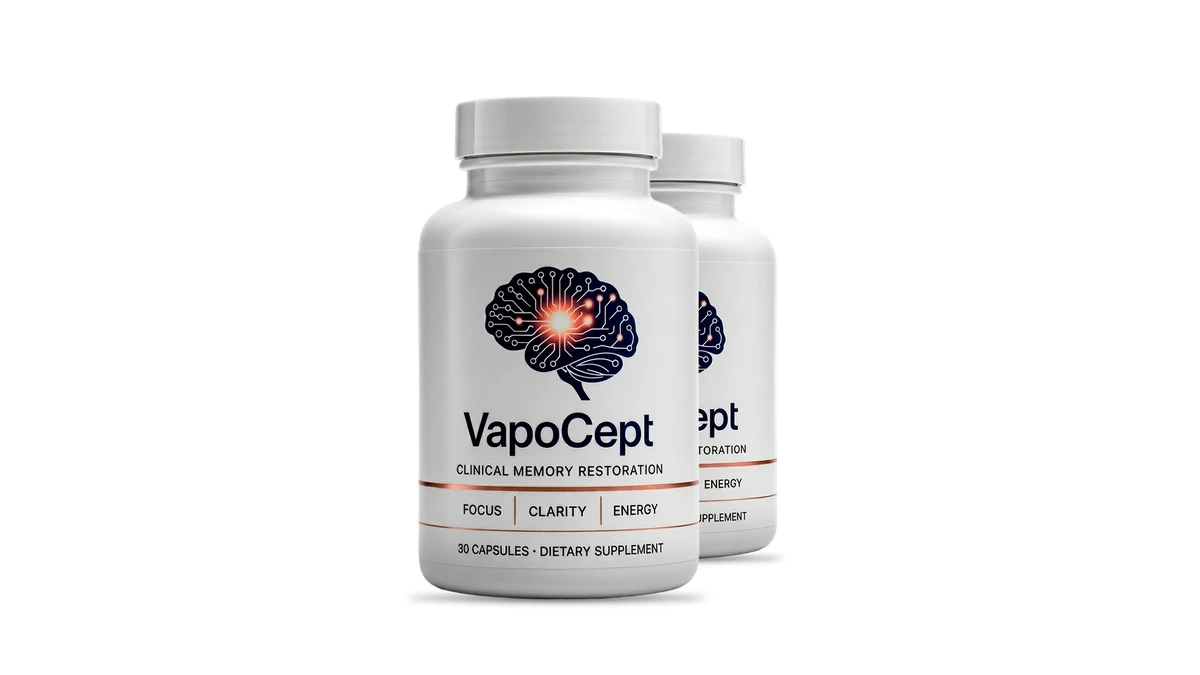
Despite the name, VapoCept is not a vapor product, an inhaler, a rub, or a drink. The reviewed page sells a once-daily capsule for oral use, taken with 8 ounces of water 20 to 30 minutes before a meal.
The page markets it for daily mental clarity, sustained energy, and overall cognitive well-being, without causing anxiety. The bottle front reads "CLINICAL MEMORY RESTORATION" with "FOCUS | CLARITY | ENERGY" underneath, and the label adds "Supports Focus and Mental Clarity" with an asterisk pointing to the standard FDA disclaimer.
That disclaimer matters. It states the product has not been evaluated by the FDA and is not intended to diagnose, treat, cure, or prevent any disease. The page makes no disease claim in words, but "memory restoration" on a bottle is a strong promise for a product with no finished-product trial behind it.
One name, four formulas
This is the finding that should stop a buyer first. Public pages under the VapoCept name sell at least four mutually incompatible formulas, and the reviewed page is only one of them.
- The reviewed formula (botanical capsule). Glucosamine sulfate 250 mg, ginkgo 100 mg, turmeric 50 mg, marigold 25 mg, green tea 15 mg, and bamboo 5 mg. This is the panel on the reviewed checkout page, and it is the formula this review judges.
- An amino-acid capsule. Niacin, calcium, two forms of arginine, two forms of citrulline, and beta-alanine, in the same circulation-style recipe we previously reviewed under the MemoVance name. A buyer who reads a review of that formula is not reading about this bottle.
- An 8-nootropic capsule. Ginkgo, bacopa, huperzine A, lion's mane, phosphatidylserine, alpha GPC, L-theanine, and niacin, with no doses published anywhere on the page. One page in this family even contradicts itself, describing an amino-acid formula in one section and the 8 nootropics in another.
- A 4-compound eucalyptol capsule. Eucalyptol at 250 mg per capsule, plus phosphatidylserine, lion's mane, and bacopa with no doses given, pitched to adults over 50 with a story about overnight brain clearance that no cited human trial supports.
Prices conflict across families too. Most families use the same 2, 3, and 6 bottle tiers at $79, $69, and $49 per bottle, but the 8-nootropic family lists 1, 3, and 6 bottles at $69, $59, and $49 per bottle. Guarantee wording conflicts as well, with purchase-date and delivery-date versions in circulation.
The practical consequence is plain. A buyer cannot reliably know which formula ships from the name alone, and a review of one VapoCept is not a review of them all. Check the Supplement Facts panel on the bottle you actually receive against the panel in this review before trusting any claim made about the name.
Who sells it: the company check
The operator named on the label and in the Terms is Gex Corporation LLP, distributed from PO Box 12730, Ogden, Utah 84412, with phone +1 (507) 448-8190 and email [email protected]. That PO box and phone number are familiar from our earlier teardowns of SodaSlim, BloodPril, Olivaro, and others in the same seller family.
BuyGoods, a Delaware corporation in Wilmington, is named as the retailer of record, and it expressly disclaims endorsement, approval, or review of the product or its claims. A retailer handling payment says nothing about whether the health claims are true.
Transparency is thin beyond those lines. No founder, no manufacturer name, no factory address, and no About page were found on the reviewed page. The footer legal pages are generic templates hosted on a different domain, and they carry leftovers from other products: the Returns page refers to a purchase on a different site and to an "Experience Store and Institute," and the Privacy page lists an unrelated Brazilian unsubscribe address.
The page also carries a testimonial disclaimer even though it shows no testimonials. It says names have been changed to protect privacy and that results are not guaranteed. A disclaimer for testimonials that do not exist is template copy, not transparency, and it tells buyers the legal pages were not written for this product.
What the ads claim, and what the evidence says
The reviewed page itself is quiet: no named doctor, no cited study, no individual testimonial, no countdown timer, and no stock counter. The claims live on the bottle and in the short product description, and they are tested below against trusted sources.
| Claim (from the reviewed page or bottle) | What the evidence actually says | Grade |
|---|---|---|
| "CLINICAL MEMORY RESTORATION" | No finished-product trial of VapoCept was found, so nothing clinical about this product has been shown. The word "clinical" on a bottle is marketing, not a trial result. | F: no product evidence |
| Ginkgo supports memory and focus | The GEM trial (3,069 adults aged 75 and older, 240 mg per day, median 6.1 years) found ginkgo ineffective for preventing dementia or Alzheimer disease. Mayo Clinic states research does not support taking ginkgo to prevent or slow dementia or cognitive decline. | D: large trial negative, dose below trial dose |
| Turmeric supports cognition | The best-known memory trial used a specially formulated, highly absorbable curcumin at 180 mg per day for 18 months in 40 adults. VapoCept lists 50 mg of an unspecified turmeric extract with no curcumin content stated, so the trial cannot be transferred to this label. | D: formulation and dose do not match |
| Daily clarity, sustained energy, no anxiety | No trial supports this combination for clarity or energy at these doses. The green tea extract supplies only 7.5 mg of EGCG, and the caffeine content is small and unstated, so neither an energy effect nor a no-anxiety claim has evidence behind it. | F: no trial at these doses |
| "Manufactured in the USA," GMP and FDA-facility badges | FDA does not approve dietary supplements before they are marketed, and facility registration is not product approval. The badges describe a facility, not a tested product. | Misleading if read as approval |
Ingredients
The reviewed label names six actives and no proprietary blend, which is genuinely better than the hidden-blend labels common in this market. Every amount is printed, so every amount can be checked. The check is the problem.
- D-Glucosamine sulfate potassium chloride, 250 mg. A joint-health ingredient, studied for joint comfort, not for memory or cognition. It contributes nothing to a memory claim, and buyers with a shellfish allergy should note that glucosamine is commonly shellfish derived.
- Ginkgo leaf extract 4:1, 100 mg. The only ingredient with large human trials, and those trials are negative for dementia prevention. The extract is not shown to be the standardized EGb 761 extract used in the GEM trial.
- Turmeric root extract 30:1, 50 mg. A concentrated extract with no curcumin amount stated, so no dose comparison is possible at all. Extract ratios are not doses, and a 30:1 ratio does not mean 1,500 mg of turmeric root.
- Marigold flower extract, 25 mg, standardized to 5% lutein. That is 1.25 mg of lutein per capsule, a small nutritional amount with no memory trial behind it at this level.
- Green tea leaf extract, 15 mg, standardized to 98% polyphenols, 80% catechins, 50% EGCG. That is 7.5 mg of EGCG, a small antioxidant amount, not a studied memory or energy dose.
- Bamboo leaf extract 30:1, 5 mg, standardized to 70% silica. That is 3.5 mg of silica, a connective-tissue nutrient with no human cognition trials.
The capsule shell is bovine gelatin, which rules the product out for vegetarians and vegans. The other ingredients are magnesium stearate and microcrystalline cellulose, both standard and inactive.
Supplement label breakdown
One capsule per day, 30 capsules per bottle, gives a 30-day supply per bottle and matches the tier math: 2 bottles for 60 days, 3 for 90 days, 6 for 180 days. The six actives sum to 445 mg per capsule by arithmetic, though the label states no blend total.
| Ingredient | Label dose | Trial dose or finding | Gap |
|---|---|---|---|
| Ginkgo | 100 mg per day | GEM trial: 240 mg per day, 3,069 adults, median 6.1 years, no dementia prevention | Less than half the trial dose, and the trial was negative |
| Turmeric extract | 50 mg per day, curcumin content not stated | Theracurmin trial: 180 mg bioavailable curcumin per day, 18 months, 40 adults, memory and attention gains | Cannot be compared: different formulation, unknown curcumin amount |
| Marigold (lutein) | 1.25 mg lutein per day | No memory trial at this level found | Small nutritional amount, not a trial dose |
| Green tea (EGCG) | 7.5 mg EGCG per day | No memory trial at this level found | Small antioxidant amount, not a trial dose |
| Glucosamine sulfate | 250 mg per day | Studied for joints, not cognition | Wrong outcome: no memory evidence at any dose |
| Bamboo (silica) | 3.5 mg silica per day | No human cognition trials found | No memory evidence at any dose |

The label also carries a real caution that buyers should heed. It says pregnant or nursing mothers, children under 18, and people with a known medical condition should consult a physician before use, and it says not to exceed the recommended dose. That caution is more useful than the marketing copy above it.
Real reviews and complaints
We checked each platform separately: BBB, Trustpilot, Reddit, Amazon, Facebook, Instagram, and X. No genuine independent buyer review of VapoCept was found on any of them, and no BBB complaint record for VapoCept was found.
What exists instead is seller-page rating inflation. Different VapoCept pages claim 4.8 out of 5 from 3,156 buyers, 4.8 out of 5 from 10,250 customers, 5.0 out of 5 from 23,300 reviews, and other conflicting totals, with no platform link behind any of them. Those numbers cannot all describe the same verified buyer pool, and none of them can be checked.
On-page accounts on audit-style affiliate pages are marketing, not independent reviews, and their own pages admit the portraits are stock images. Weighted as the protocol requires, the critical accounts matter most, and they are instructive even as marketing.
- Wrong format, mismatched label (critical). One account describes ordering from one site, expecting a drink powder, receiving capsules, and finding the bottle ingredient list did not match what was read. That account, even unverified, is exactly what the four-formula confusion predicts.
- No effect after ten weeks (critical). Another account reports ten weeks with no change it could name, while crediting the company for a refund without an argument. A refund story is not an effectiveness story.
- Partial effect, confounded (mixed). A third account reports easier afternoon reading but unchanged name recall, and another reports weight change alongside walking and cutting soda, which cannot be attributed to a capsule. Positive accounts on seller pages mostly praise the guarantee, not a measured memory change.
The honest summary is that there is no independent mix to report. The absence of a genuine review pool is itself a finding: a product sold this widely, under this many pages, has no verifiable buyer record on any independent platform we checked.
Expert views: has anyone actually tested this product?
No. No independent lab test of VapoCept was found in searches of ConsumerLab, USP, and NSF listings, FDA lab findings, and PubMed, and no finished-product clinical trial of VapoCept was found. One seller page claims third-party testing for purity and potency but names no tester, no certificate, and no lot result, which is a marketing claim, not a test.
Category testing is the context, and it must not be mistaken for a test of this product. A 2018 JAMA Network Open analysis found 776 adulterated supplement products, mostly for sexual enhancement, weight loss, and muscle building. A 2014 JAMA analysis found that two thirds of recalled supplements with hidden drugs were still adulterated after recall. A 2024 JAMA analysis of galantamine products found 9 of 10 outside 10 percent of the labeled amount and 3 of 10 contaminated with bacteria.
Those studies tested other products, not VapoCept, and they are cited here only to explain why an untested product with no certificate deserves skepticism. They do not prove anything about this bottle, in either direction.
Named expert positions point the same way as the trials. The National Center for Complementary and Integrative Health states there is no conclusive evidence that ginkgo is helpful for any health condition, and that ginkgo does not help prevent or slow dementia or cognitive decline. Mayo Clinic states research does not support taking ginkgo to prevent or slow dementia or cognitive decline, and warns about bleeding risk, including stopping ginkgo two weeks before surgery.

Price, packages, and the guarantee
Prices are visible on the reviewed page itself, with an anchor of $179 per bottle behind every tier. There is no single-bottle tier.
| Package | Total | Per bottle | Shipping | Cost per day |
|---|---|---|---|---|
| 2 bottles, 60-day supply | $158 | $79 | $9.99 | $2.80 including shipping |
| 3 bottles, 90-day supply | $207 | $69 | Free | $2.30 |
| 6 bottles, 180-day supply | $294 | $49 | Free | $1.63 |
The "YOU SAVE" figures are anchor-minus-sale arithmetic: $200, $330, and $780. No bonus, no pre-checked add-on, and no subscription or auto-ship term was visible on the first step of the page. Later checkout steps were not opened, because reaching them requires clicking a purchase button, so any upsell or subscription term that appears only at checkout is not covered by this review.
The guarantee is where the page stops being simple. The headline promises a 60-day, 100 percent satisfaction guarantee with a refund of "every penny, no questions asked." The Terms refund policy says to email within 60 days of delivery and return the bottles, even empty, with refunds in 3 to 5 business days. The Returns page says the 60 days run from the order or purchase date, requires returning all bottles plus the packing slip, states the buyer pays return shipping, and puts refunds at 5 to 10 days.
That is a real conflict, not a wording quibble. A buyer who waits for delivery, then uses the product for several weeks, can be inside one version of the window and outside the other. The 6-bottle tier is also a 180-day supply sold under a 60-day guarantee, so most of the largest pack sits outside the refund window by design. Buyers should also note the Terms choose the laws of Barbados, with binding arbitration in St. Michael, Barbados, and a class-action waiver.
Potential side effects
At these small doses, the most likely effects are mild digestive upset, headache, or dizziness, and the label itself warns against exceeding the dose. The ingredient-specific risks matter more than the dose size for older adults on common medicines.
- Ginkgo and bleeding risk. Ginkgo has an antiplatelet effect, and Mayo Clinic lists bleeding, headache, dizziness, stomach upset, and palpitations among its effects. Anyone on warfarin or another blood thinner, anyone with a bleeding condition, and anyone facing surgery should get a prescriber check first. Our supplement interactions guide covers the blood-thinner pairs in detail.
- Green tea and caffeine sensitivity. The green tea extract carries a small, unstated amount of caffeine. It is well under a cup of coffee, but caffeine-sensitive buyers and anyone taking it late in the day should know it is there.
- Glucosamine and shellfish allergy. Glucosamine is commonly derived from shellfish. Buyers with a shellfish allergy should confirm the source before use, since the label does not state it.
- Bovine gelatin capsule. The shell rules the product out for vegetarians, vegans, and anyone avoiding bovine-derived ingredients, and that is a label fact, not a side effect.
This is not medical advice. Anyone who feels unwell after starting a supplement should stop and speak to a healthcare professional, and anyone on prescription medicines should take the full label to a pharmacist first. Our supplement dosage guide explains why label doses, not marketing doses, are the numbers that matter.
Who should avoid it
- People on blood thinners or facing surgery. Ginkgo adds bleeding risk, and Mayo Clinic advises stopping ginkgo two weeks before surgery. Get a prescriber decision, not a checkout-page decision.
- People with new or worsening memory changes. A capsule is not a workup. Persistent forgetfulness, confusion, or changes that affect driving, money, or daily life need a clinician, not a 60-day trial.
- People with a shellfish allergy, or vegetarians and vegans. The glucosamine source is unstated and the capsule shell is bovine gelatin.
- Pregnant or nursing mothers and children under 18. The label itself tells these groups to consult a physician first, and the product is not made for them.
- Anyone who cannot verify which formula they are buying. If the bottle that arrives does not match the botanical panel in this review, none of the dose analysis here applies to it, and the guarantee terms on the page you bought from are the ones that govern.
For comparison, our MemoVance review covers the amino-acid memory formula that circulates under a different name, and our Cognizil review covers another quiet memory product from the same seller family. The pattern across all three is the same: a memory pitch, small or hidden doses, and an Ogden return address.
Conclusion
VapoCept, as reviewed here, is a fully disclosed label that fails its own check. Ginkgo is the strongest ingredient, and the strongest trial of ginkgo is negative. Turmeric cannot be checked at all, because its curcumin content is unstated. The remaining ingredients are small nutritional amounts or joint and connective-tissue ingredients with no memory evidence.
The four-formula problem makes the verdict worse, not better. Even a buyer who accepts the reviewed label cannot be sure that label is the one that ships under the VapoCept name. Add a guarantee whose start date and refund timing change between pages, a Barbados arbitration clause, and no independent test or review record, and the case for spending $158 to $294 is not made.
Memory concerns deserve better than a bottle with a restoration claim and no trial. See a clinician, review medications and sleep and mood with that clinician, and keep the $1.63 to $2.80 per day until a product can show its own evidence at its own dose.
Sources
- National Center for Complementary and Integrative Health. The Ginkgo Evaluation of Memory (GEM) Study. 240 mg per day of ginkgo was ineffective in reducing dementia and Alzheimer disease in older people.
- Mayo Clinic. Ginkgo. Research does not support taking ginkgo to prevent or slow dementia or cognitive decline; lists bleeding risk and stopping two weeks before surgery.
- Small GW et al. Memory and Brain Amyloid and Tau Effects of a Bioavailable Form of Curcumin in Non-Demented Adults: A Double-Blind, Placebo-Controlled 18-Month Trial. American Journal of Geriatric Psychiatry. 2018. Theracurmin 90 mg twice daily for 18 months in 40 adults.
- U.S. Food and Drug Administration. Questions and Answers on Dietary Supplements. FDA does not approve dietary supplements before they are marketed and generally does not approve supplement claims or labeling before use.
- Tucker J et al. Adulterated Dietary Supplements. JAMA Network Open. 2018. Category context only: 776 adulterated products analyzed; not a test of VapoCept.
- Cohen PA et al. Presence of Banned Drugs in Dietary Supplements Following FDA Recalls. JAMA. 2014. Category context only: two thirds of recalled supplements with hidden drugs remained adulterated.
- Cohen PA et al. Label Accuracy of Galantamine Products. JAMA. 2024. Category context only: 9 of 10 products outside 10 percent of the labeled amount, 3 of 10 contaminated.
- National Center for Complementary and Integrative Health. Using Dietary Supplements Wisely. General guidance on supplement safety and talking to a healthcare provider.
Review note: Product details, label, prices, and terms were taken from the seller's sales page and footer legal pages as of October 27, 2026; prices and offers can change. Other pages under the VapoCept name sell different formulas, prices, and guarantee wordings, and those differences are reported in the article body as findings about the product's sales operation. No seller or affiliate URL is published in this review.
Fact-checked by the SupplementDecoded Research Editorial Team