
Table of ContentsShow ChaptersHide Chapters
Medical Disclaimer
This article is for informational purposes only and does not constitute medical advice. Always consult with a qualified healthcare professional before starting any new supplement regimen.
Read our Medical / Expert Review Policy and Medical Disclaimer for details.
Key takeaways: Arthryon is a topical arthritis heat relief cream, not a capsule or supplement. Its own label discloses under 0.1% camphor as the only active ingredient percentage, far below the camphor levels in standard over-the-counter topical analgesics. Capsaicin is listed last among the other ingredients with no percentage at all, so its dose cannot be checked against any study. The reviewed page is an affiliate presell page, not the seller, and it shows no prices: pricing sits on the order page behind its order button.
Article Contents: Verdict, Specifications, What is Arthryon?, Who sells it: the company check, What the ads claim, and what the evidence says, Ingredients, Supplement label breakdown, Real reviews and complaints, Has anyone actually tested this product?, Price, packages, and the guarantee, Potential side effects, Who should avoid it, Conclusion, Sources
Verdict
Arthryon is a warming cream for sore joints, and its pitch is simple: rub it on, feel heat, move more easily. That part is plausible. Warming ingredients can create a soothing sensation on the skin.
But the product's own label undercuts the pitch. The only active ingredient percentage it discloses is camphor at under 0.1%. Standard over-the-counter topical analgesics carry camphor at 3.85% to 9.6%, so this cream's disclosed camphor is at least 38 times weaker than the low end of that range.
Capsaicin, the other warming ingredient, has no percentage anywhere on the page. Without a dose, no claim about it can be checked against the trials. Add a 4.8 out of 5 rating from 12,000 plus customers with no source, no methodology, and no way to verify a single review, and the sales page asks for more trust than it earns.
Bottom line: this is a lightly dosed warming cream sold through affiliate marketing, not a proven arthritis treatment. Talk to your doctor or pharmacist about topical options with disclosed active ingredient percentages before spending money on it.
Specifications
| Product | Arthryon Heat Relief Cream (also sold as Arthryon Arthritis Heat Relief Cream) |
|---|---|
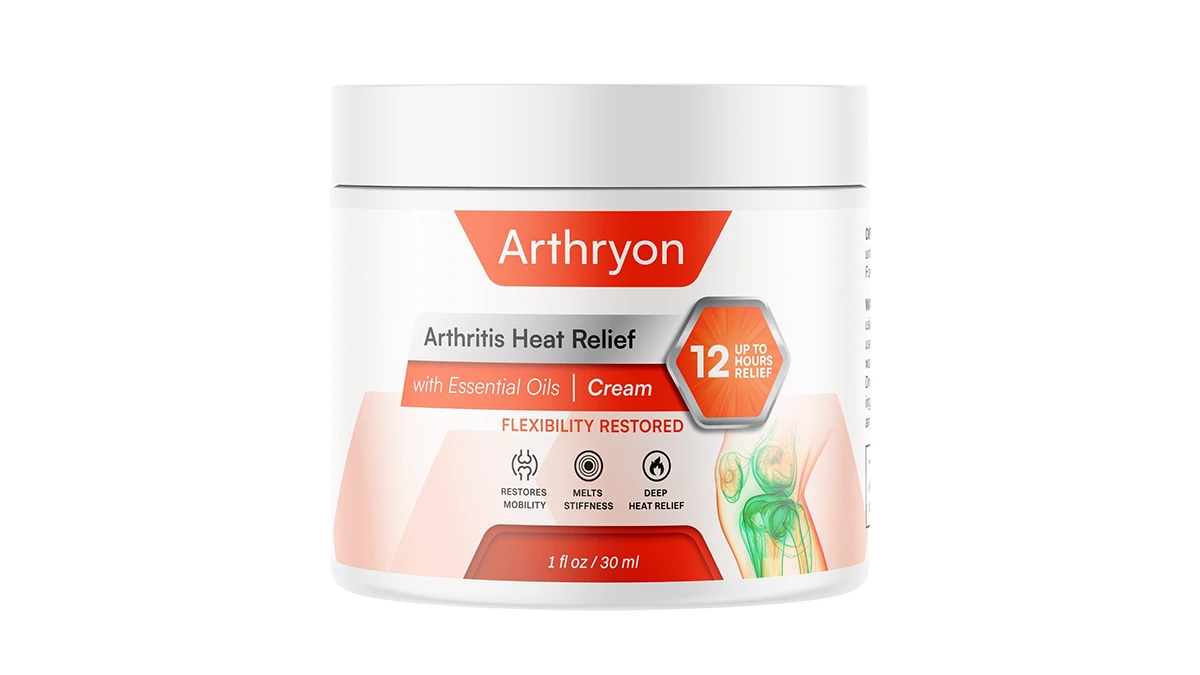
| Form | Topical cream in a jar, 1 fl oz (30 ml) per jar, as shown on the product photo |
| Active ingredient disclosed | Camphor, under 0.1%. No other active ingredient percentage is disclosed. |
| Other named ingredients | Arnica extract, camphor (again, in the other-ingredients list), capsaicin (no percentage), hemp seed oil, aloe vera, shea butter, cocoa butter, avocado oil, emu oil, vitamin E, and others |
| Not on this page | Menthol, hyaluronic acid, and tea tree oil, which other Arthryon pages list. See the variant conflict in the company check. |
| Price (order page, October 26, 2026) | 2 jars $119.90 ($59.95 per jar); 3 jars $149.85 ($49.95 per jar); 5 jars $179.85 ($35.97 per jar); free shipping on all tiers |
| Guarantee | 30-day money-back guarantee as stated on the order page, with no start date, return procedure, return address, or return-shipping payer stated anywhere found |
| Page reviewed | An affiliate presell page for US residents. The page states it is not owned by, and not directly affiliated with, the brand it promotes. |
| Seller of record | No legal company name found. The order site's terms cite California law, its privacy page leaves the telephone field blank, and the only seller contact found is a support phone number, +1-323-286-4947, the same number that appeared on the AQUATHRIVE checkout variant |
What is Arthryon?
Arthryon is a topical cream rubbed onto sore knees, hands, shoulders, back, elbows, and other joints. It is not swallowed, and it is not a dietary supplement, even though the page footer carries a supplement-style disclaimer saying its statements have not been evaluated by the Food and Drug Administration (FDA).
The page promises soothing, long-lasting heat relief that temporarily relieves minor arthritis pain, eases joint stiffness, and supports comfortable movement. It claims up to 12 hours of warming relief and says many users feel warmth within minutes.
The jar in the product photo reads "Arthritis Heat Relief with Essential Oils, Cream, Flexibility Restored, 1 fl oz / 30 ml." Thirty milliliters is a small jar. For comparison, many drugstore topical analgesics come in tubes of 57 grams (2 ounces) or larger, so buyers should check how long one jar lasts with daily use.
Arthryon is sold only online through affiliate and checkout pages. No pharmacy listing, no drugstore shelf presence, and no Drug Facts panel were found for this product. For a broader look at how to judge joint products, see the site's joint pain management guide.
Who sells it: the company check
The reviewed page does not sell Arthryon. Its footer states plainly that the site is not owned by Vital Hemp and is not directly affiliated with it, and its terms state that the site is for informational and promotional purposes only and earns commission when visitors click through and buy.
That makes the reviewed page an affiliate presell page: a promoter's page that warms up the buyer and then hands them to a checkout page through a tracking redirect. The page names no street address, no email address, and no phone number for itself. Its terms name no state for its governing law, saying only "the laws of the United States and the State in which the site operates."
The brand named in the footer is Vital Hemp. No company registration, address, or contact details for that brand appear on the reviewed page. The order page behind the order button is where the actual seller, prices, and refund terms live, and those details belong in the price section of this review.
Variant conflict: the formula changes depending on which page you land on
Other Arthryon pages found on the web describe a different formula. They list menthol, hyaluronic acid, and tea tree oil as key ingredients, and one describes a "triple-action blend" of arnica oil, hyaluronic acid, and tea tree oil.
None of those three ingredients appears anywhere on the reviewed US page. Its ingredient list has no menthol, no hyaluronic acid, and no tea tree oil. Instead, its warming ingredients are camphor and capsaicin.
This matters because a buyer cannot tell from the product name alone which formula they would receive. A cream with menthol is a different product from a cream without it, and the pages do not explain the difference. Prices differ across variants too, so any price quoted from one page may not match another.
A second product shares the name: an oral capsule that may not be sold at all
A separate cluster of advertorial articles promotes an oral Arthryon capsule, described as restoring joint fluid, blocking inflammatory signals, and rebuilding cartilage. Its ingredient list changes from article to article: one version lists hyaluronic acid, undenatured type II collagen, and Boswellia; another adds curcumin, grape seed extract, and pine bark; another adds vitamin K2.
No dose is given for any ingredient in those articles, no checkout page for the capsule was found, and the articles cite in-house "trials" with conflicting results (from 37% pain reduction in 12 users over 30 days to 78% less morning stiffness in 100 users over 8 weeks), none naming a journal, a trial registry, or an author. Treat those numbers as advertorial assertions, not studies.
The cream reviewed here is the product actually sold through checkout pages. The capsule pitch could not be traced to a purchasable product, and its claims must not be borrowed to support the cream. A similar name-sharing problem appeared with ArtiZynt, where affiliate pages sold a gel while the reviewed page sold capsules.
What the ads claim, and what the evidence says
| Page claim | What the evidence actually says | Grade |
|---|---|---|
| Up to 12 hours of warming relief | No study of Arthryon exists, and no duration trial is cited. The 12-hour figure is the seller's own claim, not a measured result. | Unproven |
| Temporarily relieves minor arthritis pain | Topical capsaicin is conditionally recommended for knee osteoarthritis by the 2019 American College of Rheumatology guideline, but only with small effect sizes and wide confidence intervals. The guideline recommends against it for hand osteoarthritis. Arthryon's capsaicin dose is undisclosed, so this recommendation cannot be transferred to it. | Weak, and not transferable without a dose |
| Reduces inflammation (arnica) | A 2013 Cochrane review found arnica gel probably improves pain and function about as well as an NSAID gel in hand osteoarthritis, but with no better, and possibly worse, side effects. That was a tested arnica gel at a known formulation, not this cream. | Moderate for arnica gel in general, unproven for this cream |
| Restores mobility and melts stiffness | No trial measured mobility or stiffness for Arthryon. Warming sensations can feel soothing, but feeling warmer is not the same as moving better. | Unproven |
| Rated 4.8 out of 5 by 12,000 plus customers | No review source, no review platform, no methodology, and no link are shown. The four "verified buyer" testimonials on the page give first names and initials only, with no way to check them. | Unverifiable |
| Doctor recommended and third-party lab tested (claimed on other Arthryon pages) | No doctor is named, no lab is named, and no test report is shown on the reviewed page. Treat these as affiliate page claims, not facts. | Unverifiable |
Ingredients
The cream's warming action is supposed to come from camphor and capsaicin. Camphor creates a warm, tingling sensation on the skin. Capsaicin, the compound that makes chili peppers hot, creates a deeper warmth and can reduce pain signals with repeated use.
Arnica extract is the botanical ingredient with the best topical evidence, as described above. Aloe vera, shea butter, cocoa butter, avocado oil, and emu oil are moisturizers and skin conditioners. Hemp seed oil is a skin oil; it is not CBD, and the page does not claim it is.
- Camphor: disclosed at under 0.1% as the active ingredient. This is the central dose problem in this review.
- Capsaicin: listed last among the other ingredients, with no percentage. Its position at the end of the list suggests a small amount, but position in an ingredient list is not a dose, and no conclusion about its strength can be drawn from it.
- Arnica extract: listed without a percentage or extract strength. The Cochrane arnica evidence comes from tested gels, not from an undisclosed amount in a multi-ingredient cream.
- Hemp seed oil: a culinary and cosmetic oil. It contains no meaningful CBD, and no CBD claim is made on the reviewed page.
- Emu oil, shea butter, cocoa butter, avocado oil: moisturizing oils and butters. They explain the cream's texture, not its pain relief.
Supplement label breakdown
There is no Drug Facts panel on the reviewed page. A proper over-the-counter topical analgesic label states its active ingredients with percentages, its purpose, its uses, its warnings, and its directions. This page's label panel is hidden behind a "Click to see full label" button and contains only an ingredient list.

The disclosed active ingredient line reads "under 0.1% camphor." Compare that with real over-the-counter labels: one DailyMed-listed external analgesic lists camphor at 9.6% with capsaicin at 0.05%, and a roll-on lists menthol at 3.85%, camphor at 3.85%, and capsaicin at 0.0355%.
That means the reviewed cream's disclosed camphor is less than one thirty-eighth of the 3.85% comparator and less than one ninety-sixth of the 9.6% comparator. A warming cream with under 0.1% camphor may still feel slightly warm, but it cannot be compared to products carrying 40 to 100 times more of the same ingredient.
Other label gaps matter too:
- No capsaicin percentage. Capsaicin trials and guideline recommendations use known concentrations, usually 0.025% to 0.075% for low-dose creams. An undisclosed amount cannot be matched to any of them.
- Camphor listed twice. Camphor appears both as the active ingredient and again in the other-ingredients list. That duplication suggests the label was assembled from a template, not checked.
- Cetyl alcohol listed twice. The same duplication appears with cetyl alcohol, another sign of an unchecked label.
- No directions or warnings panel. No application frequency, no maximum uses per day, no "do not use on broken skin" warning, and no "stop use and ask a doctor if" section appear on the page, even though the FAQ tells users to avoid eyes, face, broken skin, and sensitive areas.
- No container size in the label text. The 1 fl oz (30 ml) size comes only from the product photo, not from the label panel.
- No manufacturer name or address. No maker, distributor, or contact appears on the label panel.
Talk to your doctor or pharmacist before trying any topical product whose active ingredient percentages are missing. The percentage is what turns a warming sensation into a checkable medicine.
Real reviews and complaints
No genuine independent buyer reviews of Arthryon were found on any platform checked: not on the Better Business Bureau, Trustpilot, Reddit, Amazon, Facebook, Instagram, or X. No genuine Amazon listing exists, so there are no Amazon buyer reviews to report. That absence is the finding. A checkout-only product with no named company and no retail listing leaves buyers few public places to complain, and few places for a future buyer to check.
What does exist is marketing dressed as reviews. The sales page shows a 4.8 out of 5 rating from 12,000 plus customers with no platform, no methodology, and no link. A separate guide page claims 4.8 out of 5 from 15,000 plus ratings, again with no platform named. Those two numbers cannot both describe the same verified review pool, and neither can be checked.
The sales page's four "Verified Buyer" testimonials are undermined by the order page's own footer, which admits that the names and photographs in its testimonials have been changed and that the individuals depicted were remunerated. A testimonial with a changed name, a changed photo, and payment behind it is an advertisement, not a verified buyer review. The guide page goes further, labeling its own testimonials as "sample-style perspectives" and "not clinical evidence."
Positive quotes on affiliate-style review pages (three named buyers praising warming speed and mobility) carry no purchase verification and were not quoted here as buyer experience. In line with this site's weighting rule, the critical finding is not a complaint but the complete absence of a verifiable buyer record combined with paid, renamed testimonials presented as verified.
Has anyone actually tested this product?
No independent laboratory test of Arthryon itself was found. No FDA laboratory finding, no ConsumerLab report, no USP or NSF listing, and no peer-reviewed test names this product. The page's "third-party lab tested" wording appears only on other affiliate pages, with no lab named and no report shown, so it is an unverified marketing claim.
What testing of the wider category has found is a warning, not a reassurance. The FDA maintains a long list of pain and arthritis products found to contain hidden prescription drugs, including diclofenac and steroids, that were not on their labels. Its most recent entry, Ultra Bon, was flagged on October 23, 2026, after FDA laboratory analysis found undeclared diclofenac in a product sold for arthritis, pain, and osteoporosis.
That finding is about other products, not about Arthryon, and this review does not claim Arthryon contains hidden drugs. The point is narrower: in a category where hidden ingredients are a documented problem, a product that does not fully disclose its own active ingredient percentages gives buyers less to check, not more.
Named expert positions point the same way. The National Center for Complementary and Integrative Health (NCCIH), summarizing the osteoarthritis evidence, notes that a 2013 evaluation found arnica gel might be helpful while capsicum extract gel probably is not. The American College of Rheumatology conditionally recommends topical capsaicin for knee osteoarthritis only, with small effect sizes, and recommends against it for hand osteoarthritis.
Price, packages, and the guarantee
The sales page shows no prices at all. Prices appear only on the order page behind the order button, which is why a review that stopped at the sales page would wrongly report "no prices." On October 26, 2026, the order page offered three tiers, all with free shipping:
| Tier | Total | Per jar | Struck-through "retail" |
|---|---|---|---|
| Buy 2 jars ("Lesser Effect") | $119.90 | $59.95 | $180 |
| Buy 2, get 1 free ("Mid Efficiency") | $149.85 | $49.95 | $270 |
| Buy 3, get 2 free ("Max Efficiency") | $179.85 | $35.97 | $450 |
The 5-jar tier is pre-selected when the order page loads, and a discount code is pre-filled. No subscription, auto-billing, or trial wording was found on the initial order step, and no separate bonus product or pre-checked add-on was visible there. A later "Bonuses" step exists after payment, so post-payment upsells cannot be ruled out from this read.
The order page's urgency tactics are much stronger than the sales page's. The sales page has no countdown timer, no stock counter, and no pop-ups. The order page shows a 10-minute "free bottles reserved" countdown, a "Current Availability: LOW, Sell Out Risk: HIGH" banner, a warning about limited supply, and rotating purchase pop-ups naming buyers by first name, initial, and state.
The guarantee is a 30-day money-back guarantee, stated on the order page in one sentence with no fine print attached. Nothing found states the start date (order date or delivery date), whether opened or used jars can be returned, the return address or procedure, who pays return shipping, or any restocking fee. The order page's terms refer to a returns policy, but no returns policy page is linked from either site's footer, so those terms could not be verified.
One secondary price structure conflicts with the order page: an affiliate-style review page lists 1 bottle at $49.95, 3 bottles at $99.90, and 5 bottles at $149.85. That page could not be fully loaded to verify its figures, so the order-page prices above, dated October 26, 2026, are the ones this review stands behind, and the conflict itself is evidence that Arthryon prices vary by page.
Because the jar is only 1 fl oz (30 ml) and no applications-per-jar figure is given, no reliable per-day cost can be computed. A buyer who uses the cream daily on multiple joints could go through a small jar quickly, which makes the 5-jar bundle the only tier that lasts, and the pre-selection of that tier worth noticing.

Potential side effects
Topical warming creams most commonly cause skin redness, burning, stinging, and itching where they are applied. The Cochrane review of topical herbal products for osteoarthritis found that capsicum gel caused adverse events in 80% of users compared with 20% on placebo in a knee osteoarthritis trial, mostly skin irritation and burning.
Other risks are specific to warming ingredients and older users:
- Never combine with external heat. Heating pads, hot water bottles, and hot compresses over a warming cream can cause burns. Other Arthryon pages warn about this directly, and it is standard advice for camphor and capsaicin products.
- Keep it away from eyes and sensitive skin. Capsaicin on the hands can transfer to the eyes, face, or other sensitive areas. Wash hands with cool water after applying, and do not apply to broken, irritated, or damaged skin.
- Do not bandage tightly over it. Tight bandaging traps heat and increases irritation risk.
- Allergic reactions are possible. Arnica and other botanicals can cause contact dermatitis in sensitive people. Stop use if a rash or lasting irritation develops.
- It can mask a worsening problem. A warming sensation can make a sore joint feel better while the underlying condition, such as an injury, infection, or inflammatory arthritis, goes unchecked. Pain that worsens, swelling with fever, a hot swollen joint, or an injury you cannot bear weight on needs prompt medical care, not more cream.
Because this cream's capsaicin percentage is undisclosed, its irritation risk cannot be predicted from the label. Start with a small amount on a small area if you and your doctor decide to try any warming cream, and stop if irritation lasts.
Who should avoid it
- People with broken, irritated, or damaged skin at the application site, including wounds, rashes, and sunburn.
- People who use heating pads or hot compresses on the same area, because of burn risk.
- Anyone allergic to arnica, camphor, capsaicin, or any listed ingredient, including the botanical oils in the formula.
- People with hand osteoarthritis seeking a guideline-backed topical: the rheumatology guideline recommends against topical capsaicin for hand osteoarthritis, and recommends topical NSAIDs for knee osteoarthritis more strongly than capsaicin.
- People whose joint pain is new, severe, suddenly swollen, hot, or accompanied by fever: those symptoms need medical evaluation, not a warming cream.
- People who are pregnant or breastfeeding: standard topical analgesic labels advise asking a health professional first, and this page gives no pregnancy guidance at all.
- Children: the page gives no age guidance, while standard topical analgesic labels restrict use in young children.
Talk to your doctor or pharmacist first if you take blood thinners, use other topical medicines on the same area, or have sensitive skin. This is general information, not medical advice for your situation. The site's supplement interactions guide and dosage guide explain why checking interactions and doses matters even for products applied to the skin.
Conclusion
Arthryon sells a familiar idea: a warming cream that makes stiff joints feel better. The idea itself is not unreasonable. Warming ingredients have a real, if modest, place in joint care, and arnica gel has some trial support.
The product, as presented on the reviewed page, does not live up to that idea. Its only disclosed active ingredient sits at under 0.1% camphor, its capsaicin dose is missing entirely, its rating and testimonials cannot be verified, its formula differs from other pages selling the same name, and its seller hides behind an affiliate page with no address or phone number.
A buyer who wants a topical product with checkable dosing can find one: a pharmacy topical analgesic with a Drug Facts panel stating its active ingredient percentages. That label is the difference between a product you can evaluate and a page you must take on faith. On the evidence available, Arthryon falls on the faith side, and its price buys mostly warmth and marketing. The site's guide to choosing arthritis supplements sets out the same check: disclosed doses first, marketing second.
Sources
- National Center for Complementary and Integrative Health, Osteoarthritis: In Depth
- Cameron M, Chrubasik S. Topical herbal therapies for treating osteoarthritis. Cochrane Database of Systematic Reviews, 2013 (PubMed PMID 23728701)
- Kolasinski SL, et al. 2019 American College of Rheumatology/Arthritis Foundation Guideline for the Management of Osteoarthritis of the Hand, Hip, and Knee
- DailyMed, External Analgesic label: camphor 9.6%, capsaicin 0.05%, menthol 7.8%
- DailyMed, Pain Relieving Roll-On label: menthol 3.85%, camphor 3.85%, capsaicin 0.0355%
- FDA, Pain and Arthritis Products Containing Hidden Ingredients
- FDA, Ultra Bon may be harmful due to hidden ingredient (October 23, 2026)
- National Center for Complementary and Integrative Health, Complementary Health Approaches for Chronic Pain: What the Science Says
Review note: Product details, label, and terms for Arthryon were taken from the seller's sales and order pages as of October 26, 2026; prices and offers can change. The variant sweep examined the reviewed US affiliate presell page, the US and Canadian checkout funnels, the US guide page, the Australian sales page, and a separate oral-capsule advertorial family, and found the ingredient lists, prices, and ratings differ across them, as reported in the article. No OfferVault or Affplus listing for Arthryon surfaced in public search on that date. The review covers the product itself, not any single landing page.
Fact-checked by the SupplementDecoded Research Editorial Team