
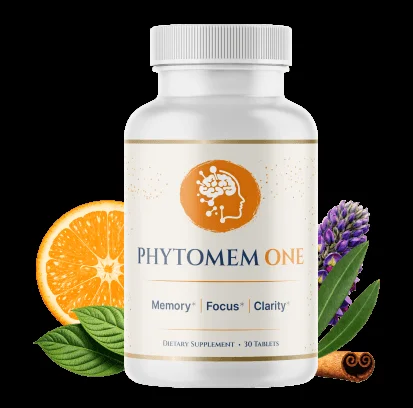
Table of ContentsShow ChaptersHide Chapters
Medical Disclaimer
This article is for informational purposes only and does not constitute medical advice. Always consult with a qualified healthcare professional before starting any new supplement regimen.
Read our Medical / Expert Review Policy and Medical Disclaimer for details.
Key takeaways:
- Phytomem One is sold as "precision brain support" for memory, focus, and clarity, but its 10-ingredient formula is a metabolic blend (blood sugar, weight, and cholesterol ingredients) with a brain pitch on top.
- Nine of the ten ingredients have zero published trials for memory or cognitive outcomes. The one exception, saffron, was tested only in diagnosed Alzheimer's patients at 30 mg a day, never in healthy older adults and never inside this product.
- The label hides every per-ingredient dose inside a single 458 mg proprietary blend, so no claim about any ingredient can be checked against the trial doses. Simple math shows the studied doses cannot plausibly fit.
- No FDA or FTC action names Phytomem One, and no independent lab has ever published a test of this product. The "FDA APPROVED" badge on the page is not what it implies: the FDA approves no dietary supplements.
- Berberine and fucoidan carry real interaction cautions for older adults on diabetes medicines and blood thinners. Talk to your doctor before combining this kind of formula with prescriptions.
Contents:
- Verdict
- What the page claims
- The page claims it, the evidence shows this
- The label: 458 mg, ten ingredients, zero disclosed doses
- The one ingredient with brain trials, and the catch
- Has anyone actually tested this product?
- Price and guarantee: the math
- Who is behind it
- Safety flags for older adults
- What to do instead
- Sources
Verdict
Phytomem One is a memory supplement whose formula has almost nothing to do with memory research.
The page promises "precision brain support" for memory, focus, and clarity. The actual label is a 458 mg proprietary blend of ten metabolic and botanical ingredients (berberine, cinnamon, banaba leaf, olive leaf, kelp extracts, kudzu flower, a blood-orange extract, saffron, and the sweetener xylitol). None of the per-ingredient doses are disclosed.
Nine of the ten ingredients have no published human trials for memory or any cognitive outcome. The tenth, saffron, was studied only in people already diagnosed with Alzheimer's disease, at 30 mg a day, and never inside a blend like this one. The studied ingredients were tested for blood sugar, weight, blood pressure, and cholesterol, not for sharper recall.
There is no independent lab test of this product, no FDA or FTC action naming it, and a stack of red flags on the sales page: an "FDA APPROVED" badge that cannot mean what it implies, 47,000 claimed success stories backed by three testimonials with changed names, and a guarantee whose fine print is stricter than its headline.
What the page claims
The sales page we reviewed in October 2026 leads with the headline "Precision Brain Support That Breaks The Stranglehold" and these promises:
- A "10-in-1 neuro-essential formula" built for "lasting mental clarity, recall, and resilience"
- It "addresses the Plastic Stranglehold AND Type 3 Diabetes for full-spectrum brain wellness"
- Laurels: "#1 BRAIN FORMULA," "47,000+ SUCCESS STORIES," and "JAPANESE BRAIN SCIENCE"
- Trust badges: GMO FREE, GMP CERTIFIED, FDA APPROVED, 100% NATURAL INGREDIENTS, MADE IN USA
- Bonus materials including "The Memory Shield Diet," said to be "developed by Dr. Nakamura himself" (no credentials or full name given anywhere)
Each ingredient gets its own heroic paragraph: saffron from "the same high-grade Persian strain studied at Tehran University of Medical Sciences," fucoxanthin "published in Neural Regeneration Research," fucoidan that supposedly clears "toxic protein buildups" and cuts oxidative stress "by up to 40%," and MoroSil, the "hero ingredient" that "enhances the bioavailability of every other ingredient in the formula."
The page claims it, the evidence shows this
Here is what the page says against what the research actually supports. Every evidence source below is a government health agency, a major medical institution, or peer-reviewed research.
| Page claim | What the evidence actually shows |
|---|---|
| "Addresses the Plastic Stranglehold AND Type 3 Diabetes" | Disease claims, not structure/function claims. There is no published trial of this product for any condition. NCCIH states that direct evidence that dietary supplements can prevent Alzheimer's disease or other forms of dementia is lacking. |
| "FDA APPROVED" badge | The FDA approves no dietary supplements. The page's own fine print carries the standard disclaimer that the statements have not been evaluated by the FDA. |
| Saffron "shown to reduce neuroinflammation and protect neurons" | One small trial (46 patients with probable mild-to-moderate Alzheimer's, 16 weeks, 30 mg/day) found saffron beat placebo on cognitive scores. Every cognitive trial enrolled diagnosed Alzheimer's patients, not healthy older adults, and none tested saffron inside a multi-ingredient blend. |
| Fucoxanthin "published in Neural Regeneration Research to support the growth of new neural connections" | The human trials are small, short weight studies: 1 to 3 mg/day for 4 weeks in mildly obese adults. A systematic review confirms the human evidence is limited to obesity parameters. No human trial tests fucoxanthin for cognition; the neural-regeneration evidence is not from human cognitive trials. |
| Fucoidan "shown to clear toxic protein buildups and reduce oxidative stress by up to 40%" | No published trials test fucoidan for cognitive outcomes. Laboratory research documents heparin-like anticoagulant activity, which is a caution, not a brain benefit, for older adults on blood thinners. |
| Berberine "activates AMPK... so your neurons can finally fuel themselves" | Berberine's evidence is modest blood-glucose lowering in people with type 2 diabetes (50-trial meta-analysis; most common dose 0.9 to 1.5 g/day). There are no published trials of berberine for memory or focus. NCCIH notes GI side effects and interactions with medicines. |
| Cinnamon "improves insulin receptor sensitivity by up to 20%" | NCCIH: "There is not enough evidence to support the use of cinnamon for diabetes or other health conditions." The choice of Ceylon over cassia is a genuine coumarin-safety plus, but it does not convert weak efficacy evidence into strong evidence. |
| MoroSil, "clinically shown to reduce inflammatory markers while improving metabolic function" | The main trial used 400 mg/day for 6 months alongside a calorie-controlled diet and exercise, and measured weight, not cognition. The label does not say "MoroSil"; it lists plain "Citrus sinensis" with no dose. |
| "47,000+ SUCCESS STORIES" | The page shows three testimonials. The footer admits: "Names and personal identifying information on this site has been changed to protect the privacy of individuals" and "the results testimonials are in no way a guarantee of results." |
| References page: "Is Phytomem One backed by SCIENCE? YES IT IS!" | The references are 11 bare URLs with no study titles, one of them duplicated. None is a study of Phytomem One itself. |
The label: 458 mg, ten ingredients, zero disclosed doses
The full Supplement Facts panel is not shown on the sales page at all. We found it on the label image tucked onto the site's contact page. Here is what it says, exactly as printed:
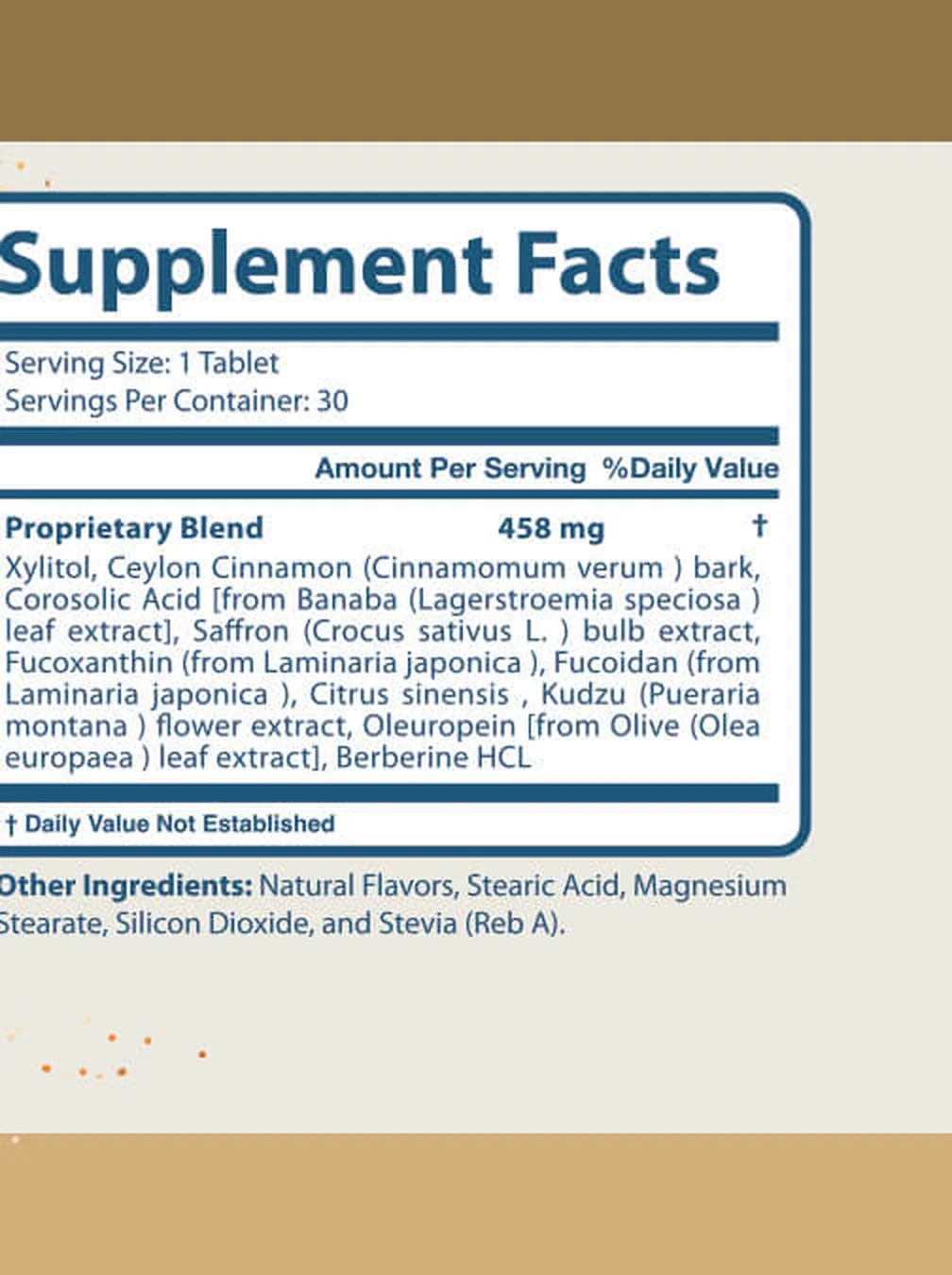
- Serving size: 1 chewable tablet, once daily; 30 tablets per bottle
- Proprietary blend, 458 mg total: xylitol, Ceylon cinnamon bark, corosolic acid (banaba leaf extract), saffron bulb extract, fucoxanthin, fucoidan, Citrus sinensis, kudzu flower extract, oleuropein (olive leaf extract), berberine HCl
- Per-ingredient doses: none disclosed for any of the ten ingredients
- Distributor: Phyto Thrive Labs, 11870 62nd St. N, Largo, FL 33773
That hidden-dose design makes the page's ingredient stories unverifiable. Compare the trial doses against the 458 mg total:
| Ingredient | What trials tested | Trial dose | Amount in this product |
|---|---|---|---|
| Saffron | Cognition in Alzheimer's patients | 30 mg/day | Hidden in the 458 mg blend |
| MoroSil (blood orange) | Weight, with diet and exercise | 400 mg/day | Hidden in the 458 mg blend |
| Berberine | Blood sugar in type 2 diabetes | 900 to 1,500 mg/day | Hidden in the 458 mg blend |
| Kudzu flower | Visceral fat | 200 to 300 mg/day | Hidden in the 458 mg blend |
| Olive leaf (oleuropein) | Blood pressure, cholesterol | 136 mg oleuropein/day | Hidden in the 458 mg blend |
| Fucoxanthin | Body weight | 1 to 3 mg/day | Hidden in the 458 mg blend |
The arithmetic alone is damning. The saffron and Morosil trial doses add up to 430 mg, which would leave 28 mg for the other eight ingredients combined. Either the formula bears no resemblance to the studied doses, or nobody can know, because the doses are hidden. That is the whole point of a proprietary blend: it lets a page borrow the prestige of real trials without matching their doses.
Two label oddities are worth noting. First, the label says "saffron bulb extract," but saffron is the dried stigma of the Crocus sativus flower, not the bulb. Second, the page's "hero ingredient" is branded "MoroSil (Sicilian Red Orange)," while the label lists only generic "Citrus sinensis," so there is no way to confirm the branded extract is what is actually in the tablet.
The one ingredient with brain trials, and the catch
Saffron deserves a fair hearing, because it is the only ingredient here with any human cognitive-outcome research at all.
In a 2010 trial, 46 patients with probable mild-to-moderate Alzheimer's disease took 30 mg of saffron per day for 16 weeks. Their cognitive scores improved more than the placebo group's. A later trial compared 30 mg/day of saffron against 10 mg/day of the prescription drug donepezil and found roughly comparable effects. A 2025 review of the small saffron literature called the results promising but the evidence base small, and asked for larger trials.
Here is the catch, in three parts:
- Wrong population. Every cognitive trial enrolled people already diagnosed with Alzheimer's disease. None tested saffron for everyday memory, focus, or "morning sharpness" in healthy older adults.
- Wrong dose context. The trials used a full 30 mg/day of saffron alone. In this product, saffron is one of ten ingredients sharing 458 mg, with its individual amount undisclosed.
- Wrong product. No trial has ever tested saffron inside this blend, or this blend at all.
Citing the Tehran saffron research to sell a memory chewable to healthy adults is the classic affiliate-page move: a real study, cited for the wrong people, at an unknown dose, in a product it never tested. It is the same pattern we documented in our MemoVance and Cognizil teardowns.
Has anyone actually tested this product?
No. We searched FDA laboratory findings, the FDA's tainted-supplements listings, ConsumerLab, USP and NSF listings, and the published literature. No independent lab has ever published test results for Phytomem One's contents, purity, or label accuracy.
The company has circulated materials headlined around independent lab results, but the same materials admit that no individual lot certificate was published. A facility certification is not a product test, and a headline is not data. Until someone tests the actual tablets, what is inside them is the company's word alone.
What independent labs have found in this category is a matter of public record, and it is not reassuring:
- A February 2024 JAMA research letter tested 10 over-the-counter galantamine "brain" supplements: 9 of the 10 had inaccurate label amounts (from under 2% to 110% of what the label claimed), and 3 of the 10 were contaminated with Bacillus cereus bacteria. All 11 generic prescription galantamine drugs tested were accurately labeled.
- A 2022 study of 7 cognitive-enhancement products found only one came close to its label claim; the rest delivered 26% to 88% of the stated amount.
- Researchers testing 10 "brain boosting" supplements found five unapproved drugs across the products, including some not listed on the labels, with doses inaccurate in 75% of the products.
- A federal review (GAO-17-416) found that of 490 memory supplements identified online, 34 carried ads purporting to treat or prevent memory-related diseases, and the FDA agreed 27 of those violated federal requirements.
None of those studies tested Phytomem One. They show what the category looks like when someone checks.
Named experts are blunt about the whole category. NCCIH states that direct evidence that dietary supplements can prevent Alzheimer's disease or other forms of dementia is lacking. Mayo Clinic physician Dr. Sara Shu wrote in January 2025: "To date, no large clinical trials or high-quality evidence suggest any product marketed as such is beneficial. Some may even pose serious health risks, including side effects and interactions with your medications." Harvard's Dr. Pieter Cohen, who led the galantamine testing, has called the over-the-counter nootropics market "so unpredictable" that it is "just not safe" to try to improve cognition with these products.
Price and guarantee: the math
The pricing page offers three tiers, each with three free digital bonuses (a diet guide, a "brain reboot" guide, and a caregiver guide, claimed at $214 total value):
| Tier | Bottles | Total | Per bottle | Per day |
|---|---|---|---|---|
| Starter | 2 | $158 | $79 | $2.63 |
| Advanced (most popular) | 3 | $177 | $59 | $1.97 |
| Ultimate (best value) | 6 | $294 | $49 | $1.63 |
At one tablet a day, the product costs between $1.63 and $2.63 per day, or roughly $50 to $80 a month, for a formula whose ingredient doses cannot be checked.
The headline promise is a "60-Day Money Back Guarantee... simple and hassle-free." The refund policy's fine print adds real conditions:
- The 60 days run from receiving the order, not from when you start taking it.
- The refund is the purchase price minus shipping, and you must return all items received.
- You pay the return shipping, to a returns address in Largo, Florida.
- Partial refunds apply to used, damaged, or late items.
Notice the tension: the 6-bottle tier is a 180-day supply, but the guarantee window is 60 days from receipt. To use the guarantee as written, you would need to decide the product does not work for you before you have finished even one bottle, then ship everything back at your own expense. That is a common pattern in this funnel family, not a unique failing, but buyers should know the headline is friendlier than the terms.
Two quieter positives, for fairness: the FAQ states there is no subscription and no hidden fees, and we saw no countdown timer on the page. Payment is processed by BuyGoods, which the footer notes is the retailer and does not endorse the product or its claims; your card statement shows BuyGoods, not the product name.
Who is behind it
The label names the distributor as Phyto Thrive Labs, 11870 62nd St. N, Largo, FL 33773 (email [email protected], shown here as plain text). The retailer of record is BuyGoods, a Delaware corporation in Wilmington, DE, which explicitly disclaims any endorsement of the product or its claims.
The page itself carries the fingerprints of a shared affiliate template:
- The contact page displays a different product's label image ("PhytoBoost Pro"), and its support form's product dropdown lists more than 30 unrelated products, from nail fungus formulas to lottery guides.
- The FAQ says to take "one capsule daily"; the label says to take one chewable tablet daily. The page calls them "30 TABLETS."
- The page's hero ingredient is branded "MoroSil (Sicilian Red Orange)"; the label lists generic "Citrus sinensis."
- The "FDA APPROVED" badge sits on the same page as the FDA's standard "these statements have not been evaluated" disclaimer.
- The page claims "47,000+ SUCCESS STORIES" but shows three testimonials, whose names the footer admits were changed.
- The Terms contain the typo "tryphytomemone.com" and the shipping policy ships to the "United Stated (Alaska, Hawaii)."
None of this proves anything about what is in the tablet. It does show how much of the operation is assembled from reusable parts: the same legal pages, the same guarantee language, and the same product dropdown serve dozens of unrelated brands.
On regulation: we found no FDA warning letter, no FTC enforcement action, no recall, and no Health Fraud Product Database entry naming Phytomem One or Phyto Thrive Labs as of October 23, 2026. That is a clean record for the product itself. The category is less clean: in 2017, the FTC and the New York Attorney General charged the marketers of the memory supplement Prevagen over allegedly false and unsubstantiated memory claims, and the federal GAO review cited above found widespread disease-claim violations among memory supplements.
Safety flags for older adults
The buyers most likely to be drawn to a memory pitch are older adults, who are also the most likely to be taking prescription medicines. This formula has several real interaction and safety considerations:
Berberine and diabetes or blood-pressure medicines. NCCIH notes that berberine "might interact with medicines in negative ways" and lists GI side effects. Berberine can lower blood sugar, which matters if you already take glucose-lowering drugs: the combination can push blood sugar too low. Anyone on diabetes medication should talk to their doctor before adding a berberine-containing formula. Our supplement interactions guide covers how these clashes happen.
Fucoidan and blood thinners. Laboratory research documents heparin-like anticoagulant activity for fucoidans. Human effects are less clear, but the interaction potential is the standard caution, and it lands on exactly the group most likely to buy a memory product: older adults taking warfarin, apixaban, or daily aspirin. If that is you, talk to your doctor or pharmacist first; our turmeric and warfarin guide explains why blood-thinner interactions deserve respect.
Kudzu flower and hormone-sensitive conditions. Kudzu flower contains isoflavones, plant compounds with estrogen-like activity, so caution is standard for anyone with a hormone-sensitive condition.
Xylitol and dogs. This is a chewable tablet containing xylitol, which is highly toxic to dogs. Households with pets should store it securely.
One genuine plus. The formula uses Ceylon cinnamon rather than cassia, which means far less coumarin (the compound that can stress the liver). That is a thoughtful choice, even though NCCIH says the evidence for cinnamon itself is insufficient for any health condition.
This is not medical advice, and we are not your doctor. If you take prescription medicines, especially for diabetes, blood pressure, or clotting, talk to your doctor or pharmacist before adding any multi-ingredient supplement. Bring the label, or a photo of it, so they can see the full ingredient list.
What to do instead
If memory worries you, the most useful first step is a conversation with your doctor, not a checkout page. Treatable causes of memory trouble, from medication side effects to thyroid issues to sleep apnea, are common and get missed when people self-treat with supplements.
If you still want a supplement, apply the checks from this review to any product: full dose disclosure for every ingredient, trial doses that match the label, human evidence in people like you, and a company that puts its real name and address on the page. Phytomem One fails all four.
Sources
- NCCIH, "In the News: Berberine" (blood-glucose effects, side effects, medicine interactions)
- NCCIH, "Cinnamon: Usefulness and Safety" (insufficient evidence for diabetes or any health condition; coumarin)
- NCCIH, "7 Things To Know About Dietary Supplements for Cognitive Function, Dementia, and Alzheimer's Disease" (no direct evidence supplements prevent Alzheimer's or dementia)
- NCCIH, "Using Dietary Supplements Wisely" (store-bought products may differ from studied products; some contain unlisted drugs)
- Mayo Clinic, "Brain health supplements" (Dr. Sara Shu, Jan 2025) (no large trials or high-quality evidence for marketed brain products; interaction risks)
- Akhondzadeh et al., J Clin Pharm Ther 2010 (PMID 20831681) (saffron 30 mg/day vs placebo in 46 Alzheimer's patients, 16 weeks)
- Briskey et al., Nutrients 2022 (PMCID PMC8838101) (Morosil 400 mg/day for 6 months with diet and exercise; weight outcomes)
- Wang et al., Front Pharmacol 2024 (PMID 39640489) (berberine meta-analysis, 50 RCTs; most common dose 0.9 to 1.5 g/day)
- Lockyer et al., Eur J Nutr 2017 (PMID 26951205) (olive leaf 136 mg oleuropein/day; blood pressure and lipids)
- Systematic review of marine algae-derived fucoxanthin (PMCID PMC9146768) (human trials small and short; obesity parameters only)
- "Influence of Fucoidans on Hemostatic System" (PMCID PMC3736433) (heparin-like anticoagulant activity in laboratory studies)
- JAMA research letter, Feb 2024 (DOI 10.1001/jama.2024.0328) (9 of 10 galantamine supplements mislabeled; 3 of 10 contaminated)
- GAO-17-416, "Memory Supplements" (May 2017) (disease-claim violations among memory supplements; enforcement context)
- FDA, Dietary Supplements (the FDA does not approve dietary supplements before they are marketed)
Review note: This review covers the Phytomem One page as it appeared in October 2026, the version showing the "Precision Brain Support That Breaks The Stranglehold" headline, the 458 mg proprietary blend label, and $158/$177/$294 pricing. Lookalike sites using the same product name exist and may show different content.
Fact-checked by the SupplementDecoded Research Editorial Team